COMSOL Blog

Modeling Temperature of a Wine Cellar

Heat Transfer | Posted on March 26th, 2013 by

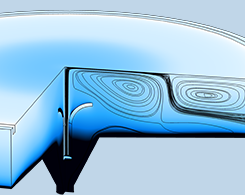
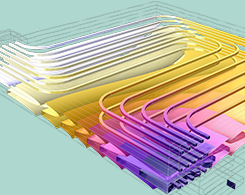
A lot of effort is put into inventing or improving existing technologies used to cool buildings, food, or any goods that need to be stored at a definite temperature. The reason is simple: adopting more efficient designs will result in achieving the same goal while consuming less energy. Both our balance sheet and the environment will benefit from these solutions. Here we will explore modeling temperature of a passive cooling design using a wine cellar as an example.

Read more on: Modeling Temperature of a Wine Cellar

How to Model Multiphysics in Multimaterial?

Events | Posted on March 25th, 2013 by

Dr. Raj Thiagarajan is a prolific producer of interesting research articles ranging from waste-water treatment to acoustics metamaterials, and lots in between. As the Managing Director at ATOA (“Atom TO Application”) Scientific Technologies, a COMSOL Certified Consultant, Raj has had to simulate all types of applications. Now he will show you how to use multiphysics simulations in multimaterial and composite product design.

Read more on: How to Model Multiphysics in Multimaterial?

Advanced Visualization Techniques in Postprocessing

Postprocessing | Posted on March 22nd, 2013 by

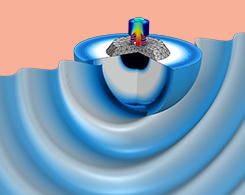
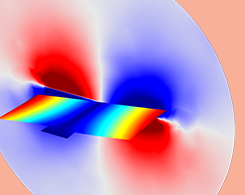
Looking for ways to cut down on the time and computer memory required to run your simulation? Does your model exhibit some form of symmetry — axial symmetry, lines or planes of symmetry, or antisymmetry for example? Or perhaps your model exhibits periodicity? If you answered yes to those questions, you’re in luck. You can model symmetry or periodicity in COMSOL Multiphysics easily by either using a 1D or 2D axisymmetric dimensional simulation or by incorporating boundary conditions that represent a symmetry or periodic condition.

Read more on: Advanced Visualization Techniques in Postprocessing

Meshing and Optimization in Engineering Magazines

News | Posted on March 21st, 2013 by

Online engineering magazines, like Design World and Desktop Engineering, are great for anyone out there interested in emerging technologies. I especially liked a few recent articles: two in Design World’s “CAE Solutions” section and one in Desktop Engineering’s simulation section, detailing a couple of major topics important to finite element analysis, or FEA. First there is meshing, the foundation of FEA software. Second, there is optimization, which is all about maximizing efficiency and improving results. The key for any production company, is an efficient product development process. FEA is a powerful tool to replace a lot of experimentation and prototype manufacturing, and optimization can be used to make virtual prototyping faster, maximizing the effectiveness of the FEA software.

Read more on: Meshing and Optimization in Engineering Magazines

Using Point Cloud Data in Your COMSOL Model

Tips & Tricks | Posted on March 20th, 2013 by

There is sometimes a need to include data from other simulation packages into a COMSOL Multiphysics model. There are a variety of ways in which this can be done, but one of the easiest approaches is to read in the point cloud data via a spreadsheet format text file. In this blog post, we walk through the steps of reading in such data, and using it in a COMSOL model.

Read more on: Using Point Cloud Data in Your COMSOL Model

Probing Your Simulation Results

Tips & Tricks | Posted on March 19th, 2013 by

For a transient simulation, imagine if you could simply insert a virtual sensor in a model at a certain location and then monitor the evolution of a field value over time while solving. In COMSOL Multiphysics you can do just that by using Probes. You define a probe in the Model Builder tree right under the Model Definitions node. Measuring the value at a point is not the only thing you can do with probes, but in this blog post we will focus on that specific task of probing. We’ll also show you how you can use probes to compress the size of a saved transient model by only storing the full solution data set at a few points in time and at the same time having a densely sampled probe data plot with an accompanying table.

Read more on: Probing Your Simulation Results

COMSOL Conference 2013 Call for Papers

Conference | Posted on March 18th, 2013 by

It’s finally that time of year again when we welcome abstracts for papers and posters to be presented at the COMSOL Conference. COMSOL enthusiasts, this is your opportunity to share your incredible work with the entire world through the COMSOL Conference 2013, to be conducted in Boston, Bangalore, and Rotterdam.

Read more on: COMSOL Conference 2013 Call for Papers

Modeling Chemical Reactions: Thermal Stress Analysis

Chemical | Posted on March 15th, 2013 by

The beauty of COMSOL is that it provides a unified modeling platform no matter what type of simulations you are performing. This is almost unique to the CAE market. Recently we showed you how to model chemical reactions using a monolith reactor as our example. First we walked you through solving the reaction kinetics and then involving plug flow, next we created a full-scale 3D model of the reactor. A chemical engineer may feel comfortable using a software optimized for this type of simulation, but what if he or she has to contemplate other properties in the device or process as well? For example, a catalytic converter is an exothermic reactor that sits near the exhaust of a car or truck, and there may be requirements for how long it must survive and function adequately before being replaced. In this final part of our “Modeling Chemical Reactions” blog series we will perform a thermal stress analysis of our converter.

Read more on: Modeling Chemical Reactions: Thermal Stress Analysis

How to Make Nuclear Waste Disposal Safe

Certified Consultants | Posted on March 14th, 2013 by

About 13% of the world’s power is nuclear. During the 1990′s, this figure was almost 18%. This trend may continue to decline or undergo a renaissance, but in the meantime nuclear waste disposal remains a hot topic among engineers and governmental agencies. Safe procedures for the disposal of nuclear waste have been in place for decades, and continued improvement of these techniques remain in discussion today.

Read more on: How to Make Nuclear Waste Disposal Safe

Optimal Distribution: Tree Roots and Microreactors

Fluid | Posted on March 13th, 2013 by

I love trees and my favorite is definitely the ficus, all varieties included. A few weeks ago I had the chance to admire a stately ficus microcarpa (see figure below). What struck me above all were its aerial roots. Roots are designed to absorb water and nutrients, sustaining the tree and synthesizing substances responsible for its growth. A thought crossed my mind right away: the shape of those roots and the way they coalesce have surely been optimized by Mother Nature.

Read more on: Optimal Distribution: Tree Roots and Microreactors