
Die Application Gallery bietet COMSOL Multiphysics® Tutorial- und Demo-App-Dateien, die für die Bereiche Elektromagnetik, Strukturmechanik, Akustik, Strömung, Wärmetransport und Chemie relevant sind. Sie können diese Beispiele als Ausgangspunkt für Ihre eigene Simulationsarbeit verwenden, indem Sie das Tutorial-Modell oder die Demo-App-Datei und die dazugehörigen Anleitungen herunterladen.
Suchen Sie über die Schnellsuche nach Tutorials und Apps, die für Ihr Fachgebiet relevant sind. Beachten Sie, dass viele der hier vorgestellten Beispiele auch über die Application Libraries zugänglich sind, die in die COMSOL Multiphysics® Software integriert und über das Menü File verfügbar sind.

This model analyzes the thermal expansion in a MEMS device, such as a microgyroscope, where thermal expansion should be minimized. The device is made from the copper-beryllium alloy UNS C17500 and uses temperature-dependent material properties from the Material Library. The purpose of ... Mehr lesen
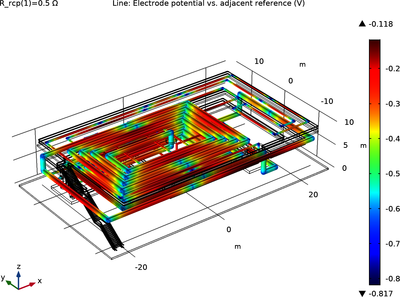
Highly alloyed stainless steel used in chlorinated seawater systems may be prone to corrosion under certain operating conditions. Conventional cathodic protection technique is less suitable for stainless steel due to unacceptable anode consumption rate and propensity to hydrogen ... Mehr lesen
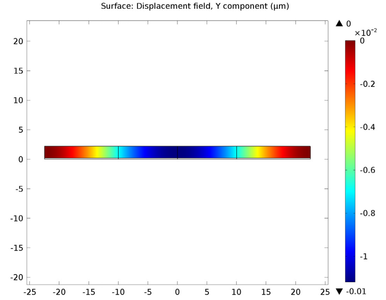
Silicon micromechanical resonators have long been used for designing sensors and are now becoming increasingly important as oscillators in the consumer electronics market. In this series of models, a surface micromachined MEMS resonator, designed as part of a micromechanical filter, is ... Mehr lesen
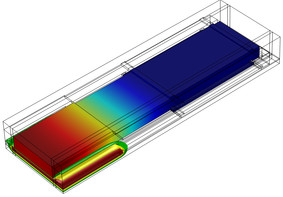
An electrostatically actuated MEMS resonator is simulated in the time and frequency domains. The device is driven by an AC + DC bias voltage applied across a parallel plate capacitor. The dependence of the resonant frequency on DC bias is assessed, and frequency domain and pull-in ... Mehr lesen
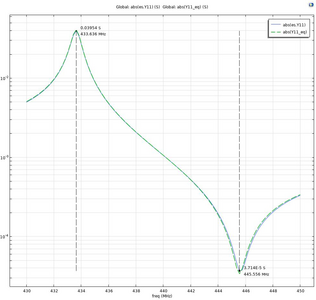
This model shows that the frequency response, i.e., admittance curve, of the SAW unit cell with IDT is in good agreement with the series resonance & antiresonance frequencies obtained from the eigenfrequency studies in the tutorial Surface Acoustic Wave Velocity Calculations from a ... Mehr lesen
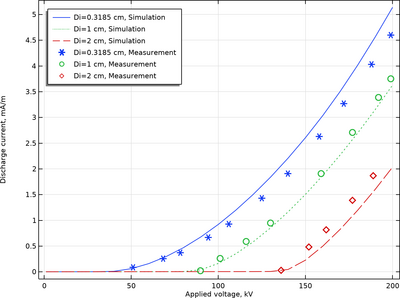
This model examines the behavior of a positive corona formed between concentric cylindrical conductors exposed to high applied voltages. The predicted current–voltage response closely matches the measurements. Rather than reproducing individual positive glow corona bursts, the setup ... Mehr lesen

This model analyzes negative corona formation in a point-to-plane configuration driven by high applied voltages. The resulting I–V characteristics align well with experimental observations documented in the literature. The goal here is to capture the steady electrical characteristics ... Mehr lesen
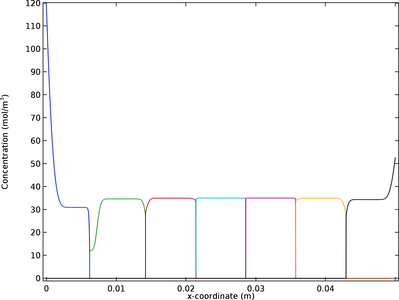
This model demonstrates isoelectric focusing (IEF) of seven ampholytes in a column. The model is in 1D and is solved in a time-dependent simulation. Mehr lesen
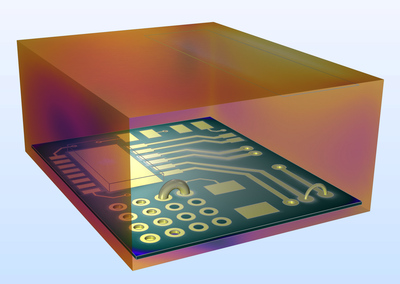
This model example shows how to simulate basic electromagnetic interference (EMI) and electromagnetic compatibility (EMC) behavior in a printed circuit board (PCB). The model contains two analyses to evaluate radiated emissions from PCB traces, crosstalk between adjacent microstrip ... Mehr lesen
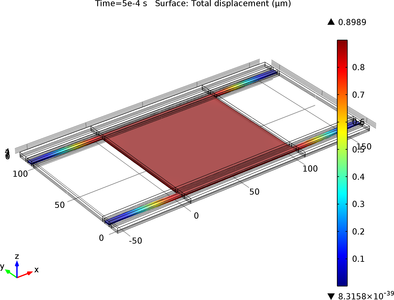
This model analyzes an RF MEMS switch consisting of a thin micromechanical bridge suspended over a dielectric layer. A DC voltage greater than the pull-in voltage is applied across the switch, causing the bridge to collapse onto the dielectric layer with a resulting increase in the ... Mehr lesen


