
In Übereinstimmung mit unserer Qualitätspolitik unterhält COMSOL eine Bibliothek aus hunderten dokumentierter Modellbeispiele, die regelmäßig mit der neuesten Version der COMSOL Multiphysics® Software getestet werden, einschließlich Benchmark-Probleme von ASME und NAFEMS sowie TEAM-Probleme.
Unsere Verification and Validation (V&V) Testsuite bietet konsistent genaue Lösungen, die mit Analyseergebnissen und etablierten Benchmark-Daten verglichen werden. Die folgenden dokumentierten Modelle sind Teil der in der COMSOL Multiphysics® Software integrierten Anwendungsbibliotheken. Sie beinhalten Referenzwerte und Quellen für eine Vielzahl von Benchmarks sowie eine Schritt-für-Schritt-Anleitung, um die erwarteten Ergebnisse auf dem eigenen Computer zu reproduzieren. Mit diesen Modellen können Sie nicht nur Ihre Aufwendungen für die Software-Qualitätssicherung (SQA) und die numerische Code-Verifikation (NCV) dokumentieren, sondern sie auch im Rahmen von internen Trainingsprogrammen einsetzen.

This example shows how to use the Parameter Estimation and Experiment features in the Reaction Engineering interface for optimization with multiple experimental data input files. The application finds the Arrhenius parameters of a first order reaction where Benzene diazonium chloride ... Mehr lesen
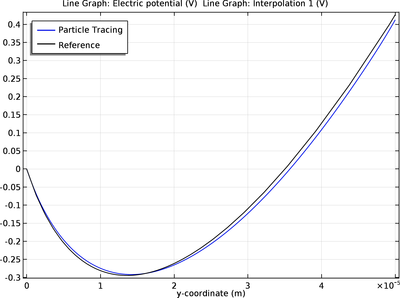
When electrons are emitted from a heated cathode in a plane parallel vacuum diode, they contribute to the space charge density in the diode, which in turn affects the electric potential distribution. If the potential difference between the cathode and the anode is not sufficiently large, ... Mehr lesen
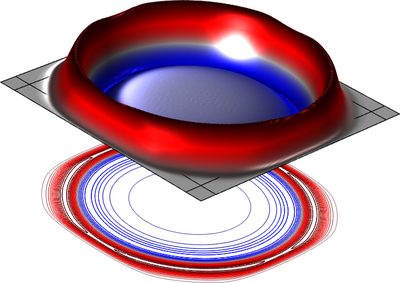
This tutorial simulates a standard test and benchmark model for perfectly matched layers (PMLs) as absorbing boundary conditions in the time domain. It involves the propagation of a transient Gaussian pulse with no flow. The Pressure Acoustics, Transient interface is used together with ... Mehr lesen
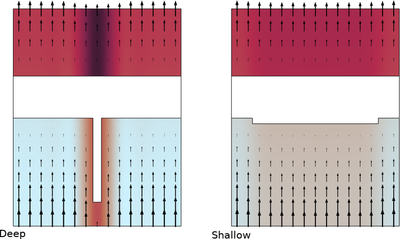
The copper current collector on negative graphite electrodes in lithium-ion batteries have been seen to dissolve at over discharge. This can be a safety concern as the dissolution damages the current collector irreversibly and dissolved copper ions can redeposit and form dendrites. ... Mehr lesen
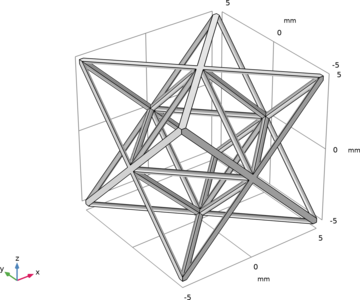
Lattice materials enable the creation of advanced additive manufacturing materials with customized mechanical properties. At the macroscopic level, these heterogeneous materials can be modeled as homogeneous materials. Homogenization techniques can accurately determine the material's ... Mehr lesen
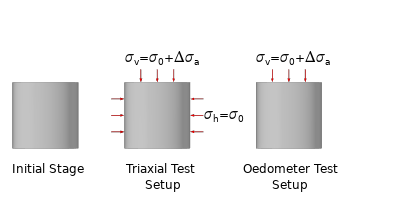
In this example, triaxial and oedometer tests are simulated using the Modified Cam-Clay material model. A nonlinear stress-strain relation is recovered with the constant Poisson's ratio formulation. The hardening and softening behavior is recovered for normally consolidated and highly ... Mehr lesen
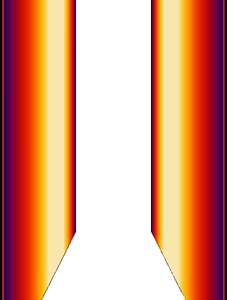
This tutorial shows how to use the Surface-to-Surface Radiation interface to simulate radiative heat transfer with radiation between diffuse emitters and diffuse-and-specular reflectors. This model is separated in two parts. The first part focuses on a validation test for the radiative ... Mehr lesen
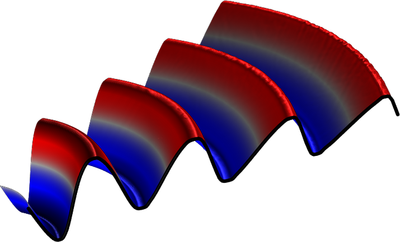
Dieses Modellbeispiel zeigt, wie Sie die nichtlineare Ausbreitung einer zylindrischen Welle mithilfe dem im Acoustics Module von COMSOL Multiphysics verfügbaren Physik-Interface Nonlinear Pressure Acoustics, Time Explicit modellieren. Das Interface implementiert das System der ... Mehr lesen
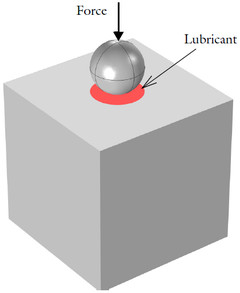
This benchmark model computes the transient pressure distribution and film height in a squeeze film bearing for lubrication in a nonconformal conjunction of a solid sphere and an elastic wall separated by a lubricant film. This model solves the benchmark case of hydrodynamic interaction ... Mehr lesen
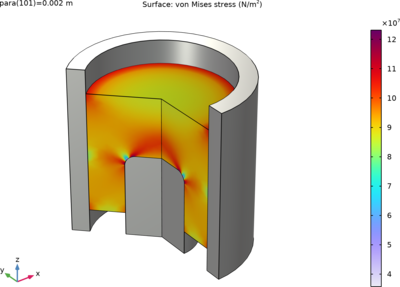
The fabrication of a cup through powder compaction is simulated in this tutorial model. The powder compaction process is becoming common in the manufacturing industry, due to its potential for producing components of complex shape and high strength. Combining the Fleck–Kuhn–McMeeking ... Mehr lesen


