
Die Application Gallery bietet COMSOL Multiphysics® Tutorial- und Demo-App-Dateien, die für die Bereiche Elektromagnetik, Strukturmechanik, Akustik, Strömung, Wärmetransport und Chemie relevant sind. Sie können diese Beispiele als Ausgangspunkt für Ihre eigene Simulationsarbeit verwenden, indem Sie das Tutorial-Modell oder die Demo-App-Datei und die dazugehörigen Anleitungen herunterladen.
Suchen Sie über die Schnellsuche nach Tutorials und Apps, die für Ihr Fachgebiet relevant sind. Beachten Sie, dass viele der hier vorgestellten Beispiele auch über die Application Libraries zugänglich sind, die in die COMSOL Multiphysics® Software integriert und über das Menü File verfügbar sind.

This document explains how to install and run COMSOL Multiphysics® and COMSOL Server™ with Amazon Elastic Compute Cloud™ (EC2™). This requires that you have first acquired a Floating Network License (FNL) or COMSOL Server License (CSL) from COMSOL. The license manager ... Mehr lesen
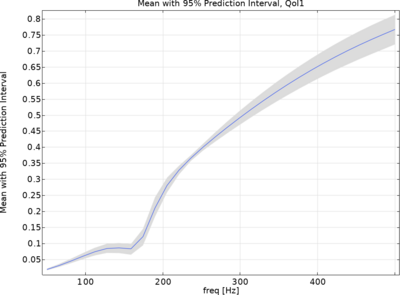
It can in many cases be difficult to get accurate material properties for porous materials. Measuring the properties to high precision can involve lengthy measurements using different techniques. It can therefore be interesting to understand how uncertainties in different material ... Mehr lesen

This model demonstrates how to create a rotated helix geometry, i.e., a helix that is winded to form a torus. This is done sweeping a circle along a parametric curve. The radius of the torus and the radius of the coil are given as parameters as well as the number of windings of the coil. Mehr lesen

The dipole tonal noise generated by flow over a cylinder in free space is modeled using a two step hydrodynamic/acoustic splitting method. First, the unsteady hydrodynamic flow field is calculated using the incompressible Navier-Stokes equations. Second, the Linearized Perturbed ... Mehr lesen

The miniaturization of electronics devices requires batteries with higher energy density and power. To increase the contact area between the electrodes and the solid electrolyte, 3D configurations such as the trench geometry are used. This example demonstrates how to model a solid-state ... Mehr lesen

This model demonstrates how to use the chatbot functionality in COMSOL Multiphysics® to add annotations to a model of a pacemaker electrode. To learn more about this model, see our accompanying blog post “Using the Chatbot Window in COMSOL Multiphysics®”. Mehr lesen
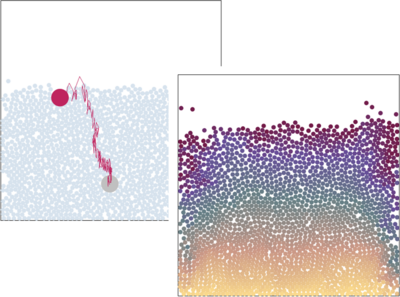
Formally known as size separation in vibrated granular materials, the Brazil nut effect (BNE) (and sometimes the Muesli effect) is a phenomenon that causes large grains to separate from small ones and rise to the top of a granular bed under vibrations. This phenomenon can be studied ... Mehr lesen
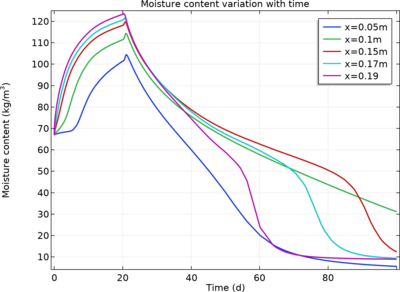
This tutorial shows how to simulate coupled heat and moisture transport in a wall. The wall is modeled considering an air flow between interior and exterior varying with time. The 1D model is the third benchmark test defined in HAMSTAD-WP2 Modeling for the validation of numerical ... Mehr lesen

The model estimates the AC breakdown voltage between parallel electrodes in air by simulating charge transport dynamics. To keep computations efficient, it is implemented in one dimension, though it can be adapted for different gases and extended to higher-dimensional setups. The ... Mehr lesen

This example exemplifies how to model thermal phase change that is subject to hysteresis. A more detailed description of the phenomenon, and the modeling process, can be seen in the blog post "Thermal Modeling of Phase-Change Materials with Hysteresis" as well as: "How to Use State ... Mehr lesen


