
Die Application Gallery bietet COMSOL Multiphysics® Tutorial- und Demo-App-Dateien, die für die Bereiche Elektromagnetik, Strukturmechanik, Akustik, Strömung, Wärmetransport und Chemie relevant sind. Sie können diese Beispiele als Ausgangspunkt für Ihre eigene Simulationsarbeit verwenden, indem Sie das Tutorial-Modell oder die Demo-App-Datei und die dazugehörigen Anleitungen herunterladen.
Suchen Sie über die Schnellsuche nach Tutorials und Apps, die für Ihr Fachgebiet relevant sind. Beachten Sie, dass viele der hier vorgestellten Beispiele auch über die Application Libraries zugänglich sind, die in die COMSOL Multiphysics® Software integriert und über das Menü File verfügbar sind.

In diesem Modellbeispiel wird der Transport von Reaktanten und Wasser in einer Hochtemperatur-Polymerelektrolytmembran-Brennstoffzelle untersucht. Das Modell umfasst Stoff- und Impulstransportphänomene in den Strömungskanälen, Gasdiffusionsschichten (GDLs) und porösen Elektroden sowie ... Mehr lesen
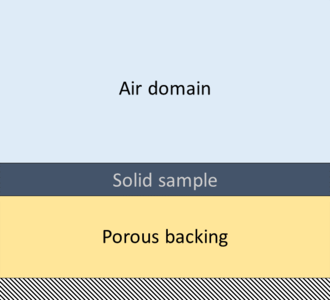
This app allows you to calculate the absorption coefficient and surface impedance of a sound absorbers for normal and random incidences. The computed quantities can be used when setting up boundary conditions in a Pressure Acoustics, Frequency Domain model or a Ray Acoustics model. The ... Mehr lesen
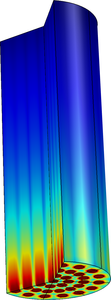
Einer der gängigsten Reaktoren in der chemischen Industrie für den Einsatz in heterogenen katalytischen Prozessen ist der Festbettreaktor. Dieser Reaktortyp wird sowohl bei der Synthese als auch bei der Abwasserbehandlung und der katalytischen Verbrennung eingesetzt. Dieses Modell ist ... Mehr lesen
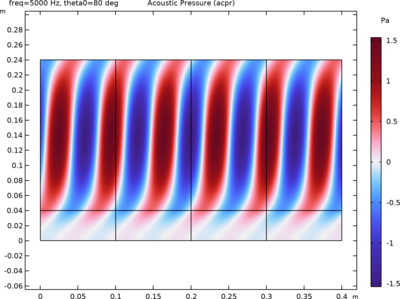
This is a 2D model of an anisotropic porous absorbing material. The absorption coefficient alpha are determined as functions of frequency for three different incidence angles. The example uses Periodic Floquet boundary conditions. The model uses two different methods for modeling the ... Mehr lesen
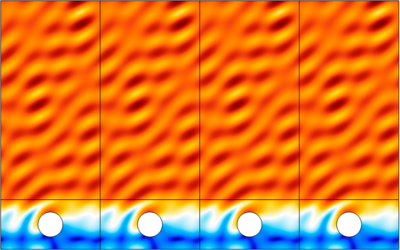
Dies ist ein Modell der Schallabsorption durch einen porösen akustischen offenzelligen Schaumstoff. In porösen Materialien breitet sich der Schall in einem Netzwerk aus kleinen, miteinander verbundenen Poren aus. Da die Dimensionen der Poren klein sind, entstehen Verluste durch ... Mehr lesen
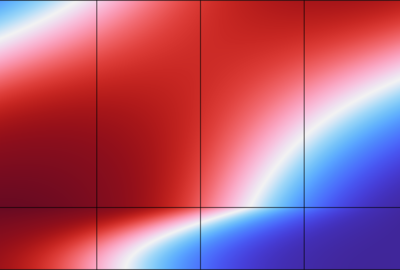
This tutorial investigates the acoustic properties of a porous layer made of glass wool. The porous material has transverse isotropic properties and is modeled with the full anisotropic poroelastic material model. Mehr lesen
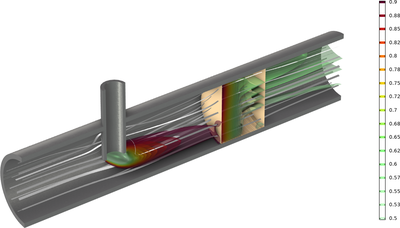
Die Modellierung von Festbetten, monolithischen Reaktoren und anderen katalytischen heterogenen Reaktoren wird mit dem Multiphysik-Interface Reacting Flow in Porous Media erheblich vereinfacht. Es definiert die Diffusion, Konvektion, Migration und Reaktion von chemischen Spezies für die ... Mehr lesen
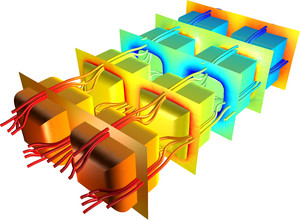
Der Transport durch poröse Strukturen wird normalerweise mit vereinfachten homogenen Modellen mit effektiven Transporteigenschaften behandelt. Dies ist in den meisten Fällen notwendig, da die typischen Abmessungen der Poren und Partikel, aus denen die poröse Struktur besteht, um mehrere ... Mehr lesen
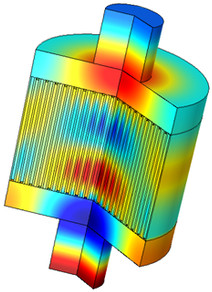
This is the model of the acoustics in a particulate-filter-like system. Real systems, like diesel particulate filters (DPFs), are designed to remove/filter soot (diesel particles) from the exhaust of diesel engine vehicles. The porous medium in such systems are typically structured with ... Mehr lesen

This 3D model example demonstrates the use of the Primary Current Distribution interface for modeling current distributions in electrochemical cells. In primary current distribution, the potential losses due to electrode kinetics and mass transport are assumed to be negligible, and ... Mehr lesen


