
Die Application Gallery bietet COMSOL Multiphysics® Tutorial- und Demo-App-Dateien, die für die Bereiche Elektromagnetik, Strukturmechanik, Akustik, Strömung, Wärmetransport und Chemie relevant sind. Sie können diese Beispiele als Ausgangspunkt für Ihre eigene Simulationsarbeit verwenden, indem Sie das Tutorial-Modell oder die Demo-App-Datei und die dazugehörigen Anleitungen herunterladen.
Suchen Sie über die Schnellsuche nach Tutorials und Apps, die für Ihr Fachgebiet relevant sind. Beachten Sie, dass viele der hier vorgestellten Beispiele auch über die Application Libraries zugänglich sind, die in die COMSOL Multiphysics® Software integriert und über das Menü File verfügbar sind.

Voltammetry is modeled at a microelectrode of 10um radius. In this common analytical electrochemistry technique, the potential at a working electrode is swept up and down and the current is recorded. The current-voltage waveform ("voltammogram") gives information about the reactivity and ... Mehr lesen
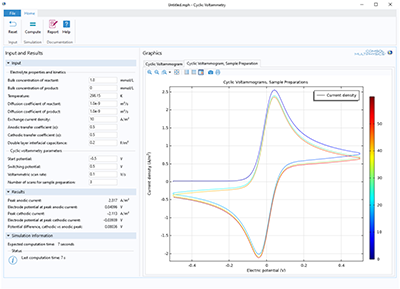
Zweck dieser App ist es, die Anwendung der Cyclovoltammetrie zu demonstrieren und zu simulieren. Sie können die Massenkonzentration beider Spezies, die Transporteigenschaften, die kinetischen Parameter sowie das Zyklusspannungsfenster und die Scanrate variieren. Die Cyclovoltammetrie ... Mehr lesen
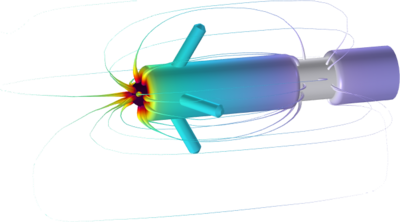
Dieses Modell veranschaulicht die Verwendung von COMSOL Multiphysics für die Modellierung von Problemen der Ionenstromverteilung in Elektrolyten, in diesem Fall in menschlichem Gewebe. Das Problem wird anhand einer Herzschrittmacher-Elektrode veranschaulicht, lässt sich aber auch auf ... Mehr lesen
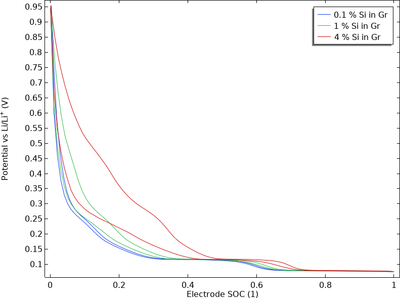
Due to its high capacity, silicon (Si) is often added to graphite in the negative electrode of lithium-ion batteries. Silicon–graphite blended electrodes may exhibit significant thermodynamic voltage hysteresis (“path dependence”) because the equilibrium potential of the lithium–silicon ... Mehr lesen

This 3D model example demonstrates the use of the Primary Current Distribution interface for modeling current distributions in electrochemical cells. In primary current distribution, the potential losses due to electrode kinetics and mass transport are assumed to be negligible, and ... Mehr lesen
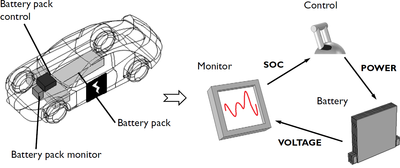
This is a template base model containing the physics, geometry and mesh of a lithium-ion battery, defined in 1D. The model makes use of four lithiation parameters which are used to define the relative balancing of the negative and positive electrodes, as well as global cell state of ... Mehr lesen
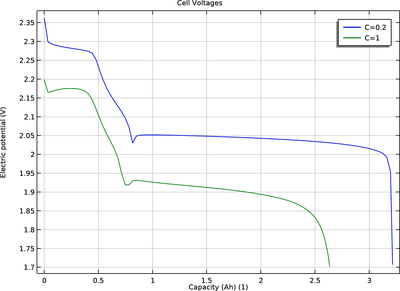
Lithium-sulfur (Li-S) batteries are used in niche applications with high demands for specific energy densities, which may be as high as 500-600 Wh/kg. The chemistry is fairly complex, since multiple polysulfide species participate in the various charge transfer reactions. The chemistry ... Mehr lesen
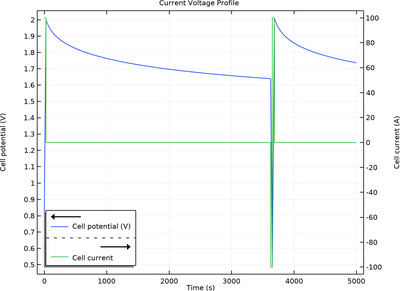
This model illustrates the effect of oxygen and hydrogen formation and recombination on the performance and self-discharge of an electrochemical capacitor with a water-based electrolyte. A load cycle consisting of mixed constant current pulses and rest periods at an open circuit is ... Mehr lesen
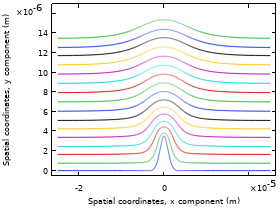
In einem Lithiummetall-Akku lagert sich während des Ladens Lithiummetall an der negativen Elektrode ab. Massentransport und Ohmsche Effekte im Elektrolyten führen zu einem beschleunigten Wachstum kleiner Vorsprünge auf der Metalloberfläche während des Ladevorgangs. Im schlimmsten Fall ... Mehr lesen
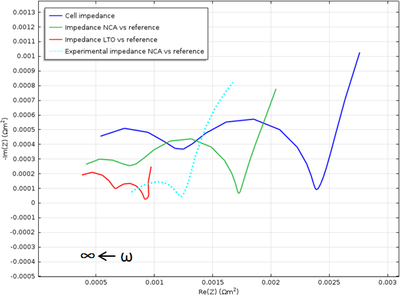
The goal with this app is to explain experimental electrochemical impedance spectroscopy (EIS) measurements and to show how you can use a simulation app, along with measurements, to estimate the properties of lithium-ion batteries. The app takes measurements from an EIS experiment and ... Mehr lesen


