
Die Application Gallery bietet COMSOL Multiphysics® Tutorial- und Demo-App-Dateien, die für die Bereiche Elektromagnetik, Strukturmechanik, Akustik, Strömung, Wärmetransport und Chemie relevant sind. Sie können diese Beispiele als Ausgangspunkt für Ihre eigene Simulationsarbeit verwenden, indem Sie das Tutorial-Modell oder die Demo-App-Datei und die dazugehörigen Anleitungen herunterladen.
Suchen Sie über die Schnellsuche nach Tutorials und Apps, die für Ihr Fachgebiet relevant sind. Beachten Sie, dass viele der hier vorgestellten Beispiele auch über die Application Libraries zugänglich sind, die in die COMSOL Multiphysics® Software integriert und über das Menü File verfügbar sind.
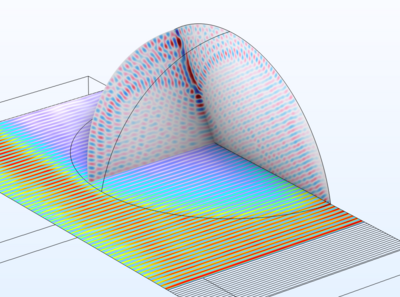
Wird ein Tropfen auf ein Substrat aufgebracht, auf dem sich akustische Oberflächenwellen ausbreiten, wird deren Energie in den Tropfen übertragen und erzeugt ein akustisches Feld. Die übertragene Energie wird gedämpft und führt zu einer Strömung. Diese Strömung ermöglicht eine ... Mehr lesen

When high-fidelity measurement microphones are calibrated, a pressure reciprocity calibration method is used. During calibration, two microphones are connected at each end of a closed cylindrical cavity. For the calibration procedure, it is important to understand the acoustic field ... Mehr lesen

This model presents a practical and efficient method to compute the sound transmission loss (STL) through a building component. Specifically, this example treats the case of a double-glazed window. The method used here is valid for structural components that have a small influence on ... Mehr lesen
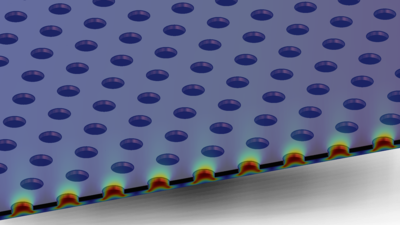
This tutorial model is of a micro perforated plate (also known as MPP) backed by a vibrating structure. This is a typical configuration in, for example, a MEMS microphone. The vibrating structure is not modeled explicitly, but just assigned a vibration velocity. The vibrating structure ... Mehr lesen
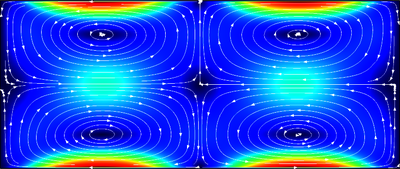
Die jüngsten Fortschritte bei der Herstellung von mikrofluidischen Systemen erfordern die Handhabung lebender Zellen und anderer Mikropartikel sowie das Mischen. All dies kann beispielsweise durch die Nutzung akustischer Strahlungskräfte und des viskosen Widerstands durch die Strömung ... Mehr lesen
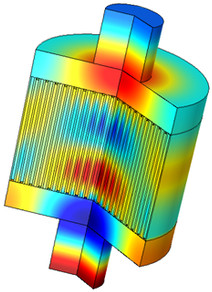
This is the model of the acoustics in a particulate-filter-like system. Real systems, like diesel particulate filters (DPFs), are designed to remove/filter soot (diesel particles) from the exhaust of diesel engine vehicles. The porous medium in such systems are typically structured with ... Mehr lesen

Dieses Tutorial-Modell zeigt einen virtuellen Testaufbau eines Konferenzlautsprechers. Das Lautsprechersystem besteht aus einem Lautsprecher sowie drei Mikrofonen. Das Modell veranschaulicht die Schallabstrahlung des Lautsprechers, die Rückkopplung sowie die Fähigkeit des Systems, ... Mehr lesen
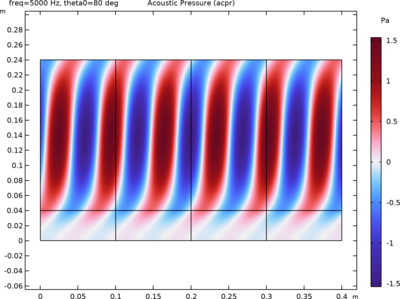
This is a 2D model of an anisotropic porous absorbing material. The absorption coefficient alpha are determined as functions of frequency for three different incidence angles. The example uses Periodic Floquet boundary conditions. The model uses two different methods for modeling the ... Mehr lesen
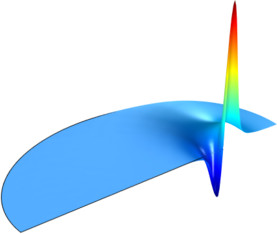
An ellipse with sound-hard walls has the interesting property that an acoustic signal emanating from one of the foci refocuses at the other focal point b/c seconds later, where b (in meters) is the major axis length and c (m/s) is the speed of sound. This model involves a Gaussian ... Mehr lesen
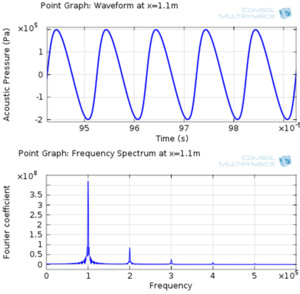
This model example shows how to model nonlinear propagation of 1D finite-amplitude Acoustic waves in fluids using Acoustics Module of COMSOL Multiphysics. The model is based on the 2nd order Westervelt equation. The one dimensional nonlinear wave equation is solved in the time domain by ... Mehr lesen


