
Die Application Gallery bietet COMSOL Multiphysics® Tutorial- und Demo-App-Dateien, die für die Bereiche Elektromagnetik, Strukturmechanik, Akustik, Strömung, Wärmetransport und Chemie relevant sind. Sie können diese Beispiele als Ausgangspunkt für Ihre eigene Simulationsarbeit verwenden, indem Sie das Tutorial-Modell oder die Demo-App-Datei und die dazugehörigen Anleitungen herunterladen.
Suchen Sie über die Schnellsuche nach Tutorials und Apps, die für Ihr Fachgebiet relevant sind. Beachten Sie, dass viele der hier vorgestellten Beispiele auch über die Application Libraries zugänglich sind, die in die COMSOL Multiphysics® Software integriert und über das Menü File verfügbar sind.
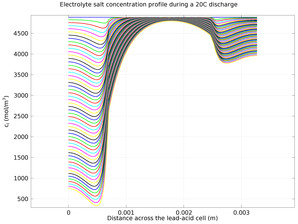
Lead-acid batteries are widely used as starting batteries for various traction applications such as cars and trucks and so forth. The reason for this is the fairly low cost in combination with the performance robustness for a broad range of operating conditions. However, one drawback of ... Mehr lesen
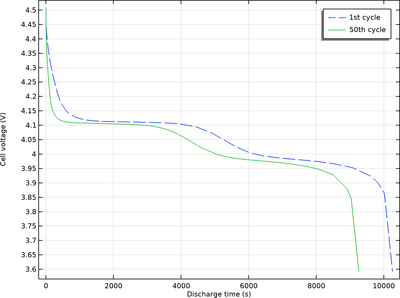
Some positive electrode materials are known to deteriorate in overcharged lithium-ion battery cells. Predominantly, manganese containing electrode materials such as LMO and NMC can loose capacity due to manganese dissolving from the materials at overcharge. This decomposition is a ... Mehr lesen
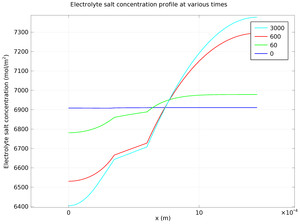
This model simulates the discharge of a Nickel-Metal Hydride (NiMH) battery using the Battery with Binary Electrolyte interface. The geometry is in one dimension and the model is isothermal. The model serves as an introduction to NiMH modeling, and can be further extended to include ... Mehr lesen
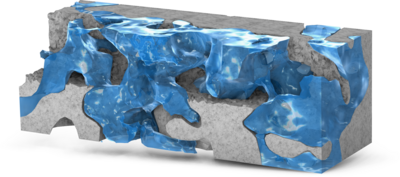
Digital Rock technology utilizes high-resolution imaging techniques, such as SEM and X-ray CT, to characterize the pore structures of rock cores. This approach enables pore-scale modeling of reservoir rocks, offering valuable insights into pore morphology, connectivity, and fluid ... Mehr lesen
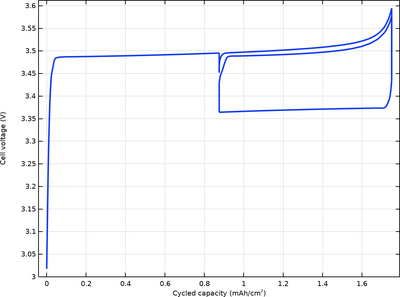
Lithium iron phosphate (LFP) is a common positive electrode material in lithium-ion batteries. Specific for the LFP electrode material is that its equilibrium (open circuit) potential, when defined as a function of the lithiation state, features a large flat plateau with a more or less ... Mehr lesen
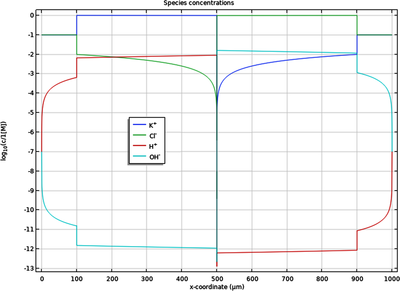
A bipolar membrane consists of one anion-selective, and one cation-selective membrane, in contact with each other. The combined cation and anion selectivity makes the bipolar membrane highly impermeable to all ions, with the exception of H+ and OH- which are formed by water splitting ... Mehr lesen

This example demonstrates how to couple the Lithium-ion Battery interface to the Phase Field interface for modeling electrode deformations. The example is based on the Lithium Plating with Deformation model, available in the Battery Design Module Application Library. As current is ... Mehr lesen
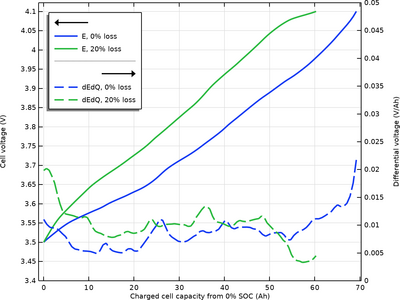
How the open-circuit voltage (OCV) of a lithium-ion battery varies with the state of charge is governed by various physical properties such as the thermodynamics of the electrode reactions, the relative capacities of the electrode materials, and the amount of cyclable lithium, but also ... Mehr lesen
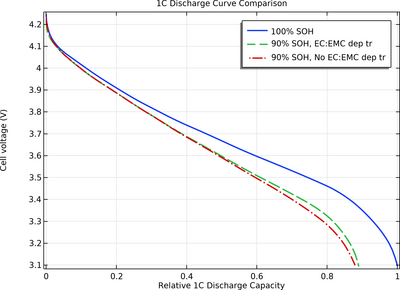
The liquid electrolyte in lithium-ion batteries (LIBs) typically consists of a lithium salt, such as LiPF6, dissolved in one or several solvents. Commercial LIBs commonly employ a mix of multiple hydrocarbon-based solvents along with additional additives. In an electrolyte consisting of ... Mehr lesen
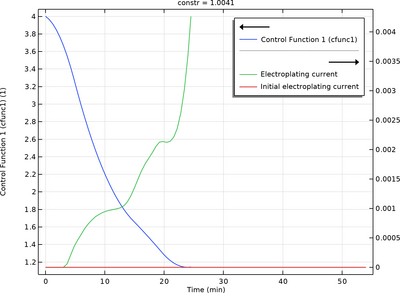
This model demonstrates how to optimize the charging profile of a battery using gradient based optimization. The optimization solver minimizes the time required for charging the battery from 0% to 90% state of charge, while at the same time constraining the amount lithium inventory lost ... Mehr lesen


