
Die Application Gallery bietet COMSOL Multiphysics® Tutorial- und Demo-App-Dateien, die für die Bereiche Elektromagnetik, Strukturmechanik, Akustik, Strömung, Wärmetransport und Chemie relevant sind. Sie können diese Beispiele als Ausgangspunkt für Ihre eigene Simulationsarbeit verwenden, indem Sie das Tutorial-Modell oder die Demo-App-Datei und die dazugehörigen Anleitungen herunterladen.
Suchen Sie über die Schnellsuche nach Tutorials und Apps, die für Ihr Fachgebiet relevant sind. Beachten Sie, dass viele der hier vorgestellten Beispiele auch über die Application Libraries zugänglich sind, die in die COMSOL Multiphysics® Software integriert und über das Menü File verfügbar sind.
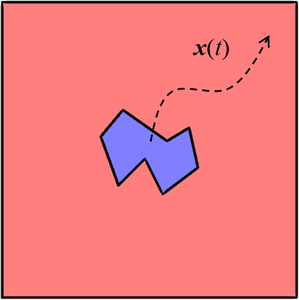
This presentation and series of models show how to use the Deformed Mesh interfaces to model small and large translations and rotations of objects. A more detailed description of these models can be seen in the blog post Model Translational Motion with the Deformed Mesh Interfaces and ... Mehr lesen
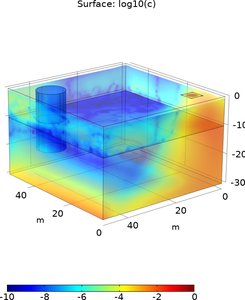
A simple model for groundwater contamination portrays a well that is bored into an aquifer. The aquifer consists of a partially saturated layer and a fully saturated layer. The model investigates how much of the contaminant ends up in the well after a contaminant is introduced in the ... Mehr lesen
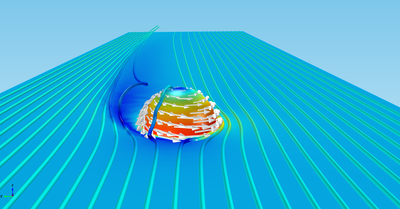
The Magnus effect explains the curl that soccer players can give the ball, resulting in the enjoyable goals that we can see in every FIFA World Cup™. This model looks at the Magnus effect in the laminar and turbulent flow regimes for transient and stationary flows. It also discusses ... Mehr lesen
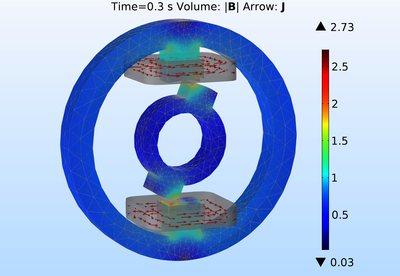
Switched reluctance motors work on the principle of reluctance torque. The stator and rotor will interact to minimize the reluctance for the flux path. This application simulates the behavior of the motor when the stator winding is excited with a step voltage and when the rotor is at a ... Mehr lesen

This model illustrates the working principle of an axial homopolar induction bearing. An electrically conducting rotor rotating in a magnetic field produced by a permanent magnets induces eddy currents on the conducting rotor. The eddy currents, in turn, produce a magnetic field that ... Mehr lesen

These models demonstrate the implementation of a Helmholtz filter to: Smooth noisy input data to a transient simulation Smooth spatially varying data over an arbitrary surface Generate a mesh that is adapted to the spatial variation of an input load Learn more in the accompanying ... Mehr lesen
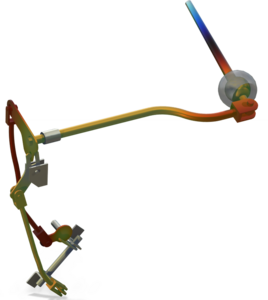
This model demonstrates the ability to simulate Multibody Dynamics in COMSOL. It comprises a multilink mechanism that is used in an antique automobile as a gearshift lever. It was created out of curiosity to find out how large forces are on the individual components. The model uses ... Mehr lesen

This tutorial demonstrates how to create domains for modeling inside and outside of an imported CAD assembly. You will also learn how to use the defeaturing tools for deleting details from the imported geometry. Mehr lesen

This example exemplifies how curve fitting can be performed in COMSOL Multiphysics®, and how this can be applied to your modeling. A more detailed description of the phenomenon and the modeling process can be seen in the blog post "Curve Fitting of Experimental Data with COMSOL ... Mehr lesen

This example exemplifies how to model the Beer-Lambert law using the core functionality of COMSOL Multiphysics. A more detailed description of the phenomenon and the modeling process can be seen in the blog post "Modeling Laser-Material Interactions with the Beer-Lambert Law". Mehr lesen


