
Die Application Gallery bietet COMSOL Multiphysics® Tutorial- und Demo-App-Dateien, die für die Bereiche Elektromagnetik, Strukturmechanik, Akustik, Strömung, Wärmetransport und Chemie relevant sind. Sie können diese Beispiele als Ausgangspunkt für Ihre eigene Simulationsarbeit verwenden, indem Sie das Tutorial-Modell oder die Demo-App-Datei und die dazugehörigen Anleitungen herunterladen.
Suchen Sie über die Schnellsuche nach Tutorials und Apps, die für Ihr Fachgebiet relevant sind. Beachten Sie, dass viele der hier vorgestellten Beispiele auch über die Application Libraries zugänglich sind, die in die COMSOL Multiphysics® Software integriert und über das Menü File verfügbar sind.
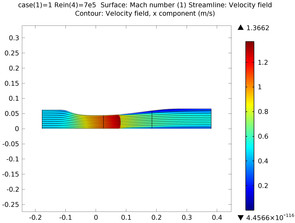
In this model the high speed turbulent gas flow in a converging and diverging nozzle is modeled using the High Mach Number Flow interface. The diffuser is transonic in the sense that the flow at the inlet is subsonic, but due to the contraction and the low outlet pressure, the flow ... Mehr lesen
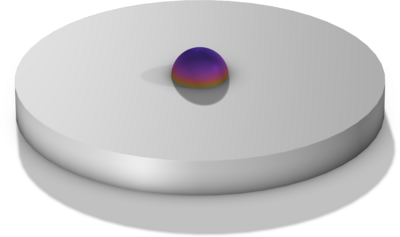
Die Verdunstung von Tröpfchen ist im Alltag allgegenwärtig und spielt bei vielen industriellen Prozessen wie dem Tintenstrahldruck, der Reinigung oder Beschichtung von Oberflächen und dem Wärmetransport durch Phasenwechsel eine wesentliche Rolle. In diesem Modell verdunstet ein ... Mehr lesen
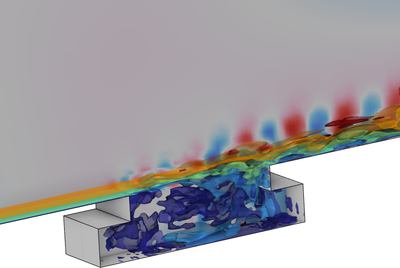
Die Strömung über einen Hohlraum und das dabei entstehende tonale Geräusch ist eine typische Quelle für Strömungsgeräusche in Rohrleitungssystemen, die Ventile und andere Hohlräume aufweisen. Dieses Tutorial-Modell stellt einen einfachen Fall von Strömungsgeräuschen in Hohlräumen eines ... Mehr lesen
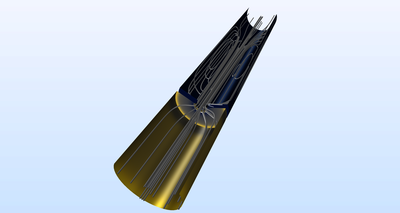
This example considers the turbulent flow of an oil-water suspension through an orifice. The oil droplets are broken up into smaller droplets by the turbulent stresses as the suspension passes through the orifice. The aim of this model is to track the distribution of droplet sizes. The ... Mehr lesen
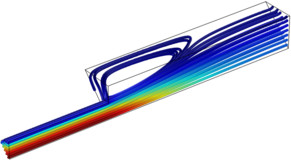
This tutorial model solves the incompressible Navier-Stokes equations in a backstep geometry using the Laminar Flow interface. A characteristic feature of fluid flow in geometries of this kind is the recirculation region that forms where the flow exits the narrow inlet region. The model ... Mehr lesen
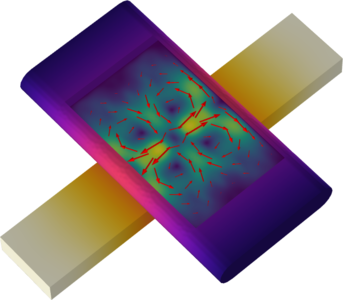
Dies ist ein 3D-Modell einer akustischen Falle in einer Glaskapillare, die durch einen piezoelektrischen Wandler betrieben wird. Das System wird durch ein oszillierendes elektrisches Potential über den piezoelektrischen Wandler angetrieben, das mechanische Schwingungen im Festkörper und ... Mehr lesen
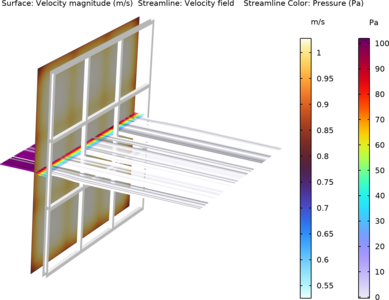
This example demonstrates simulation of a turbulent flow in a geometry with an air filter. Porous material of the filter induces an abrupt pressure drop and drastic increase of turbulence level inside the filter. Mehr lesen
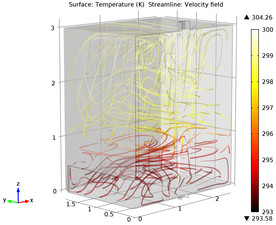
In general, there are two classes of ventilation: mixing ventilation and displacement ventilation. In displacement ventilation, air enters a room at the floor level and displaces warmer air to achieve the desired temperature. Heating sources in the room can include running electronic ... Mehr lesen
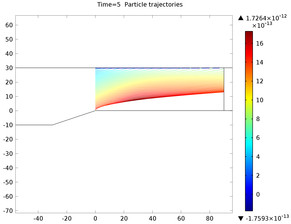
When a temperature gradient in a gas exists, suspended particles will tend to move from regions of high temperature to low. The force which produces this effect is called the thermophoretic force. Gas molecules colliding with a particle from the hot side have a higher velocity than the ... Mehr lesen
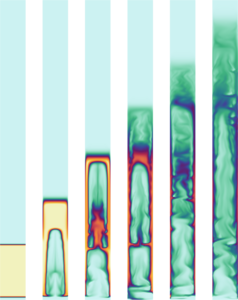
Circulating fluidized beds are widely used in the food & beverage, pharmaceutical, chemical, and energy industries to achieve efficient contact between solid and fluid reactants. This model visualizes how a circulating fluidized bed operates. In the model, the dispersed phase, which ... Mehr lesen


