
Die Application Gallery bietet COMSOL Multiphysics® Tutorial- und Demo-App-Dateien, die für die Bereiche Elektromagnetik, Strukturmechanik, Akustik, Strömung, Wärmetransport und Chemie relevant sind. Sie können diese Beispiele als Ausgangspunkt für Ihre eigene Simulationsarbeit verwenden, indem Sie das Tutorial-Modell oder die Demo-App-Datei und die dazugehörigen Anleitungen herunterladen.
Suchen Sie über die Schnellsuche nach Tutorials und Apps, die für Ihr Fachgebiet relevant sind. Beachten Sie, dass viele der hier vorgestellten Beispiele auch über die Application Libraries zugänglich sind, die in die COMSOL Multiphysics® Software integriert und über das Menü File verfügbar sind.
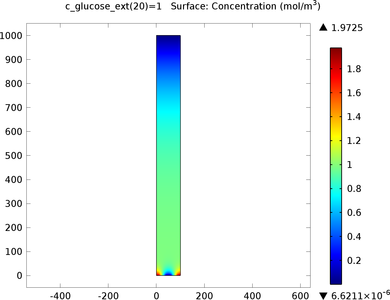
Electrochemical glucose sensors use amperometric methods to measure the concentration of glucose in a sample. This example models the diffusion of glucose and ferri/ferrocyanide redox mediators in a unit cell of electrolyte above an interdigitated electrode. The sensor gives a linear ... Mehr lesen
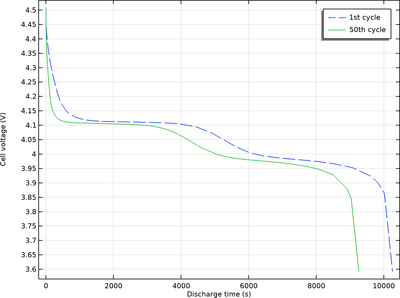
Some positive electrode materials are known to deteriorate in overcharged lithium-ion battery cells. Predominantly, manganese containing electrode materials such as LMO and NMC can loose capacity due to manganese dissolving from the materials at overcharge. This decomposition is a ... Mehr lesen
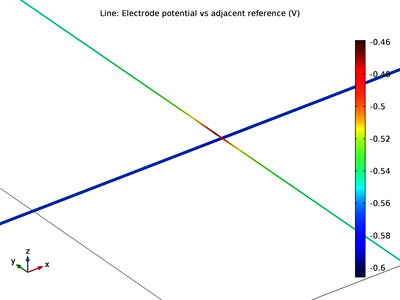
The impressed current cathodic protection (ICCP) system is often employed to mitigate corrosion of buried pipelines in the oil and gas industry. Metallic objects such as buried pipelines, which are present within the current flow of the ICCP system, may suffer from the stray current ... Mehr lesen
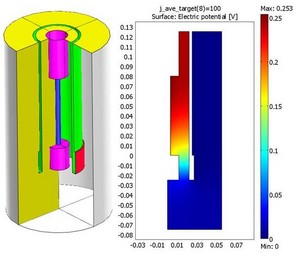
Rotating cylinder Hull cells are an important experimental tool in electroplating and electrodeposition and are used for the measurement of nonuniform current distribution, mass transport, and throwing power of plating baths. The model reproduces the results for a commercially available ... Mehr lesen

This application demonstrates how you can access and include external thermodynamic and physical property calculations in your simulation, using the Thermodynamics feature. The example shows how you can easily modify the predefined Plug-flow reactor type in the Reaction Engineering ... Mehr lesen
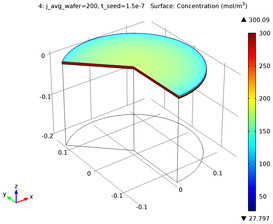
This example extends the analysis made in the model Electrodeposition on a Resistive Patterned Wafer by including the diffusion and convection of copper ions in the electrolyte. The coupled mass transport convection-diffusion effects are of interest in this type of reactor since they ... Mehr lesen

Oscillating chemical reactions were long thought to simply not exist in homogeneous solution, and even the poster child, the Belousov–Zhabotinsky reaction, met such an initial skepticism, that even though it was discovered in 1951, it took almost 20 years for it to gain widespread fame. ... Mehr lesen
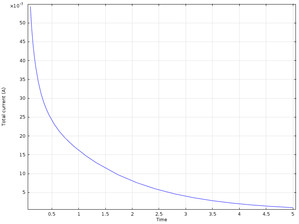
The common electroanalytical method of exhaustive amperometric detection in a microscopic thin layer is modelled as a 1D-symmetric diffusion problem. The simulated result agrees with the analytical Cottrell equation at short times, and deviates as expected at long times when the ... Mehr lesen
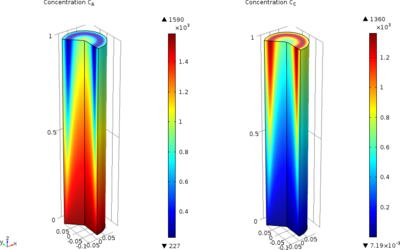
This application uses the Chemical Reaction Engineering Module to study an elementary, exothermic, irreversible reaction in a tubular reactor (liquid phase, laminar flow regime). To keep its temperature down, the reactor uses a cooling jacket with a constant coolant temperature. The ... Mehr lesen
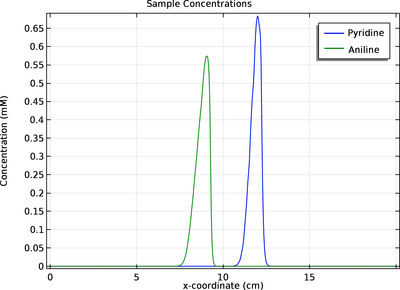
Zone electrophoresis (ZE) is an electrophoretic separation technique typically used for analyzing proteins, nucleic acids, and biopolymers. During the process, different species in a sample are transported in a continuous electrolyte buffer system, subject to a potential gradient. Due to ... Mehr lesen


