
Die Application Gallery bietet COMSOL Multiphysics® Tutorial- und Demo-App-Dateien, die für die Bereiche Elektromagnetik, Strukturmechanik, Akustik, Strömung, Wärmetransport und Chemie relevant sind. Sie können diese Beispiele als Ausgangspunkt für Ihre eigene Simulationsarbeit verwenden, indem Sie das Tutorial-Modell oder die Demo-App-Datei und die dazugehörigen Anleitungen herunterladen.
Suchen Sie über die Schnellsuche nach Tutorials und Apps, die für Ihr Fachgebiet relevant sind. Beachten Sie, dass viele der hier vorgestellten Beispiele auch über die Application Libraries zugänglich sind, die in die COMSOL Multiphysics® Software integriert und über das Menü File verfügbar sind.
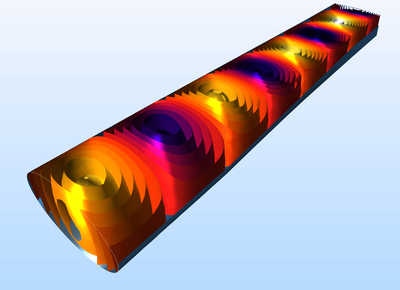
Dies ist ein Modell eines Adapters für die Mikrowellenausbreitung im Übergang zwischen einem rechteckigen und einem elliptischen Wellenleiter. Solche Wellenleiteradapter sind so konzipiert, dass die Energieverluste aufgrund von Reflexionen bei den Betriebsfrequenzen minimal sind. Um die ... Mehr lesen
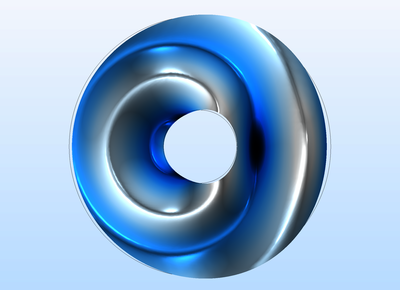
This example model calculates the bistatic radar cross section (RCS) per unit length of a circle using the Electromagnetic Waves, Time Explicit physics interface. A 2D circle is excited by a 200 MHz sinusoidal signal modulated by a temporal Gaussian pulse. A wideband RCS frequency ... Mehr lesen
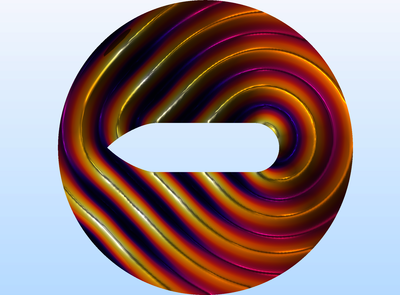
This tutorial model demonstrates the use of a background field in an electromagnetic scattering problem. Although this example is a boat hit by a radar, this same technique can be used in any situation where an isolated object meets electromagnetic waves from a distant source. For ... Mehr lesen
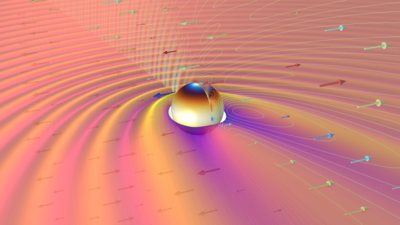
This verification model uses the Electromagnetic Waves, Boundary Elements interface to simulate the RCS of perfectly conducting sphere. The simulated result is compared to analytical calculation to verify the accuracy. Mehr lesen
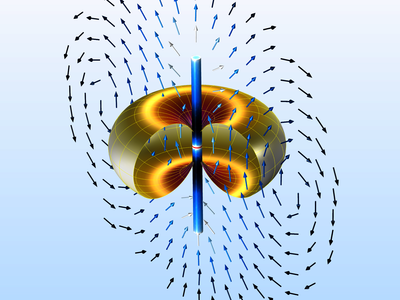
The dipole antenna is one of the most straightforward antenna configurations. It can be realized with two thin metallic rods that have a sinusoidal voltage difference applied between them. The length of the rods is chosen such that they are quarter wavelength elements at the operating ... Mehr lesen

Die induzierten Ströme in einem Kupferzylinder erzeugen Wärme, die wiederum die elektrische Leitfähigkeit verändert. Das bedeutet, dass die Feldausbreitung gleichzeitig mit dem Wärmetransport durch den Zylinder und das umgebende System gelöst werden muss. Dieses Modell zeigt diese ... Mehr lesen
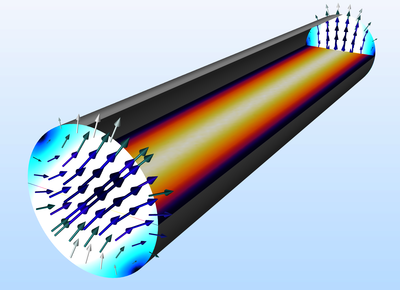
This model of a circular waveguide demonstrates how to use ports with numerical solution of the port modes. It illustrates how to align the polarization of degenerate port modes and in particular how to model and excite the TE11 mode of circular waveguides in 3D. Mehr lesen

A metallic cylindrical rod is hidden inside a spherical dielectric shell and its orientation is unknown. By studying the polarization-dependent scattered field of a cylindrical object and performing a parametric sweep as a function of polarization angle, the rod is detected for the ... Mehr lesen
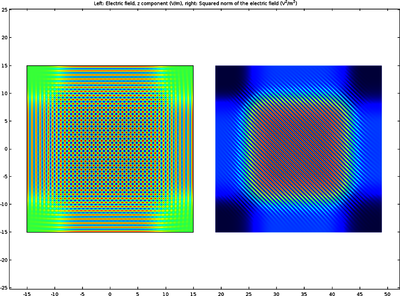
When two coherent light beams intersect, an interference pattern appears. If this occurs in a material that is sensitive to light, with intensities greater than a certain exposure threshold, the interference pattern is recorded in the material as a modulation of the refractive index and ... Mehr lesen
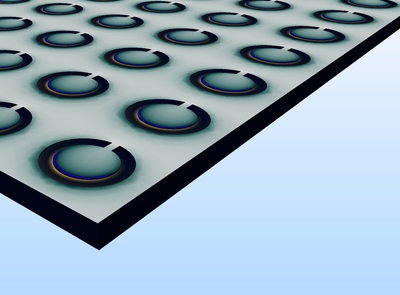
Frequency-selective surfaces (FSS) are periodic structures with a bandpass or a bandstop frequency response. This model shows that only signals around the center frequency can pass through the periodic complementary split ring resonator layer. Mehr lesen


