
Die Application Gallery bietet COMSOL Multiphysics® Tutorial- und Demo-App-Dateien, die für die Bereiche Elektromagnetik, Strukturmechanik, Akustik, Strömung, Wärmetransport und Chemie relevant sind. Sie können diese Beispiele als Ausgangspunkt für Ihre eigene Simulationsarbeit verwenden, indem Sie das Tutorial-Modell oder die Demo-App-Datei und die dazugehörigen Anleitungen herunterladen.
Suchen Sie über die Schnellsuche nach Tutorials und Apps, die für Ihr Fachgebiet relevant sind. Beachten Sie, dass viele der hier vorgestellten Beispiele auch über die Application Libraries zugänglich sind, die in die COMSOL Multiphysics® Software integriert und über das Menü File verfügbar sind.
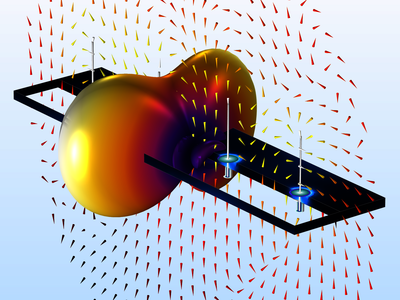
It is possible to shape the radiation pattern and steer the beam from an antenna array by controlling the relative phases and magnitudes of the input signal. This example shows how to design an active electronically scanned array (AESA) using arithmetic phase progression on each antenna ... Mehr lesen
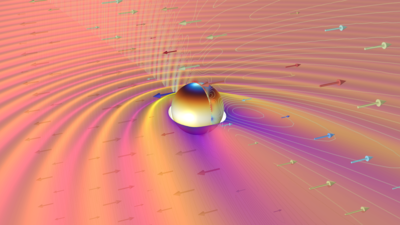
This model illustrates the process of evaluating the radar cross section (RCS) of a metallic sphere through the utilization of the boundary element method (BEM). By taking advantage of a vertical symmetry plane that is parallel to the polarization of an incident background field, the ... Mehr lesen

It is possible to generate harmonics that are multiples of the frequency of laser light by using nonlinear optical materials. This model demonstrates second harmonic generation using transient wave simulation and nonlinear material properties. A YAG (lambda=1.06 micron) laser beam is ... Mehr lesen

Laser systems are an important application area in modern electronics. With nonlinear materials it is possible to generate harmonics that are a multiple of the frequency of the laser light. This model shows how a second harmonic generation can be set up as a transient wave simulation, ... Mehr lesen
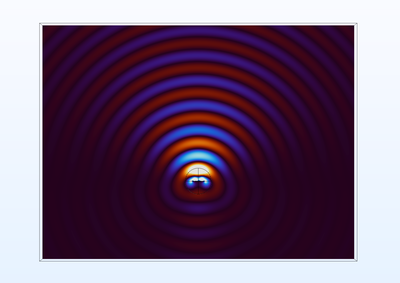
This tutorial model analysis of a microstrip patch antenna shows how to couple the finite element method (FEM) to the boundary element method (BEM) for evaluating the field outside the FEM computational domain. The model computes the S-parameter, near-field distribution, and far-field ... Mehr lesen
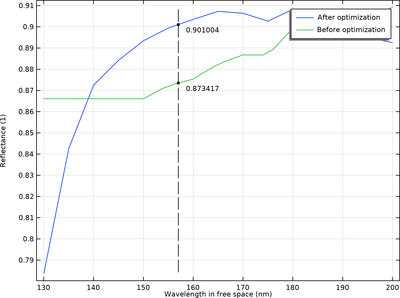
This example demonstrates how to optimize the thickness of a microelectromechanical systems (MEMS) mirror coating material for maximum reflectivity. To reduce the simulation time, a Layered Impedance Boundary Condition is used to model the thin coating material on top of the metallic ... Mehr lesen

Mixed-mode S-parameters describe the responses of a circuit with balanced ports excited and terminated by two types of modes: common and differential modes. They are calculated using a full S-parameter matrix of a four-port network that is composed of four single ended lines. This ... Mehr lesen
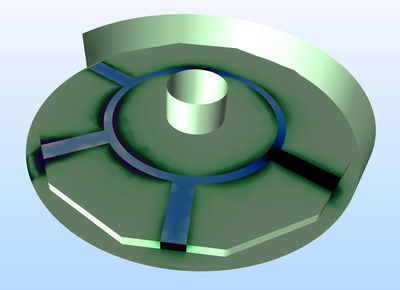
A 180° Ring Hybrid (Rat-Race Coupler) is a four-port network with 180° phase difference between two ports. It is cheaper to manufacture this type of microstrip line component compared to a wave guide 180° hybrid junction, so called magic-T. The objective of this model is to compute the S ... Mehr lesen

A plane electromagnetic wave is incident on a metallic sphere partially embedded on a substrate. In this electromagnetic scattering problem, the far-field variables are computed for a few elevation angles of incidence. Mehr lesen
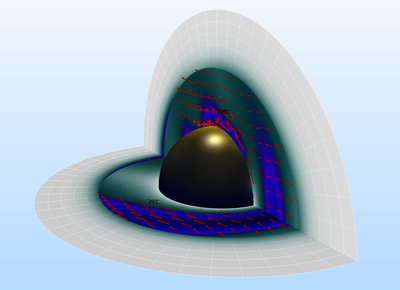
A classic benchmark problem in computational electromagnetics is to solve for the radar cross section (RCS) of a sphere in free space illuminated by a plane wave. This model solves for the RCS of a metallic sphere that has a very high conductivity, which can be treated as a material with ... Mehr lesen


