
Die Application Gallery bietet COMSOL Multiphysics® Tutorial- und Demo-App-Dateien, die für die Bereiche Elektromagnetik, Strukturmechanik, Akustik, Strömung, Wärmetransport und Chemie relevant sind. Sie können diese Beispiele als Ausgangspunkt für Ihre eigene Simulationsarbeit verwenden, indem Sie das Tutorial-Modell oder die Demo-App-Datei und die dazugehörigen Anleitungen herunterladen.
Suchen Sie über die Schnellsuche nach Tutorials und Apps, die für Ihr Fachgebiet relevant sind. Beachten Sie, dass viele der hier vorgestellten Beispiele auch über die Application Libraries zugänglich sind, die in die COMSOL Multiphysics® Software integriert und über das Menü File verfügbar sind.
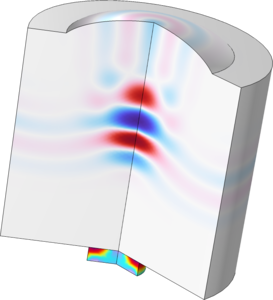
Piezoelektrische Bauteile werden häufig als Quellen zur Erzeugung von Schallwellen oder als Empfänger zur Erfassung akustischer Signale eingesetzt. In Anwendungen wie der Ultraschallbildgebung und der zerstörungsfreien Prüfung kann ein und derselbe Wandler als Sender zum Senden eines ... Mehr lesen

Plasma discharges containing chlorine are commonly used to etch semiconductors and metals in microelectronics fabrication. This tutorial model studies chlorine plasma discharges using a global (volume-averaged) diffusion model. Global diffusion models can run simulations in a fraction ... Mehr lesen

As integrated circuit (IC) technology advances, with circuits becoming more powerful and compact, it is increasingly important to identify and prevent any cause of circuit failure. One particularly critical factor contributing to circuit failure is electromigration within the ... Mehr lesen

This tutorial shows how to solve the full time-dependent wave equation in dispersive media such as plasmas and semiconductors. The 2D TM in-plane wave model solves for the vector potential from the wave equation and for an auxiliary electric polarization density from an ordinary ... Mehr lesen
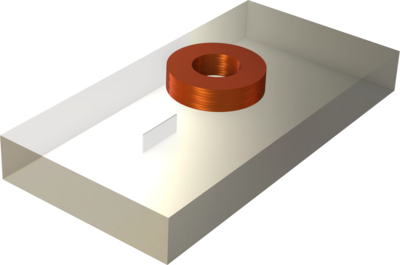
This model is a benchmark problem from TEAM workshop (problem 15 part I, see https://www.compumag.org/wp/team/). The model simulates the behavior of a coil as it scans a conductive plate containing a defect (a crack). The computed coil parameters, which include change in resistance and ... Mehr lesen
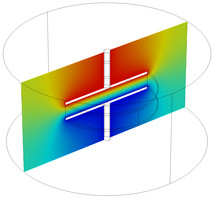
Ein Kondensator mit einer angelegten sinusförmig zeitlich veränderlichen Spannungsdifferenz wird modelliert. Es wird ein großer Frequenzbereich berücksichtigt und die Impedanz des Geräts berechnet. Die Genauigkeit des Lösers wird untersucht. Die Beziehung zwischen der Impedanz im ... Mehr lesen
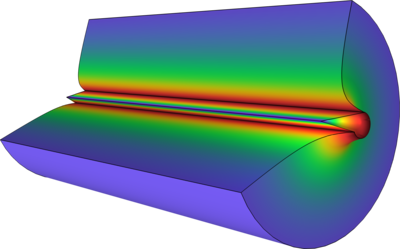
This introduction model creates a simple model of the magnetostatics problem with a wire of infinite length carrying current, which is commonly found in textbooks. Since there is an analytical solution to this problem, the model can be used to compare theory with numerical results from ... Mehr lesen
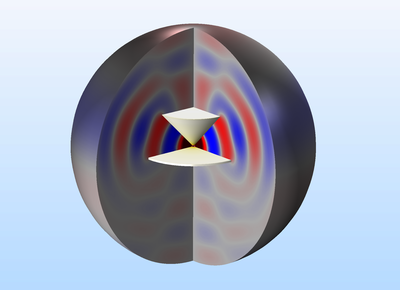
Conical antennas are useful for many applications due to their broadband characteristics and relative simplicity. In this example, we study the antenna impedance and radiation pattern as functions of frequency for a monoconical antenna with a finite ground plane and a 50 ohm coaxial ... Mehr lesen
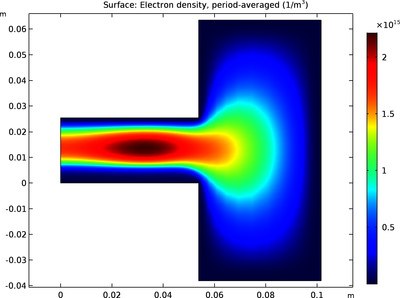
This model investigates the National Institute of Standards and Technology (NIST) Gaseous Electronics Conference (GEC) reference cell in two dimensions using the Plasma, Time Periodic interface. A 2D example helps in understanding the physics without excessive CPU time. The cell is ... Mehr lesen
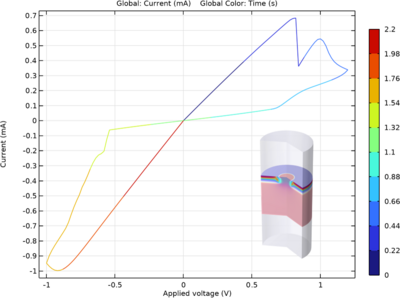
This model captures the dynamic resistive switching behavior of an oxide-based memristor. The device features a thin metal oxide layer sandwiched between two metal electrodes. When a voltage is applied, oxygen vacancies within the oxide layer migrate, acting as charge carriers and ... Mehr lesen


