
Die Application Gallery bietet COMSOL Multiphysics® Tutorial- und Demo-App-Dateien, die für die Bereiche Elektromagnetik, Strukturmechanik, Akustik, Strömung, Wärmetransport und Chemie relevant sind. Sie können diese Beispiele als Ausgangspunkt für Ihre eigene Simulationsarbeit verwenden, indem Sie das Tutorial-Modell oder die Demo-App-Datei und die dazugehörigen Anleitungen herunterladen.
Suchen Sie über die Schnellsuche nach Tutorials und Apps, die für Ihr Fachgebiet relevant sind. Beachten Sie, dass viele der hier vorgestellten Beispiele auch über die Application Libraries zugänglich sind, die in die COMSOL Multiphysics® Software integriert und über das Menü File verfügbar sind.
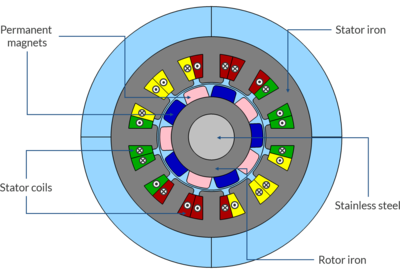
Dies ist ein Primer-Modell einer Permanentmagnet-Maschine. Es handelt sich um ein allgemeines Modell, das zur Simulation eines Motors oder Generators modifiziert werden kann. Es demonstriert verschiedene Möglichkeiten von COMSOL Multiphysics®, um Aspekte des Maschinendesigns zu ... Mehr lesen
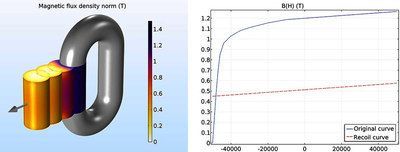
Soft permanent magnets like AlNiCo are easily demagnetized if handled incorrectly. This is a demonstration of how to model the self-demagnetization of a cylindrical AlNiCo magnet when moved out of its associated/protective magnetic circuit. The modeling is performed in three steps: The ... Mehr lesen
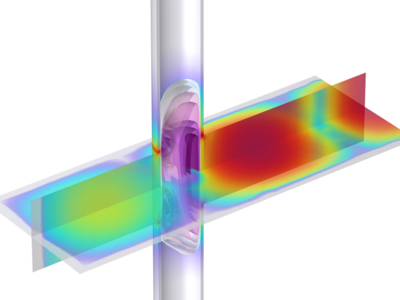
This tutorial model explores the behavior of a microwave plasma torch. The plasma is generated within a dielectric tube inserted in a rectangular waveguide. The simulation solves the coupled equations for plasma transport and heating, microwave electromagnetic fields, fluid flow, and ... Mehr lesen
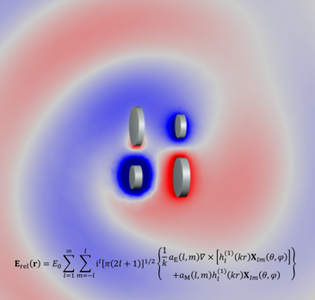
The multipole expansion is a powerful tool for analyzing electromagnetic waves scattered by small objects. In the expansion, the scattered field is represented as a superposition of the fields created by a finite set of point multipoles. Each point multipole is connected to a unique ... Mehr lesen

This model represents index guided photonic crystal fiber as discussed in the J. D. Joannopoulus book. The dispersion diagram of the fundamental and higher order modes matches well with Chapter 9, Figure 4. The hole radius is varied from 0.23[um] to 4.69[um]. J.D. Joannopoulus, R.D. ... Mehr lesen

Diese Beispiele zeigen, wie man die Gesamtreflexion, -transmission und -absorption von Licht berechnet, wenn eine ebene Welle mit optischen Wellenlängen auf eine dielektrische Platte mit einer dünnen Metallbeschichtung trifft. Es sind drei Beispiele enthalten, die zeigen: Eine optisch ... Mehr lesen

Electron transport in low-temperature plasmas depends strongly on the electron energy distribution function (EEDF), which is often approximated as Maxwellian but is frequently nonequilibrium in reality. Incorporating nonequilibrium EEDF behavior into spatially dependent models often ... Mehr lesen
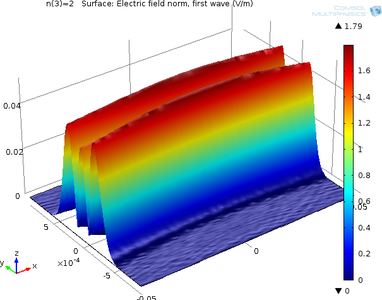
This model demonstrates how a nonlinear equation system can be setup to solve for the eigenfrequencies of a symmetric laser cavity. The model uses the bidirectional formulation of the Electromagnetic Waves, Beam Envelopes physics interface. The computed eigenfrequencies are verified with ... Mehr lesen
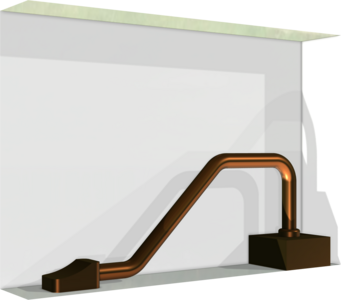
This model analyzes Joule heating and thermal expansion in a bond wire in an LED. Its purpose is to estimate the temperature increase and the resulting mechanical stresses in the bond wire due to thermal expansion. The magnitude of these stresses can be used to assess the risk of fatigue ... Mehr lesen

A 3D silicon waveguide is set up with rib and slot configurations. The meshing includes physics-controlled mesh, with the number of longitudinal mesh elements set to 50 to visualize the wave oscillation. The detailed discussion of the model setup is discussed in the blog post: "Silicon ... Mehr lesen


