
Die Application Gallery bietet COMSOL Multiphysics® Tutorial- und Demo-App-Dateien, die für die Bereiche Elektromagnetik, Strukturmechanik, Akustik, Strömung, Wärmetransport und Chemie relevant sind. Sie können diese Beispiele als Ausgangspunkt für Ihre eigene Simulationsarbeit verwenden, indem Sie das Tutorial-Modell oder die Demo-App-Datei und die dazugehörigen Anleitungen herunterladen.
Suchen Sie über die Schnellsuche nach Tutorials und Apps, die für Ihr Fachgebiet relevant sind. Beachten Sie, dass viele der hier vorgestellten Beispiele auch über die Application Libraries zugänglich sind, die in die COMSOL Multiphysics® Software integriert und über das Menü File verfügbar sind.
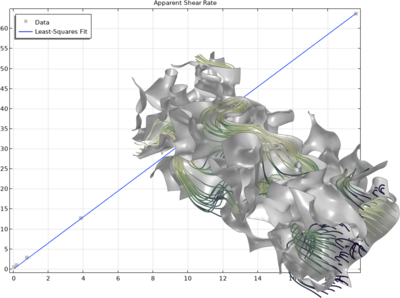
Non-Newtonian fluids have complex flow characteristics that vary with shear rate, making their behavior in porous materials difficult to predict. Pore scale modeling captures these flow patterns at a microscopic level, helping derive properties for macroscale use. This model ... Mehr lesen
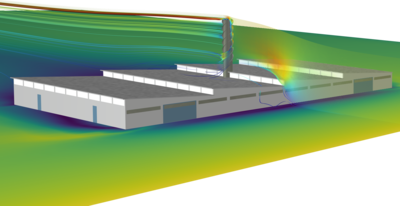
Wind strakes on a chimney impede the uniform detachment along the height of the chimney, which can induce vibrations and eventually lead to fatigue at the footing of the chimney. A stationary turbulent flow simulation is computed for a chimney with strakes mounted on a factory building. ... Mehr lesen
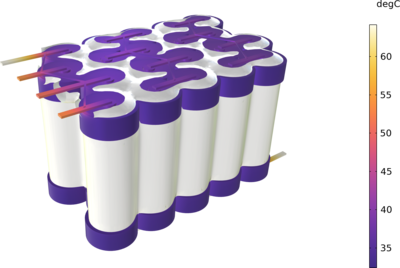
Thermal management of a battery pack is simulated considering two scenarios, air (natural convection) and phase change material (PCM) in the gap between the batteries. The PCM considered is a composite material of paraffin wax and graphite additive. Graphite is typically added for ... Mehr lesen
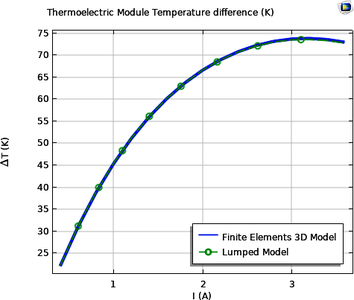
Thermoelectric coolers are widely used for electronics cooling in various application areas, ranging from consumer products to spacecraft design. The thermoelectric modules are a common application of thermoelectricity in cooling engineering. They consist of several thermoelectric legs ... Mehr lesen

In this time-dependent model, a silica block of glass, coated with a thin copper layer is subjected to a heat flux. Copper is a highly conductive material, while the silica glass is of poor thermal conductivity, which sets up an highly-varied temperature differential. The model must ... Mehr lesen
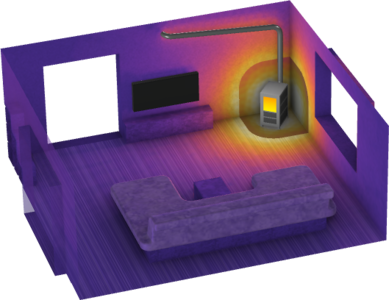
This model represents a stove in a living room. A radiation study is performed with the Surface-to-Surface Radiation physics interface. It shows the intensity of the stove radiation received on different surfaces of the room. Mehr lesen
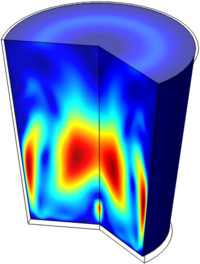
Dieses Modell behandelt die freie Konvektion und den Wärmetransport eines Glases mit kaltem Wasser, das sich auf Raumtemperatur erwärmt. Zu Beginn haben das Glas und das Wasser eine Temperatur von 5 °C und werden dann auf einen Tisch in einem Raum mit 25 °C gestellt. Die nicht-isotherme ... Mehr lesen

Density variations can initiate flow even in a still fluid. In earth systems, density variations can arise from naturally occurring salts, subsurface temperature changes, or migrating pollution. This buoyant or density-driven flow factors into fluid movement in salt-lake systems, saline ... Mehr lesen

This app demonstrates the following: Selecting predefined or user-defined materials User option to switch between laminar flow or turbulent flow Changing boundary conditions using methods Visualizing temperature dependent material properties as graph plots User option to set the solver ... Mehr lesen
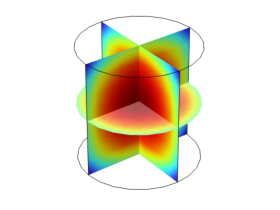
These models use the Discrete Ordinates method (DOM) and P1 approximation to solve a 3D radiative transfer problem in an emitting, absorbing, and linear-anisotropic scattering finite cylindrical medium. Using the S6 quadrature of DOM leads to accurate results, which are needed in ... Mehr lesen


