
Die Application Gallery bietet COMSOL Multiphysics® Tutorial- und Demo-App-Dateien, die für die Bereiche Elektromagnetik, Strukturmechanik, Akustik, Strömung, Wärmetransport und Chemie relevant sind. Sie können diese Beispiele als Ausgangspunkt für Ihre eigene Simulationsarbeit verwenden, indem Sie das Tutorial-Modell oder die Demo-App-Datei und die dazugehörigen Anleitungen herunterladen.
Suchen Sie über die Schnellsuche nach Tutorials und Apps, die für Ihr Fachgebiet relevant sind. Beachten Sie, dass viele der hier vorgestellten Beispiele auch über die Application Libraries zugänglich sind, die in die COMSOL Multiphysics® Software integriert und über das Menü File verfügbar sind.
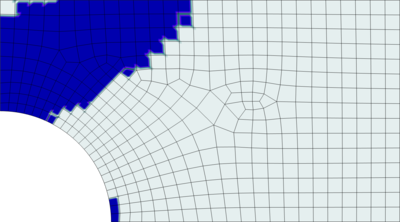
This example shows the analysis of a perforated plate loaded into the plastic regime. The purpose of the analysis is to demonstrate how plastic strains can be mapped between dissimilar meshes. Mehr lesen
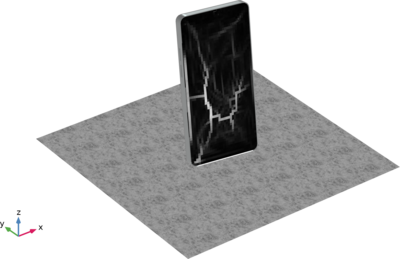
Falltests werden verwendet, um zu bewerten, wie Verbraucherprodukte auf Stöße und hohe Beschleunigungen reagieren. In diesem Beispiel wird das Interface Solid Mechanics, Explicit Dynamics verwendet, um einen Falltest eines Smartphones numerisch zu simulieren, wobei die bleibende ... Mehr lesen
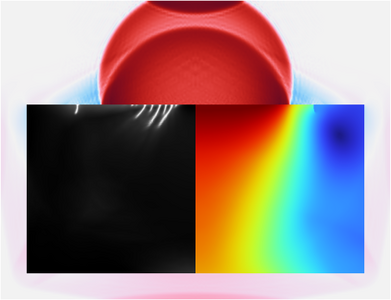
An acoustic point source emits a pressure wave in water that travels toward a piece of glass. Cracks are formed and propagate due to high tensile stresses developed in the glass. A fully coupled acoustic-structure interaction problem including phase field damage in solids is solved in ... Mehr lesen
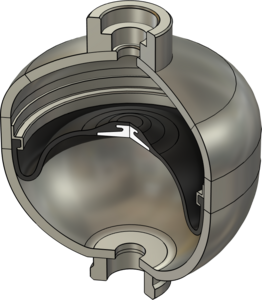
Diaphragm accumulators are essential components that store energy and regulate hydraulic systems. A flexible rubber diaphragm divides the hydraulic fluid from a compressible inert gas, typically nitrogen. These accumulators perform multiple tasks, such as temporarily storing hydraulic ... Mehr lesen
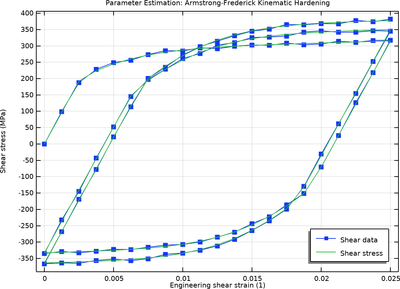
This tutorial model demonstrates how to estimate the material parameters of a combined hardening elastoplastic material model given cyclic shear data. Mehr lesen
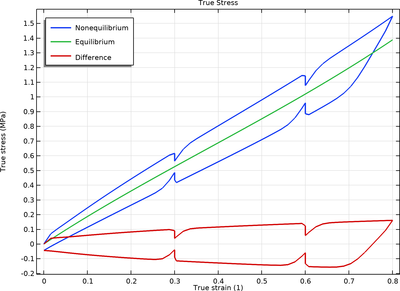
In this example, the Bergstrom–Boyce material model is used to capture the nonequilibrium behavior of carbon-black-filled chloroprene rubber under a strain history that alternates compression with relaxation. Results are verified against experimental and numerical results taken from ... Mehr lesen
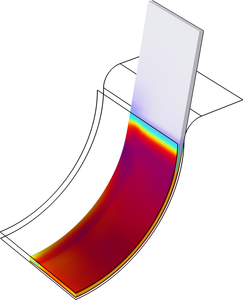
This example benchmarks a NAFEMS validation model of a friction contact problem with an elastoplastic material model. A thin metal sheet is forced into a die by a punch. Both the compressing displacement and the release of the punch are modeled in order to compute the forming angle (at ... Mehr lesen
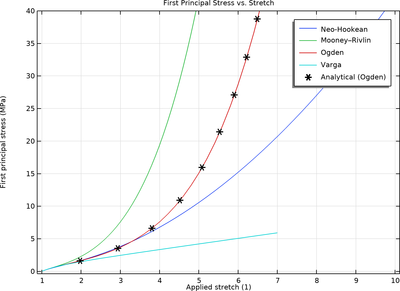
This model demonstrates the inflation of a rubber balloon with four different hyperelastic material models. The results are compared with the analytical solution for a thin-walled, spherical vessel. Controlling the inflation of hyperelastic balloons is important in clinical ... Mehr lesen
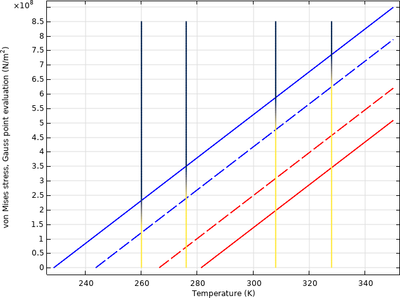
The model includes a compilation of benchmark examples included in the text book: Shape Memory Alloys: Modeling and Engineering Applications. D. Lagoudas Ed. Springer 2008. The model uses the Souza–Auricchio model and shows the thermomechanical properties of a NiTi alloy sample ... Mehr lesen

This example illustrates how to combine different Creep material models. Here a Norton–Bailey model (primary creep) is combined with a Norton model (secondary creep). This example is a continuation of the model thermally induced creep. Mehr lesen


