
Die Application Gallery bietet COMSOL Multiphysics® Tutorial- und Demo-App-Dateien, die für die Bereiche Elektromagnetik, Strukturmechanik, Akustik, Strömung, Wärmetransport und Chemie relevant sind. Sie können diese Beispiele als Ausgangspunkt für Ihre eigene Simulationsarbeit verwenden, indem Sie das Tutorial-Modell oder die Demo-App-Datei und die dazugehörigen Anleitungen herunterladen.
Suchen Sie über die Schnellsuche nach Tutorials und Apps, die für Ihr Fachgebiet relevant sind. Beachten Sie, dass viele der hier vorgestellten Beispiele auch über die Application Libraries zugänglich sind, die in die COMSOL Multiphysics® Software integriert und über das Menü File verfügbar sind.
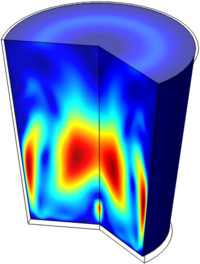
Dieses Modell behandelt die freie Konvektion und den Wärmetransport eines Glases mit kaltem Wasser, das sich auf Raumtemperatur erwärmt. Zu Beginn haben das Glas und das Wasser eine Temperatur von 5 °C und werden dann auf einen Tisch in einem Raum mit 25 °C gestellt. Die nicht-isotherme ... Mehr lesen

Swirl flow is an application that involves steady rotational flow around an axis. Rather than modeling this process in 3D, COMSOL Multiphysics provides a 2D axisymmetric interface where the flow in the rotational direction is still included in the equations. This example shows the ... Mehr lesen
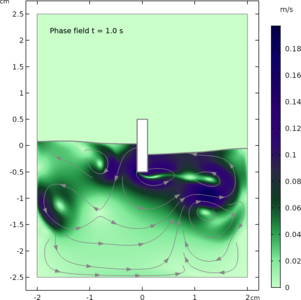
Wir präsentieren die Ergebnisse eines Vergleichs der Level-Set-, Phasenfeld- und Moving-Mesh-Methoden zur Modellierung freier Flüssigkeitsoberflächen in der Software COMSOL Multiphysics®. Der Vergleich wird anhand eines Beispielproblems durchgeführt. Das Beispiel untersucht die Bildung ... Mehr lesen

This example illustrates the principle of electrochemical polishing. The simplified 2D model geometry consists of two electrodes and an intermediate electrolyte domain The positive electrode has a protrusion, representing a surface defect. The purpose of the model is to examine how this ... Mehr lesen
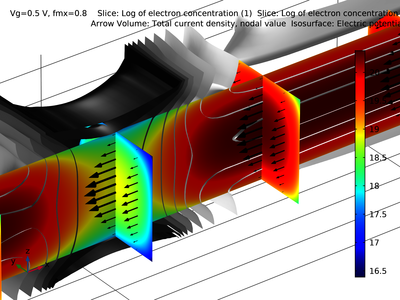
This 3D model of a nanowire MOSFET employs the density-gradient theory to add the effect of quantum confinement to the conventional drift-diffusion formulation, without requiring excessively high computational costs. The oxide layer is simulated explicitly with geometric domains, and ... Mehr lesen
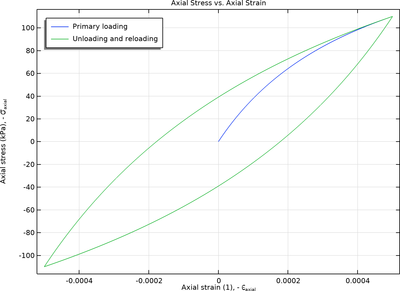
The small strain overlay material model captures the effect of high stiffness at low strain as well as the hysteresis under cyclic loading, which is a common effect for most soils. The formulation allows stiffness degradation with an increase in shear strain, and the full recovery of ... Mehr lesen
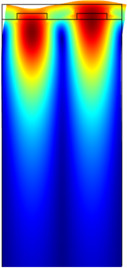
Eine akustische Oberflächenwelle (surface acoustic wave, SAW) ist eine akustische Welle, die sich entlang der Oberfläche eines festen Materials ausbreitet. Ihre Amplitude nimmt in der Tiefe des Materials schnell, oft exponentiell, ab. SAWs werden in vielen Arten von elektronischen ... Mehr lesen
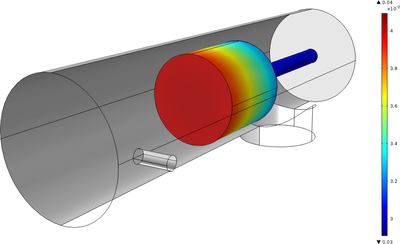
Chemical vapor deposition (CVD) is a process often used in the semiconductor industry to grow layers of high-purity solid material on top of a wafer substrate. CVD is achieved using many different techniques and across a range of pressures from atmospheric to ultrahigh vacuum (UHV/CVD). ... Mehr lesen


