
Die Application Gallery bietet COMSOL Multiphysics® Tutorial- und Demo-App-Dateien, die für die Bereiche Elektromagnetik, Strukturmechanik, Akustik, Strömung, Wärmetransport und Chemie relevant sind. Sie können diese Beispiele als Ausgangspunkt für Ihre eigene Simulationsarbeit verwenden, indem Sie das Tutorial-Modell oder die Demo-App-Datei und die dazugehörigen Anleitungen herunterladen.
Suchen Sie über die Schnellsuche nach Tutorials und Apps, die für Ihr Fachgebiet relevant sind. Beachten Sie, dass viele der hier vorgestellten Beispiele auch über die Application Libraries zugänglich sind, die in die COMSOL Multiphysics® Software integriert und über das Menü File verfügbar sind.
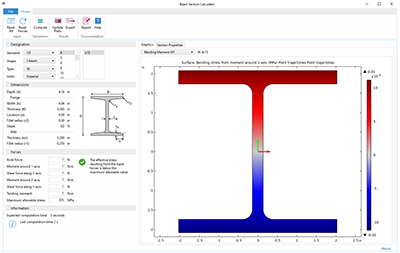
This app demonstrates: Light theme This app allows you to evaluate cross-section data for a wide range of American and European standard beams. Given a set of forces and moments acting on the section, you can also compute a detailed stress distribution. Calculated cross-section data ... Mehr lesen
MOSFETs typically operate in three regimes depending on the drain-source voltage for a given gate voltage. Initially the current-voltage relation is linear, this is the Ohmic region. As the drain-source voltage increases the extracted current begins to saturate, this is the saturation ... Mehr lesen
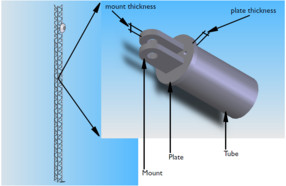
The example Stiffness Analysis of a Communication Mast’s Diagonal Mounting in the COMSOL Multiphysics Model Library shows how you can modify a 3D CAD model to improve its performance. In that case, the applied changes were based solely on the analyst’s experience with similar structures. ... Mehr lesen
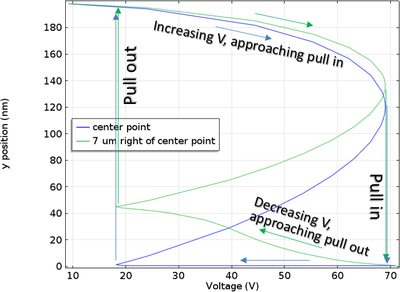
An electrostatically actuated MEMS resonator is simulated. The device is driven by an AC + DC bias voltage applied across a parallel plate capacitor. In this example, the pull-in and pull-out voltages of the resonator are computed. This is done via a quasi-static analysis of the ... Mehr lesen
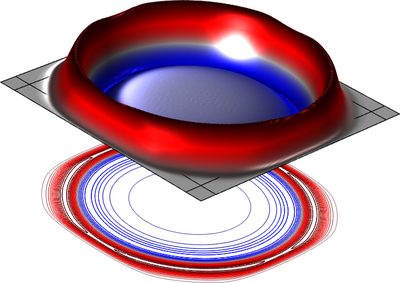
This tutorial simulates a standard test and benchmark model for perfectly matched layers (PMLs) as absorbing boundary conditions in the time domain. It involves the propagation of a transient Gaussian pulse with no flow. The Pressure Acoustics, Transient interface is used together with ... Mehr lesen
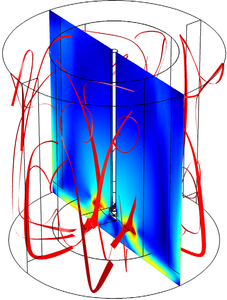
This tutorial example simulates the flow in a flat bottom mixer containing, agitated by a pitched four blade impeller, where the fluid is water, and flow is assumed to be turbulent. The flow in the mixer is modeled using the k-ε turbulence model, and a time-dependent simulation ... Mehr lesen
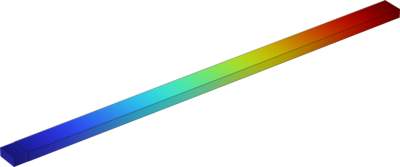
The elastoacoustic effect is a change in the speed of elastic waves that propagate in a structure undergoing static elastic deformations. The effect is used in many ultrasonic techniques for nondestructive testing of prestressed states within structures. This example studies the ... Mehr lesen
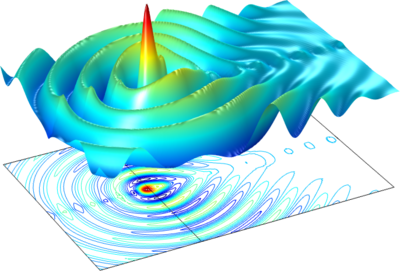
This is a benchmark model for the linearized Euler interface of the Acoustics Module. The model is from the NASA "Fourth Computational Aeroacoustics (CAA) Workshop on Benchmark Problems (2004)". The model results are compared to an analytical solution by Agarwal et al. (AIAA Vol. 42, No. ... Mehr lesen
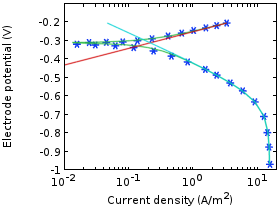
This tutorial shows how to use the Optimization interface to perform electrode kinetics parameter estimations based on polarization data. A zero-dimensional electrode polarization model is defined that separates kinetics expressions for the metal dissolution and the oxygen reduction ... Mehr lesen

This model uses the Reacting Flow multiphysics interface to simulate a methane steam reformer. The model accounts for the interactions between the chemical reactions, the transport of species, the fluid flow, and the heat transfer in a porous medium. Mehr lesen


