
Die Application Gallery bietet COMSOL Multiphysics® Tutorial- und Demo-App-Dateien, die für die Bereiche Elektromagnetik, Strukturmechanik, Akustik, Strömung, Wärmetransport und Chemie relevant sind. Sie können diese Beispiele als Ausgangspunkt für Ihre eigene Simulationsarbeit verwenden, indem Sie das Tutorial-Modell oder die Demo-App-Datei und die dazugehörigen Anleitungen herunterladen.
Suchen Sie über die Schnellsuche nach Tutorials und Apps, die für Ihr Fachgebiet relevant sind. Beachten Sie, dass viele der hier vorgestellten Beispiele auch über die Application Libraries zugänglich sind, die in die COMSOL Multiphysics® Software integriert und über das Menü File verfügbar sind.
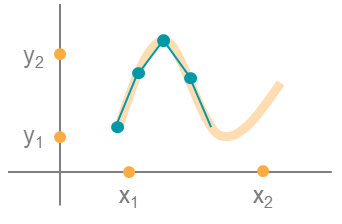
The Curve Digitizer application can be used to digitize/extract curves from images. This application provides an easy way to digitize a variety of 1D plots with different axes in Cartesian or Polar coordinate system. After a curve image is imported, the digitization is done in a few ... Mehr lesen
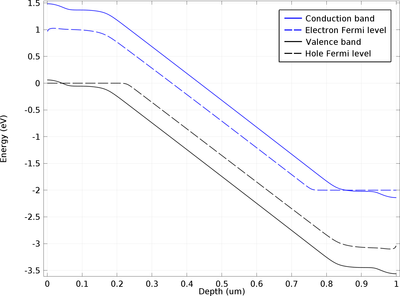
Dieses einfache Modell zeigt, wie Sie die Interfaces Semiconductor Optoelectronics verwenden können, um eine einfache GaAs-PIN-Diodenstruktur zu modellieren. Sowohl die stimulierte als auch die spontane Emission im Halbleiter werden berücksichtigt. Die entsprechende Absorption des Lichts ... Mehr lesen
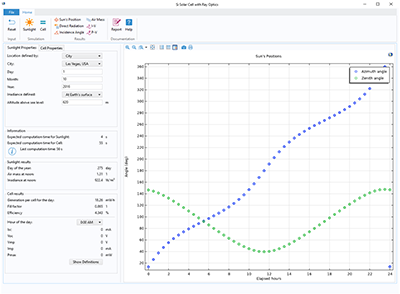
This app demonstrates the following: Multiple components (1D and 3D) in a single app Using the same choice list in the app as in the model using Data Access functionality Output numerical results for a specific time step using a combo box The app combines the Ray Optics Module and ... Mehr lesen
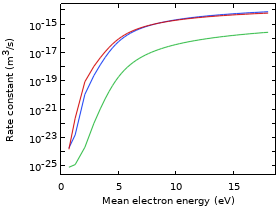
This model solves the Boltzmann equation in the two-term approximation for a background of molecular and atomic hydrogen. Electron mobility and source terms are computed by suitable integration of the electron energy distribution function over electron impact cross sections. Mehr lesen

In the semiconductor manufacturing process, photoresist coating is an important process and the thickness of the photoresist layer needs to be precisely controlled. Usually, the photoresist layer is thinned by spin coating. The specific principle is to use centrifugal force to throw ... Mehr lesen
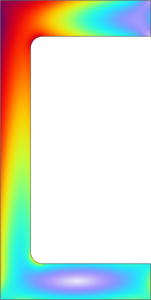
This benchmark demonstrates how to use the Beam interface in the Structural Mechanics Module. It calculates the deformation, section forces, and stresses in a cantilever beam as well as a number of eigenfrequencies. It also illustrates how to use the Beam Cross Section interface to ... Mehr lesen

A spiral slot antenna provides a conformal design and can be used for communication, sensing, tracking, positioning, and many applications in different microwave frequency bands due to its wide-band frequency response. This model shows how to build a spiral geometry using parametric ... Mehr lesen
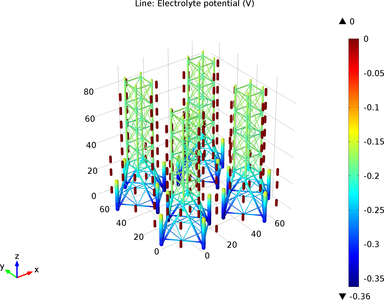
This example extends the corrosion protection system analysis of the single oil platform example by modeling the influence of multiple oil platforms placed in an array. The use of the Current Distribution on Edges, BEM interface significantly reduces the problem size and computational ... Mehr lesen

It is possible to generate harmonics that are multiples of the frequency of laser light by using nonlinear optical materials. This model demonstrates second harmonic generation using transient wave simulation and nonlinear material properties. A YAG (lambda=1.06 micron) laser beam is ... Mehr lesen

It is more difficult to generate laser emissions in the short-wavelength part of the visible and near visible part of the electromagnetic spectrum than in the long-wavelength part. Nonlinear frequency mixing makes it easier to generate new short wavelengths from existing laser ... Mehr lesen


