
Die Application Gallery bietet COMSOL Multiphysics® Tutorial- und Demo-App-Dateien, die für die Bereiche Elektromagnetik, Strukturmechanik, Akustik, Strömung, Wärmetransport und Chemie relevant sind. Sie können diese Beispiele als Ausgangspunkt für Ihre eigene Simulationsarbeit verwenden, indem Sie das Tutorial-Modell oder die Demo-App-Datei und die dazugehörigen Anleitungen herunterladen.
Suchen Sie über die Schnellsuche nach Tutorials und Apps, die für Ihr Fachgebiet relevant sind. Beachten Sie, dass viele der hier vorgestellten Beispiele auch über die Application Libraries zugänglich sind, die in die COMSOL Multiphysics® Software integriert und über das Menü File verfügbar sind.
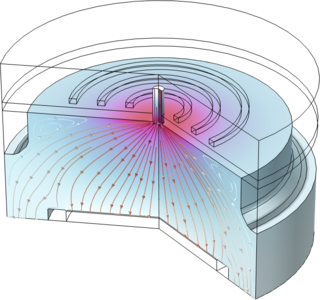
This tutorial studies the deposition of amorphous silicon using an inductively coupled plasma reactor with a silane/argon gas mixture. It examines how the deposition rate varies across the wafer as a function of silane mole fraction and input power. Mehr lesen

This example demonstrates how to apply the Uncertainty Quantification (UQ) Module in COMSOL Multiphysics to analyze the performance and reliability of a simple resistor. Small variations in material properties, geometry, and manufacturing processes can significantly impact the resistance ... Mehr lesen

This example simulates the propagation of a positive streamer in transformer oil under a lightning impulse voltage. The space charge density and the electric field are obtained. The simulated streamer radius agrees well with the measured values. Mehr lesen
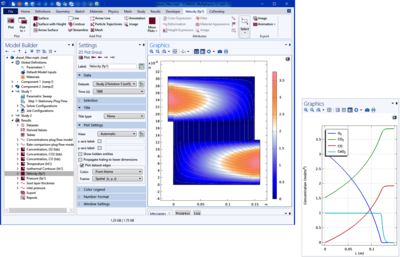
In this tutorial, a filter system for a diesel engine is modeled, including a soot layer development and oxidization. The build-up of the layer is held in check by both catalytic and non-catalytic reactions, where carbon is oxidized to carbon monoxide and carbon dioxide, which in turn ... Mehr lesen
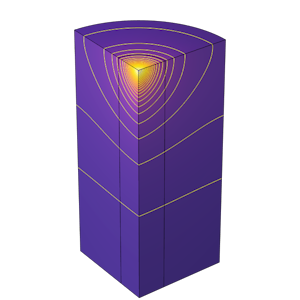
This tutorial shows how to use the Radiative Beam in Absorbing Media interface (Heat Transfer Module) to model the attenuation of a laser light going through a sample of silica glass, and the heat source generated by the absorption. Mehr lesen
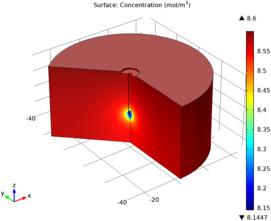
This tutorial example serves as an introduction to the Corrosion Module and models the metal oxidation and oxygen reduction current densities on the surface of a galvanized nail, surrounded by a piece of wet wood, which acts as electrolyte. The protecting zinc layer on the nail is not ... Mehr lesen
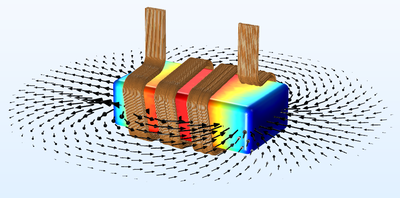
A demo model of a 50 Hz AC coil wound around a ferromagnetic (linear) core. The model is intended as a tutorial to show how to create a relatively complex geometry and set up the new Multi-Turn Coil features for the simulation. The model requires the Design module to fillet the edges of ... Mehr lesen
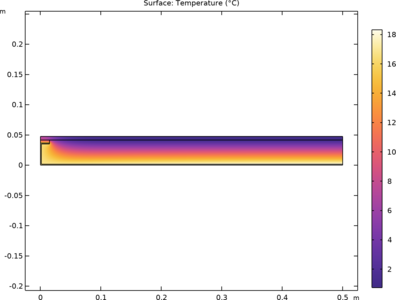
This example studies heat transfer in a composite two-dimensional structure. Four materials with distinct thermal conductivities k compose the structure. The top and bottom boundaries are facing environments respectively at 0°C and 20°C. The temperature distribution and the heat flux ... Mehr lesen

Unwanted arcing can have serious adverse effects on electrical and electronic equipment and systems. To improve the understanding and prediction of arc dynamics, it is crucial to conduct multiphysics simulations of transient arc processes. This model features a 3D simulation of transient ... Mehr lesen

This model demonstrates the motion of a bicycle with a hands-free rider when given an initial forward velocity and perturbed with a lean about the forward axis. This is implemented through the Multibody Dynamics module in COMSOL. The wheels of the bicycle have been modelled assuming ... Mehr lesen


