
Die Application Gallery bietet COMSOL Multiphysics® Tutorial- und Demo-App-Dateien, die für die Bereiche Elektromagnetik, Strukturmechanik, Akustik, Strömung, Wärmetransport und Chemie relevant sind. Sie können diese Beispiele als Ausgangspunkt für Ihre eigene Simulationsarbeit verwenden, indem Sie das Tutorial-Modell oder die Demo-App-Datei und die dazugehörigen Anleitungen herunterladen.
Suchen Sie über die Schnellsuche nach Tutorials und Apps, die für Ihr Fachgebiet relevant sind. Beachten Sie, dass viele der hier vorgestellten Beispiele auch über die Application Libraries zugänglich sind, die in die COMSOL Multiphysics® Software integriert und über das Menü File verfügbar sind.

This example shows how to set up an ionic polymer-metal composite (IPMC) as an actuator for a robotic manta ray. Two IPCM beams are integrated into the fin and can be controlled independently. The chemomechanical effect is achieved with the Shrinkage and Swelling multiphysics ... Mehr lesen
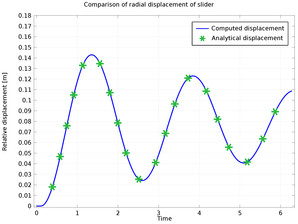
This model illustrates the modeling of slider motion caused by a base rotation. The motion of the slider is analyzed under various forces such as inertia force, centrifugal force, spring force and damping force. The prismatic joint, which is used to connect the two components, is spring ... Mehr lesen
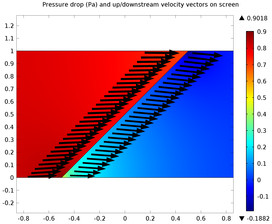
This model simulates the flow through a uniform inclined screen using the Screen feature in Single-Phase Flow physics and compares the results with an analytic solution. Mehr lesen

A demultiplexer is a device that directs different frequency bands to different outputs. In this tutorial model, we will design a demultiplexer by performing shape optimization on all initial circular boundaries in a sonic crystal (phononic crystal) configuration. The model uses shape ... Mehr lesen

In this example you will build and solve a 3D beam model using the 3D Beam interface. This model shows how a thermally induced deformation of a beam is modeled. Temperature differences are applied across the top and bottom surfaces as well as the left and right surfaces of the beam. ... Mehr lesen
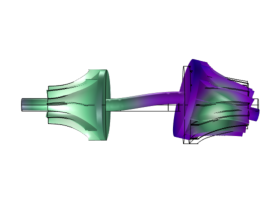
Cross-coupled forces present in a hydrodynamic bearing often act as a negative damping in a rotor. Near the critical speed, this may lead to uncontrolled vibration of the turbocharger causing a risk of bearing failure. In this example, the influence of the cross-coupling forces on the ... Mehr lesen

A journal bearing is composed of an outer cylinder (bearing) wrapped around an inner rotating journal (shaft), with a lubricant separating the two. Under certain operating conditions, cavitation can occur between the bearing and the journal, leading to component damage and failure. ... Mehr lesen

This example showcases a helical planetary gear train composed of a sun gear, ring gear, carrier, and five planet gears. Three cases are analyzed by in turn fixing the ring gear, sun gear, and carrier. For each configuration, a transient multibody analysis is performed to determine the ... Mehr lesen

Some conventional three-port power dividers are resistive power dividers and T-junction power dividers. Such dividers are either lossy or not matched to the system reference impedance at all ports. In addition, isolation between two coupled ports is not guaranteed. The Wilkinson power ... Mehr lesen
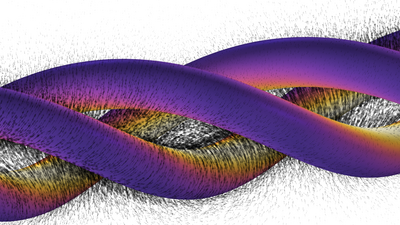
These models demonstrate various ways of exciting magnetic fields using the Magnetic Field Formulation interface in the AC/DC Module, an add-on to the COMSOL Multiphysics® software. To learn more about these models, see the accompanying blog post “Modeling of Excitations with ... Mehr lesen


