
Die Application Gallery bietet COMSOL Multiphysics® Tutorial- und Demo-App-Dateien, die für die Bereiche Elektromagnetik, Strukturmechanik, Akustik, Strömung, Wärmetransport und Chemie relevant sind. Sie können diese Beispiele als Ausgangspunkt für Ihre eigene Simulationsarbeit verwenden, indem Sie das Tutorial-Modell oder die Demo-App-Datei und die dazugehörigen Anleitungen herunterladen.
Suchen Sie über die Schnellsuche nach Tutorials und Apps, die für Ihr Fachgebiet relevant sind. Beachten Sie, dass viele der hier vorgestellten Beispiele auch über die Application Libraries zugänglich sind, die in die COMSOL Multiphysics® Software integriert und über das Menü File verfügbar sind.
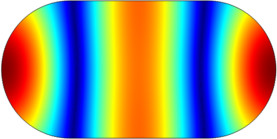
Berechnen Sie in diesem Modell die Ausbreitungsmoden in der Kammer eines Autoschalldämpfers. Die Geometrie ist ein Querschnitt der Kammer im Beispiel Absorptionsschalldämpfer. Der Zweck des Modells besteht darin, die Form der sich ausbreitenden Moden zu untersuchen und ihre ... Mehr lesen

The problem of a plane wave scattering off a cylinder-shaped object suggests the use of the 2D axisymmetric formulation. This can save computation time and reduce the memory usage compared to the model in 3D space. This example demonstrates the use of the built-in plane wave expansion ... Mehr lesen

This tutorial demonstrates how to model the interaction between an acoustic field and the heat release from a flame, using the Flame Model domain feature. Modeling this interaction is important in order to understand and predict unstable acoustic modes in gas turbines and jet engines. ... Mehr lesen

Model of the sound radiation from a circular duct with uniform flow. The convected acoustic problem is described using the linearized potential flow equations, solved in the frequency domain. The acoustic inlet is treated including higher order modes using the Port boundary condition and ... Mehr lesen

When high-fidelity measurement microphones are calibrated, a pressure reciprocity calibration method is used. During calibration, two microphones are connected at each end of a closed cylindrical cavity. For the calibration procedure, it is important to understand the acoustic field ... Mehr lesen
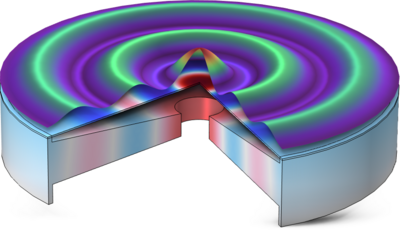
This example of a simple axisymmetric condenser microphone includes all the relevant physics and determines the microphone sensitivity as well as microphone capacitance for the specific simplified microphone geometry and material parameters. It solves a fully coupled multiphysics model ... Mehr lesen
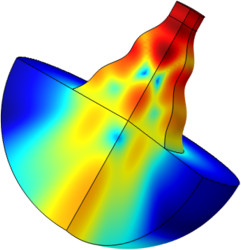
A plane-wave mode feeds an axisymmetric horn radiating from an infinite baffle toward an open half space. The radius of the waveguide attached to the horn throat is assumed to be fixed, as well as the depth of the horn and the size of the horn mouth attached to the baffle. By varying the ... Mehr lesen
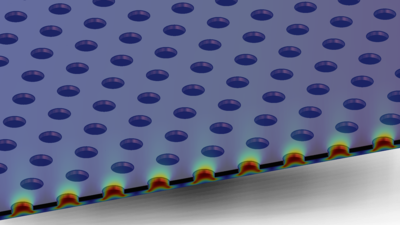
This tutorial model is of a micro perforated plate (also known as MPP) backed by a vibrating structure. This is a typical configuration in, for example, a MEMS microphone. The vibrating structure is not modeled explicitly, but just assigned a vibration velocity. The vibrating structure ... Mehr lesen
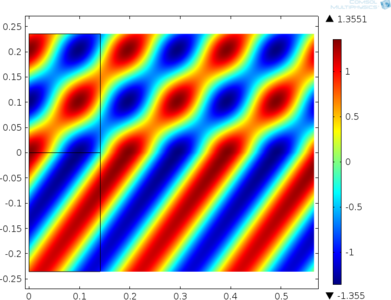
This model determines the reflection coefficient of plane acoustic waves, at different frequencies and at different angles of incidence, off a water-sediment interface. The ability of the Poroelasitc Waves interface to model the coupled acoustic and elastic wave in any porous substance ... Mehr lesen
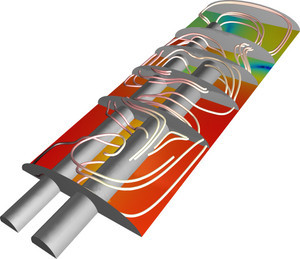
Reflective mufflers are best suited for the low-frequency range where only plane waves can propagate in the system, while dissipative mufflers with fibers are efficient in the mid- to high-frequency range. Dissipative mufflers based on flow losses, on the other hand, also work at low ... Mehr lesen


