
Die Application Gallery bietet COMSOL Multiphysics® Tutorial- und Demo-App-Dateien, die für die Bereiche Elektromagnetik, Strukturmechanik, Akustik, Strömung, Wärmetransport und Chemie relevant sind. Sie können diese Beispiele als Ausgangspunkt für Ihre eigene Simulationsarbeit verwenden, indem Sie das Tutorial-Modell oder die Demo-App-Datei und die dazugehörigen Anleitungen herunterladen.
Suchen Sie über die Schnellsuche nach Tutorials und Apps, die für Ihr Fachgebiet relevant sind. Beachten Sie, dass viele der hier vorgestellten Beispiele auch über die Application Libraries zugänglich sind, die in die COMSOL Multiphysics® Software integriert und über das Menü File verfügbar sind.

The Drift Diffusion interface solves a pair of reaction/advection/diffusion equations, one for the electron density and the other for the mean electron energy. This tutorial example computes the electron number density and mean electron energy in a drift tube. Electrons are released due ... Mehr lesen

This model showcases the broadband optimization for the Microstructured antireflective coatings that are modeled in the model (#99011). Following are the parameters that are optimized: Rectangular microstructure: Height and width of the rectangular microstructure. Pyramidal ... Mehr lesen
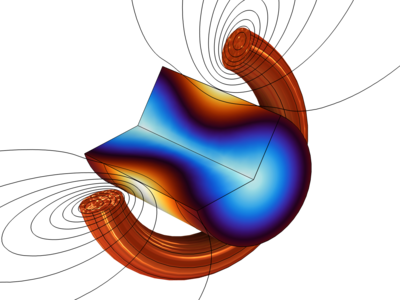
The eddy currents in a conductive cylinder, generated from currents passing through a surrounding coil, are studied. The skin effect in the coil is also studied. Mehr lesen
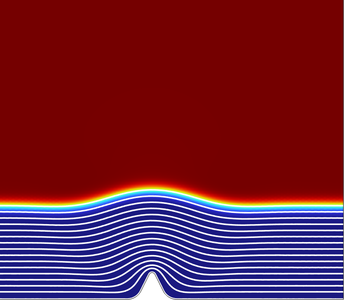
This example demonstrates how to couple the Lithium-ion Battery interface to the Phase Field interface for modeling electrode deformations. The example is based on the Lithium Plating with Deformation model, available in the Battery Design Module Application Library. As current is ... Mehr lesen

This model demonstrates two approaches to model the acoustics in a generic nacelle with an acoustic liner and a background flow. The first method uses the Compressible Potential Flow and the Linearized Potential Flow, Frequency Domain interfaces, while the second, more detailed approach, ... Mehr lesen

This model demonstrates how to use the Interior Contact feature to model the contact pressure at a bolted joint connecting two copper busbars. The AC current flowing through the assembly is induced to flow close to the outside boundaries of the conductors, but the contact resistance is ... Mehr lesen

This example model simulates the long-path echo of trumpet sounds reflected from a building 500 m away. The echo can only be heard at night because of the acoustic ray refraction in the atmosphere with different temperature profiles. The model is solved using the ray tracing in the ... Mehr lesen

This is a small 2D demonstration model that couples the Linearized Navier-Stokes, Frequency Domain, Solid Mechanics, and Turbulent Flow (k-epsilon) physics interfaces to model the vibrations of a plate located in a 2D viscous parallel plate flow. This type of model is used to model fluid ... Mehr lesen

This model simulates the propagation of a positive streamer in a weak electric field where the process of photoionization is essential to provide seed electrons at the front of the streamer head. The simulated electric field and electron density as a function of time agree well with that ... Mehr lesen

This model computes the fundamental eigenfrequency and eigenmode for a tuning fork that is synchronized from Inventor® via the LiveLink™ interface. The length of the fork is then optimized so that the tuning fork sounds the note A, 440 Hz. Mehr lesen


