
Die Application Gallery bietet COMSOL Multiphysics® Tutorial- und Demo-App-Dateien, die für die Bereiche Elektromagnetik, Strukturmechanik, Akustik, Strömung, Wärmetransport und Chemie relevant sind. Sie können diese Beispiele als Ausgangspunkt für Ihre eigene Simulationsarbeit verwenden, indem Sie das Tutorial-Modell oder die Demo-App-Datei und die dazugehörigen Anleitungen herunterladen.
Suchen Sie über die Schnellsuche nach Tutorials und Apps, die für Ihr Fachgebiet relevant sind. Beachten Sie, dass viele der hier vorgestellten Beispiele auch über die Application Libraries zugänglich sind, die in die COMSOL Multiphysics® Software integriert und über das Menü File verfügbar sind.

Fluence rate is a key parameter for ultraviolet (UV) water purifier. It describes the amount of radiation that pathogens absorb and is then directly related to the disinfection level of the purifier. The aim of this example is to demonstrate the fluence rate calculation with the ... Mehr lesen

These models demonstrate the implementation of a Helmholtz filter to: Smooth noisy input data to a transient simulation Smooth spatially varying data over an arbitrary surface Generate a mesh that is adapted to the spatial variation of an input load Learn more in the accompanying ... Mehr lesen

In this example, the etching of silicon in a CF4/O2 plasma reactor is studied using a global model. Parametric sweeps for ion energy and oxygen mole fraction are computed. Mehr lesen

When estimating the parameters of a multiphysics model, both experimental noise and modeling uncertainties will contribute to corresponding uncertainties in the final parameters estimated. In this verification example, we demonstrate the new Variance functionality in the Parameter ... Mehr lesen

This example shows how to model Lithium diffusion in a silicon electrode that swells. The model shows how swelling-induced plastic deformation can increase the maximum state of charge (SOC). Mehr lesen

The purpose of this model is to introduce the specular reflection in Surface-to-Surface Radiation using the ray-shooting algorithm. Different parameters are available to the user to yield better accuracy in the results when using the ray-shooting algorithm. The model is a standard ... Mehr lesen
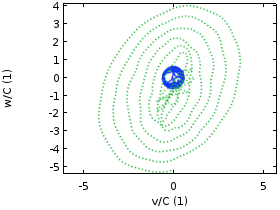
Bearing clearances should be kept minimum to avoid non-synchronous vibration of a rotor. However, a tight clearance reduces the durability of the bearing. This example illustrates modeling of the vibration induced by nonlinear contact for different radial clearances. It is shown that ... Mehr lesen

Radial magnetic coupling between two permanent magnet rotors is modeled using the Rotating Machinery, Magnetic interface. The permanent magnets in the inner and the outer rotors are outward flux-focused and inward flux-focused to maximize the coupling torque. Mehr lesen

This example illustrates the modeling of a tensegrity table. The table is made of two rigid bodies connected through a central wire and four outer wires. Two cases are analyzed. In the first case, the top of the table is loaded with vertically downward acting load of varying magnitude. ... Mehr lesen
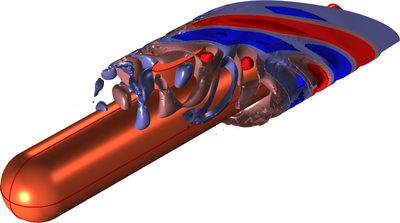
This model analyzes the scattering of a plane propagating modulated Gaussian pulse off a submarine hull. The scattered field and the spatial response are also determined. The model uses the Pressure Acoustics, Time Explicit interface to model this large acoustic model in the time domain. ... Mehr lesen


