
Die Application Gallery bietet COMSOL Multiphysics® Tutorial- und Demo-App-Dateien, die für die Bereiche Elektromagnetik, Strukturmechanik, Akustik, Strömung, Wärmetransport und Chemie relevant sind. Sie können diese Beispiele als Ausgangspunkt für Ihre eigene Simulationsarbeit verwenden, indem Sie das Tutorial-Modell oder die Demo-App-Datei und die dazugehörigen Anleitungen herunterladen.
Suchen Sie über die Schnellsuche nach Tutorials und Apps, die für Ihr Fachgebiet relevant sind. Beachten Sie, dass viele der hier vorgestellten Beispiele auch über die Application Libraries zugänglich sind, die in die COMSOL Multiphysics® Software integriert und über das Menü File verfügbar sind.
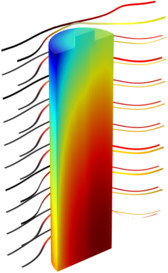
Dieses Beispiel simuliert das Wärmeprofil in einem luftgekühlten zylindrischen Akku in 3D. Der Akku befindet sich in einer Matrix in einem Akkupack. Das thermische Modell ist mit einem 1D- Akkumodell gekoppelt, das verwendet wird, um eine Wärmequelle im aktiven Akkumaterial zu erzeugen. Mehr lesen
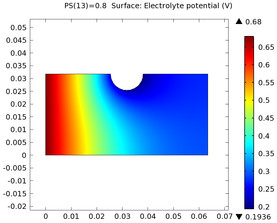
This example models cathodic protection of a steel reinforcing bar in concrete. Three different electrochemical reactions are considered on the steel surface. Charge and oxygen transport are modeled in the concrete domain, where the electrolyte conductivity and oxygen diffusivity depend ... Mehr lesen
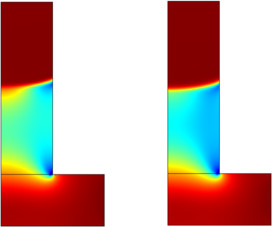
In diesem Beispiel wird ein schmaler vertikaler Zylinder untersucht, der auf einem mit Wasser gefüllten Reservoir steht. Aufgrund der Wandhaftung und der Oberflächenspannung an der Luft/Wasser-Grenzfläche steigt das Wasser durch den Kanal auf. Oberflächenspannung und Wandadhäsionskräfte ... Mehr lesen
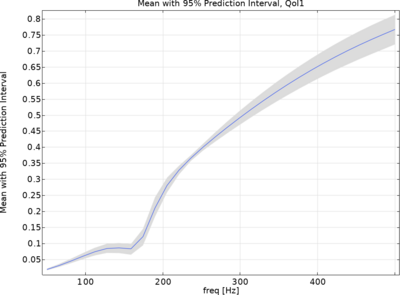
It can in many cases be difficult to get accurate material properties for porous materials. Measuring the properties to high precision can involve lengthy measurements using different techniques. It can therefore be interesting to understand how uncertainties in different material ... Mehr lesen
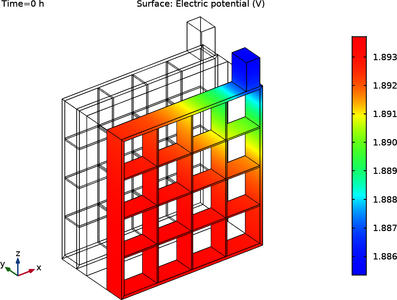
This 3D model example demonstrates the use of the Lead-Acid Battery interface for modeling current distribution in full cell employing a lead-acid battery chemistry. The lead acid battery chemistry uses PbO2 as the positive porous electrode and Pb as the negative porous electrode and ... Mehr lesen
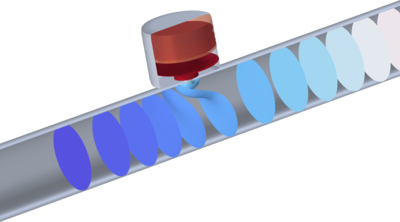
This tutorial model shows a system consisting of a Helmholtz resonator on the side of a main duct. The resonator volume is partly filled with a porous material. The model computes the reflection, transmission, and absorption of the system. Thermoviscous losses are included in the model ... Mehr lesen
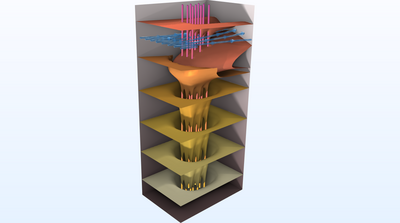
This model shows how to compute an array of borehole heat exchangers (BHEs) for shallow geothermal energy production. The BHEs are simplified as line heat sinks with a uniform heat extraction rate. The array is embedded into a layered subsurface model with groundwater flow in one of the ... Mehr lesen
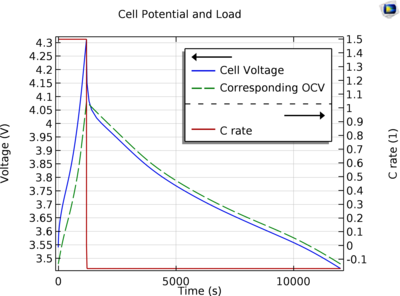
This app can be used as a design tool to develop an optimized battery configuration for a specific application. The application computes the capacity, energy efficiency, heat generation, and capacity losses due to parasitic reactions of a battery for a specific load cycle. Various ... Mehr lesen
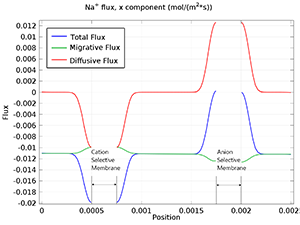
Electrodialysis is a separation process for electrolytes based on the use of electric fields and ion selective membranes. Some common applications of the electrodialysis process are: Desalination of process streams, effluents, and drinking water pH regulation in order to remove acids ... Mehr lesen

This example compares moisture transport within two types of anisotropic porous medium. The first component defines a layered structure. The structure alternates between layers with high and low moisture diffusivity. So the moisture spreads more easily along the layers than transversely. ... Mehr lesen


