
Die Application Gallery bietet COMSOL Multiphysics® Tutorial- und Demo-App-Dateien, die für die Bereiche Elektromagnetik, Strukturmechanik, Akustik, Strömung, Wärmetransport und Chemie relevant sind. Sie können diese Beispiele als Ausgangspunkt für Ihre eigene Simulationsarbeit verwenden, indem Sie das Tutorial-Modell oder die Demo-App-Datei und die dazugehörigen Anleitungen herunterladen.
Suchen Sie über die Schnellsuche nach Tutorials und Apps, die für Ihr Fachgebiet relevant sind. Beachten Sie, dass viele der hier vorgestellten Beispiele auch über die Application Libraries zugänglich sind, die in die COMSOL Multiphysics® Software integriert und über das Menü File verfügbar sind.

This example demonstrates an app that utilizes the LiveLink™ interface for Solid Edge® to run simulations on CAD designs. Mehr lesen
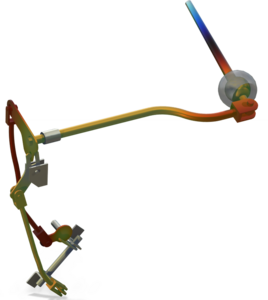
This model demonstrates the ability to simulate Multibody Dynamics in COMSOL. It comprises a multilink mechanism that is used in an antique automobile as a gearshift lever. It was created out of curiosity to find out how large forces are on the individual components. The model uses ... Mehr lesen

Modeling and simulation is useful for evaluating the feasibility of storing hydrogen underground. In this example of a geological formation, hydrogen is injected through an injection well at a rate of 1 kg/s over a period of 2 years, until it is ready to be extracted and discharged ... Mehr lesen
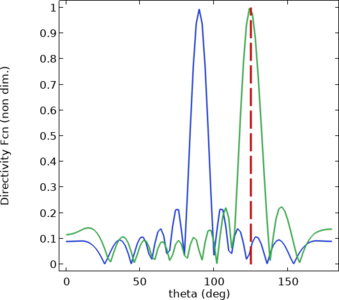
A line array of eleven spherical hydrophones embedded in a neoprene coating is modeled in 3D. The sensitivity of the array is analyzed with regard to varying angles of incidence of the background pressure field. The array directivity function is computed and compared to the analytical ... Mehr lesen
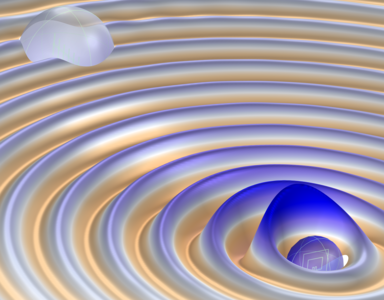
In this model, the transmitter (microstrip patch) and receiver (Yagi–Uda) antennas are modeled simultaneously in the FEM domain and are coupled with FEM–BEM coupling. The results are compared with the analytical Friis transmission formula. In detail, the emw and emw2 interfaces find out ... Mehr lesen
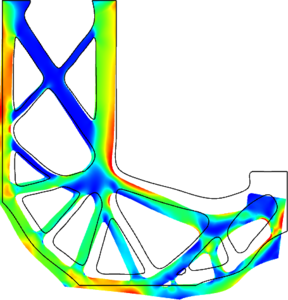
This model demonstrates 2D topology optimization for the problem of minimum mass subject to a compliance constraint and a stress constraint. The stress constraint is implemented with a P-norm global aggregation function. The stress input to this is interpolated differently than the Young ... Mehr lesen

This model demonstrates dielectric barrier discharge (DBD) in air subjected to an AC applied voltage. As the voltage amplitude increases, the discharge intensity correspondingly strengthens. Furthermore, the dominant component of the discharge current transitions from displacement ... Mehr lesen

A gray body with a spherical cavity with various opening areas is simulated using the Heat Transfer, Surface-to-Surface Radiation interface. The emissivity for each case is computed and compared with the classical gray body theory. The COMSOL Multiphysics® result agrees very ... Mehr lesen
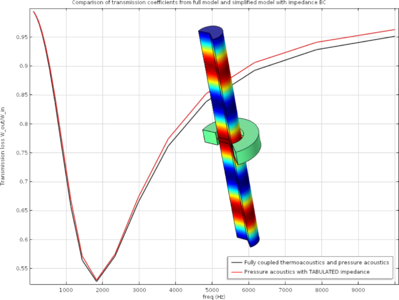
This application illustrates a modeling approach for deriving physically consistent simplified models in the Acoustics Module. The approach consists of converting complex sub-components to an impedance boundary condition and otherwise using simple acoustics throughout the COMSOL model. ... Mehr lesen
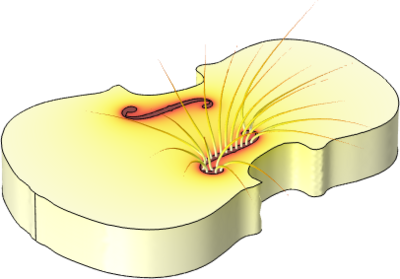
These models are featured in the blog post Analyze Violin Tone and Volume with Multiphysics Modeling. One applies acoustic-structure interaction to study how the air mode resonance is affected by the coupled vibrations in the violin body. The other uses a potential flow approximation to ... Mehr lesen


