
Die Application Gallery bietet COMSOL Multiphysics® Tutorial- und Demo-App-Dateien, die für die Bereiche Elektromagnetik, Strukturmechanik, Akustik, Strömung, Wärmetransport und Chemie relevant sind. Sie können diese Beispiele als Ausgangspunkt für Ihre eigene Simulationsarbeit verwenden, indem Sie das Tutorial-Modell oder die Demo-App-Datei und die dazugehörigen Anleitungen herunterladen.
Suchen Sie über die Schnellsuche nach Tutorials und Apps, die für Ihr Fachgebiet relevant sind. Beachten Sie, dass viele der hier vorgestellten Beispiele auch über die Application Libraries zugänglich sind, die in die COMSOL Multiphysics® Software integriert und über das Menü File verfügbar sind.
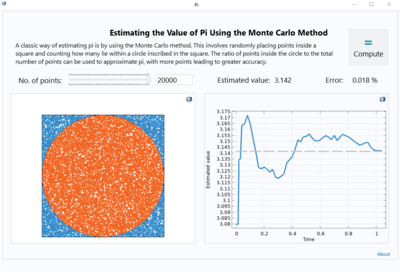
A classic way of estimating pi is by using the Monte Carlo method. This involves randomly placing points inside a square and counting how many lie within a circle inscribed in the square. The ratio of points inside the circle to the number of points in total can be used to approximate ... Mehr lesen

In this example, an CF4/O2 plasma reactor at low pressure is studied using a global model. Parametric sweeps for pressure and oxygen mole fraction are computed. Mehr lesen
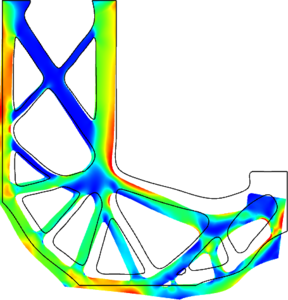
This model demonstrates 2D topology optimization for the problem of minimum mass subject to a compliance constraint and a stress constraint. The stress constraint is implemented with a P-norm global aggregation function. The stress input to this is interpolated differently than the Young ... Mehr lesen
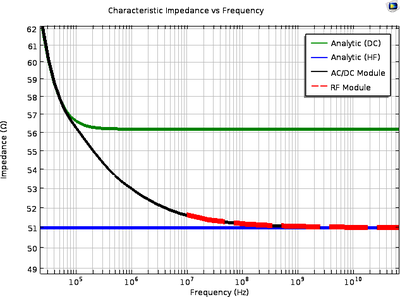
Electrical cables, also called transmission lines, are used everywhere in the modern world to transmit both power and data. These cables carry electromagnetic energy, but instead of dealing with the full complexity of the electromagnetic fields, they are more commonly classified ... Mehr lesen
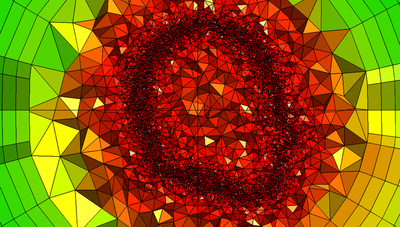
Creating irregular geometries can be a good solution, even the only option, for some types of applications. These files present a way to use a text file with material properties defined in coordinates to assign different materials even though there is only one regular domain. The same ... Mehr lesen

Usually limited to a specific region, corona discharges appear as a consistent luminosity. The attributes of steady glow corona discharges change depending on their polarity. Positive glow corona, also referred to as Hermstein's glow or ultra corona, presents a direct current (DC) aspect ... Mehr lesen
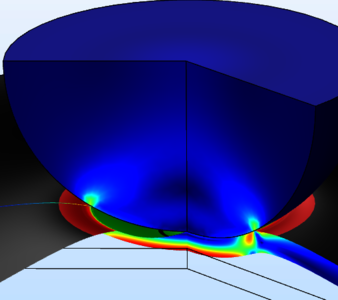
A steel ball is pressed down against a rubber membrane. When the contact pressure exceeds a certain value, the two parts start sticking together. When the ball is retracted, the membrane is pulled upwards in the bonded region. During the retraction, the bond is partially broken. This ... Mehr lesen

This model aims to demonstrate how a multilayer insulation can affect the temperature distribution of a satellite orbiting around the Earth. It is based on the Spacecraft Thermal Analysis model available in the Application Library. Mehr lesen

The dipole tonal noise generated by flow over a cylinder in free space is modeled using a two step hydrodynamic/acoustic splitting method. First, the unsteady hydrodynamic flow field is calculated using the incompressible Navier-Stokes equations. Second, the Linearized Perturbed ... Mehr lesen
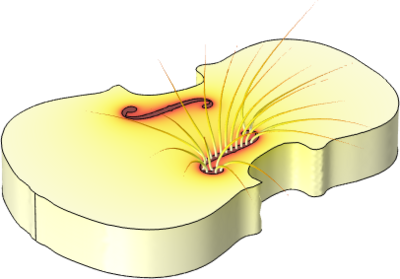
These models are featured in the blog post Analyze Violin Tone and Volume with Multiphysics Modeling. One applies acoustic-structure interaction to study how the air mode resonance is affected by the coupled vibrations in the violin body. The other uses a potential flow approximation to ... Mehr lesen


