
Die Application Gallery bietet COMSOL Multiphysics® Tutorial- und Demo-App-Dateien, die für die Bereiche Elektromagnetik, Strukturmechanik, Akustik, Strömung, Wärmetransport und Chemie relevant sind. Sie können diese Beispiele als Ausgangspunkt für Ihre eigene Simulationsarbeit verwenden, indem Sie das Tutorial-Modell oder die Demo-App-Datei und die dazugehörigen Anleitungen herunterladen.
Suchen Sie über die Schnellsuche nach Tutorials und Apps, die für Ihr Fachgebiet relevant sind. Beachten Sie, dass viele der hier vorgestellten Beispiele auch über die Application Libraries zugänglich sind, die in die COMSOL Multiphysics® Software integriert und über das Menü File verfügbar sind.
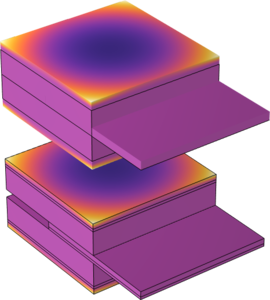
This tutorial model demonstrates the use of the multiphysics coupling feature Thermal Connection, Layered Shell, Surfaces. In this model, three layered shells are connected to heat domains by interior and exterior boundaries. The results obtained with the Heat Transfer in Shells ... Mehr lesen
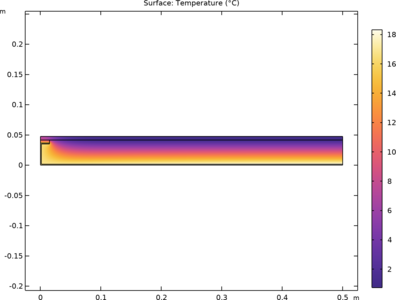
This example studies heat transfer in a composite two-dimensional structure. Four materials with distinct thermal conductivities k compose the structure. The top and bottom boundaries are facing environments respectively at 0°C and 20°C. The temperature distribution and the heat flux ... Mehr lesen
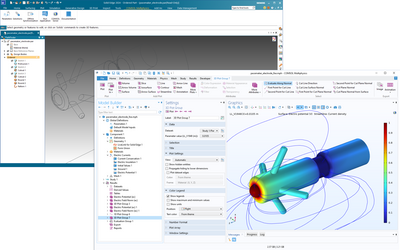
This model, dealing with the current and potential distribution around one pair of electrodes, demonstrates how to synchronize and modify geometry in Solid Edge® by using the LiveLink™ interface with a parametric sweep. Mehr lesen
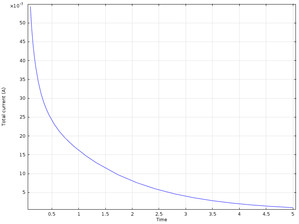
The common electroanalytical method of exhaustive amperometric detection in a microscopic thin layer is modelled as a 1D-symmetric diffusion problem. The simulated result agrees with the analytical Cottrell equation at short times, and deviates as expected at long times when the ... Mehr lesen

Combinations of optical devices such as polarizers and wave retarders can be used to control the intensity and polarization of transmitted radiation. In this tutorial, two linear polarizers with orthogonal transmission axes are used to reduce the intensity of a ray to zero. Then the ... Mehr lesen
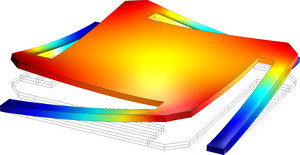
One method of creating spring-like structures or inducing curvature in thin structures is to plate them to substrates that are under the influence of residual stresses. The plating process can control this stress even for similar materials. One such device is the electrostatically ... Mehr lesen
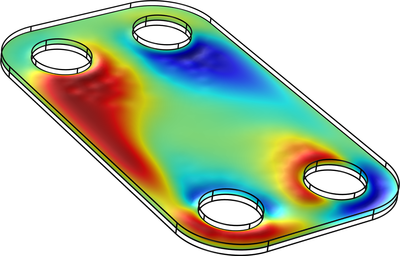
This model demonstrates how to use the built-in shape optimization functionality to improve the performance of a plate heat exchanger. The optimization reduces the path immediately in front of the inlets and outlets to increase the length of typical streamlines. This leads to a improved ... Mehr lesen
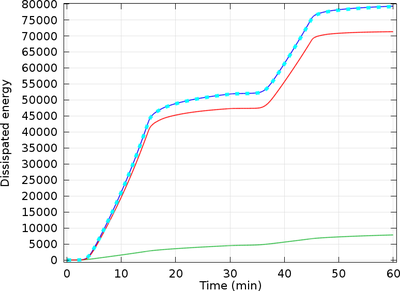
Fatigue testing of nonlinear materials with creep mechanism is a time-consuming process. In accelerated life testing the experiment time is greatly reduced by subjecting the material to testing conditions in excess of the operating one. In the model an aggressive thermal load cycle is ... Mehr lesen


