
Die Application Gallery bietet COMSOL Multiphysics® Tutorial- und Demo-App-Dateien, die für die Bereiche Elektromagnetik, Strukturmechanik, Akustik, Strömung, Wärmetransport und Chemie relevant sind. Sie können diese Beispiele als Ausgangspunkt für Ihre eigene Simulationsarbeit verwenden, indem Sie das Tutorial-Modell oder die Demo-App-Datei und die dazugehörigen Anleitungen herunterladen.
Suchen Sie über die Schnellsuche nach Tutorials und Apps, die für Ihr Fachgebiet relevant sind. Beachten Sie, dass viele der hier vorgestellten Beispiele auch über die Application Libraries zugänglich sind, die in die COMSOL Multiphysics® Software integriert und über das Menü File verfügbar sind.

This model demonstrates the filtration of grains of three different sizes as they pass through two vibrating sieves of different hole sizes. Mehr lesen
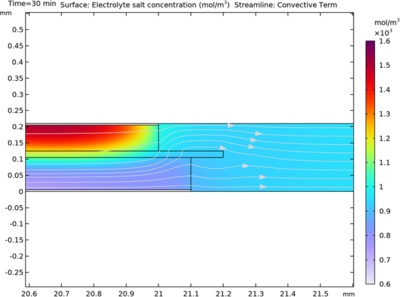
The electrodes of a lithium-ion battery are porous and consist of an active solid electrode material, a binder, and pores filled with a liquid electrolyte. Expansion of the active material due to lithium intercalation changes the volume fraction of electrolyte-filled pores in the ... Mehr lesen

This example model demonstrates four different approaches for computing the integrals of fields over arbitrarily placed geometries that can be re-positioned without having to re-solve the model. This approach is also useful if you want to integrate the results of a model over different ... Mehr lesen

This model demonstrates how to use a space-time formulation to optimize a heating profile over time. Get an overview in the accompanying blog post Equation-Based Modeling with a Space-Time Discretization. Mehr lesen

The model remove details example v63.mph illustrates how to manually add the Remove Details operation and virtual operations to find and remove small details from a model geometry. In the model geometry cleanup example v63.mph, the automatic Geometry Cleanup added Remove Details ... Mehr lesen

This is a demo model to show how to model connections in a mechanical system using Multibody Dynamics interface. In this model, pantograph mechanism is modeled. The purpose of this mechanism is to produce an identical, either enlarged or miniaturized, copy of an existing drawing. Mehr lesen

In semiconductor manufacturing, vacuum chucks are used to rapidly and contamination-free adsorb and secure wafers before processes such as transfer, lithography, and inspection. Traditional empirical design makes it difficult to quantify the effects of groove shape, size, distribution, ... Mehr lesen

This example of a plasmonic waveguide filter shows that the waveguide rejects the electromagnetic radiation of the wavelength between 1.4 um and 1.6 um, but allows the rest of the wavelength. The silver material can be modeled using the Drude-Lorentz approximation, with ε∞ = 3.7, ωp = 13 ... Mehr lesen

This model demonstrates how to solve an ordinary differential equation for the motion of a spacecraft about a planet. In addition to computing the path, it is possible to use several results presentation features to make interesting visualizations. For a full description of this model, ... Mehr lesen
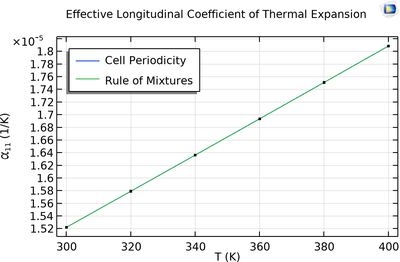
The homogenized material properties of a composite are computed based on the temperature-dependent properties of matrix and fiber. The homogenized parameters are compared to the analytical values derived from the rule of mixtures. This is an extension of model https://www.comsol.com ... Mehr lesen


