
Die Application Gallery bietet COMSOL Multiphysics® Tutorial- und Demo-App-Dateien, die für die Bereiche Elektromagnetik, Strukturmechanik, Akustik, Strömung, Wärmetransport und Chemie relevant sind. Sie können diese Beispiele als Ausgangspunkt für Ihre eigene Simulationsarbeit verwenden, indem Sie das Tutorial-Modell oder die Demo-App-Datei und die dazugehörigen Anleitungen herunterladen.
Suchen Sie über die Schnellsuche nach Tutorials und Apps, die für Ihr Fachgebiet relevant sind. Beachten Sie, dass viele der hier vorgestellten Beispiele auch über die Application Libraries zugänglich sind, die in die COMSOL Multiphysics® Software integriert und über das Menü File verfügbar sind.
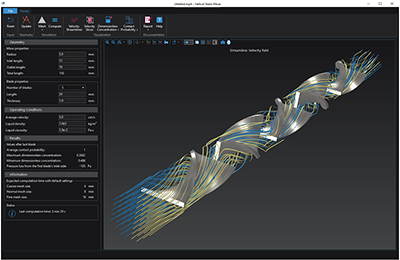
This app demonstrates the following: Geometry parts and parametric geometries Dark theme Use of subwindows Material appearance visualization with environment reflections Report generation for both Microsoft® Word and Microsoft® PowerPoint Options for setting different mesh sizes ... Mehr lesen

This is a tutorial model that demonstrates how to use mesh parameters such as Minimum element size Resolution of curvature Resolution of narrow regions Maximum element growth rate The instructions also detail how to access the mesh statistics and how to create a mesh plot. Mehr lesen
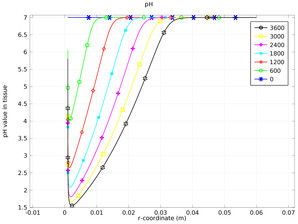
This model incorporates the transport and electrolytic reaction in the treatment of tumor tissue. Oxygen evolution at the anode produces protons, which lowers the pH, while chlorine production also leads to lowered pH through the hydrolysis of chlorine. One effect of a low pH is the ... Mehr lesen
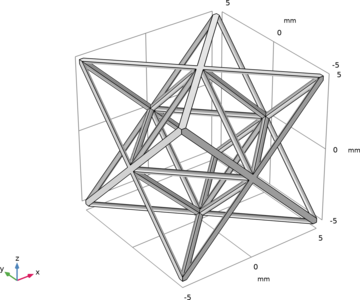
Lattice materials enable the creation of advanced additive manufacturing materials with customized mechanical properties. At the macroscopic level, these heterogeneous materials can be modeled as homogeneous materials. Homogenization techniques can accurately determine the material's ... Mehr lesen
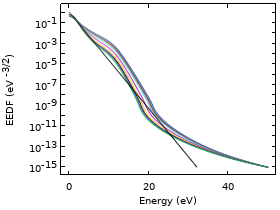
In this example, a hydrogen plasma reactor at moderate pressure is studied using a global model. The heavy species heat equation is included. In the first part of the study, a Maxwellian electron energy distribution function is used. In the second part, the global model is solved self ... Mehr lesen
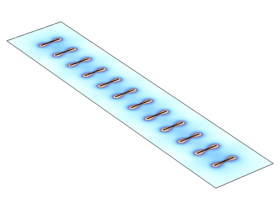
This example of a dipole antenna array demonstrates a cost-effective analysis using the Boundary Element Method (BEM). When dealing with a large array made of metallic radiators, the Finite Element Method (FEM) would necessitate greater computational resources. The simulation results ... Mehr lesen
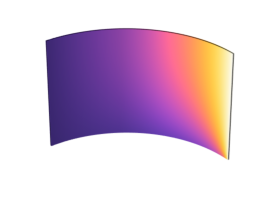
This model simulates a static analysis of heat conduction in a thin conductive shell. This is a benchmark model where the result is compared with a NAFEMS benchmark solution. Mehr lesen
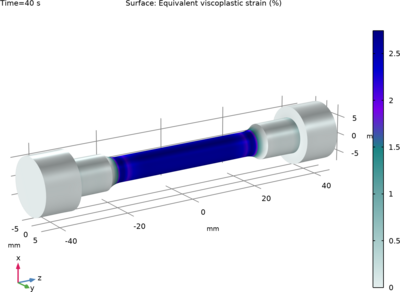
Most metals and alloys undergo viscoplastic deformation at high temperatures. In case of cyclic loading, a constitutive law with both isotropic and kinematic hardening is necessary to describe effects such as ratcheting, cyclic softening/hardening, and stress relaxation. The Lemaitre ... Mehr lesen
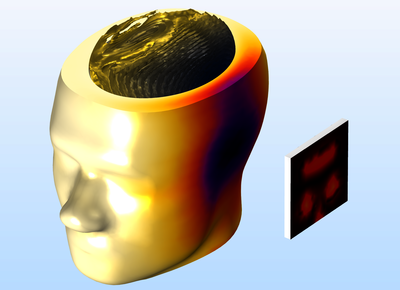
Users of consumer electronics with radiating devices are exposed to radio frequency (RF) emission. The amount of exposure is defined as the specific absorption rate (SAR). That is, the SAR value represents the radio frequency (RF) energy rate absorbed by a body. This model computes local ... Mehr lesen
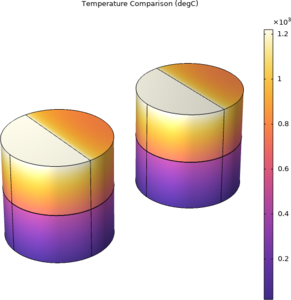
This example is a variant of the Composite Thermal Barrier tutorial and shows how to set up multiple sandwiched thin layers with different thermal conductivities in two different ways. First, the composite is modeled as a 3D object. In the second approach the Lumped Thermal System ... Mehr lesen


