
Die Application Gallery bietet COMSOL Multiphysics® Tutorial- und Demo-App-Dateien, die für die Bereiche Elektromagnetik, Strukturmechanik, Akustik, Strömung, Wärmetransport und Chemie relevant sind. Sie können diese Beispiele als Ausgangspunkt für Ihre eigene Simulationsarbeit verwenden, indem Sie das Tutorial-Modell oder die Demo-App-Datei und die dazugehörigen Anleitungen herunterladen.
Suchen Sie über die Schnellsuche nach Tutorials und Apps, die für Ihr Fachgebiet relevant sind. Beachten Sie, dass viele der hier vorgestellten Beispiele auch über die Application Libraries zugänglich sind, die in die COMSOL Multiphysics® Software integriert und über das Menü File verfügbar sind.

This example focuses on the species transport within the gas diffusion layers (GDLs) of a proton exchange membrane (PEM) fuel cell. The geometry models a cell with two adjacent flow channels of different pressures, a situation that may occur in a cell with serpentine flow channels, or in ... Mehr lesen
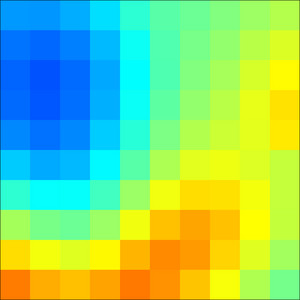
This model uses the Optimization interface to solve the inverse problem for determining the spatially variable hydraulic conductivity on a discretized quadratic grid from a number of aquifer pump tests. Because the number of observations is smaller than the number of unknown parameters, ... Mehr lesen
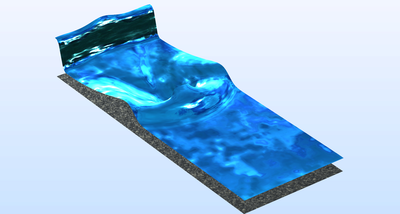
This example uses the Shallow Water equations to model the impact of a water wave on a column. A body of water with a height of 0.3 meters is initially contained behind a gate. At the start of the simulation, the gate is suddenly released and the body of water forms a wave moving toward ... Mehr lesen

This is a conceptual model illustrating how to couple fluid-structure interaction, heat transfer, and thermal expansion. A bimetallic strip in an air channel is heated so that it bends. After some time, an airflow with an inlet temperature which varies in time is introduced. As a ... Mehr lesen
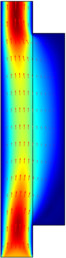
This is a tutorial model of the coupling between flow of a fluid in an open channel and a porous block attached to one of the channel walls. The flow is described by the Navier-Stokes equation in the free region and a Forchheimer-corrected version of the Brinkman equations in the porous ... Mehr lesen
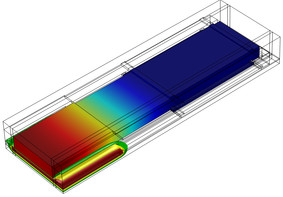
An electrostatically actuated MEMS resonator is simulated in the time and frequency domains. The device is driven by an AC + DC bias voltage applied across a parallel plate capacitor. The dependence of the resonant frequency on DC bias is assessed, and frequency domain and transient ... Mehr lesen
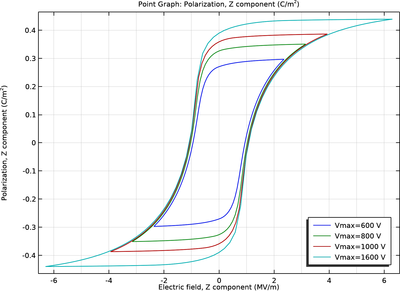
Ferroelectric materials exhibit nonlinear polarization behavior such as hysteresis and saturation at large applied electric fields. Many piezoelectric materials are ferroelectric. This model analyzes a simple actuator made of PZT piezoelectric ceramic material, which is subjected to ... Mehr lesen
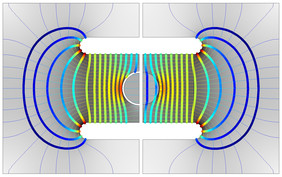
The thin low permittivity gap boundary condition is meant to approximate a thin layer of material with low relative permittivity compared to its surroundings. This boundary condition is available for electrostatic field modeling. This example compares the thin low permittivity gap ... Mehr lesen
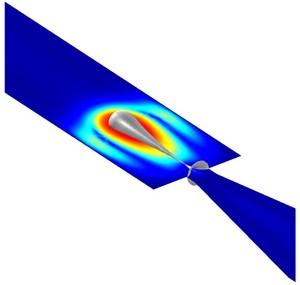
Obwohl sie ursprünglich für den Einsatz in Druckern erfunden wurden, sind Tintenstrahldüsen inzwischen auch in anderen Anwendungsbereichen wie den Biowissenschaften und der Mikroelektronik zu finden. Simulationen können nützlich sein, um das Verständnis der Strömung zu verbessern und das ... Mehr lesen
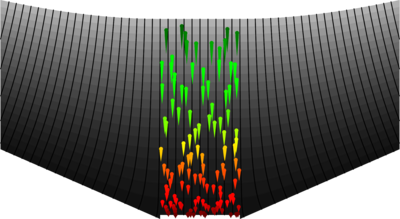
An electron gun must be able to draw a sufficient current and accelerate the electrons to the desired speed. The first part of an electron gun geometry presents unique design challenges because the emitted electron speeds are usually lowest there, and therefore the space charge density ... Mehr lesen


