
Die Application Gallery bietet COMSOL Multiphysics® Tutorial- und Demo-App-Dateien, die für die Bereiche Elektromagnetik, Strukturmechanik, Akustik, Strömung, Wärmetransport und Chemie relevant sind. Sie können diese Beispiele als Ausgangspunkt für Ihre eigene Simulationsarbeit verwenden, indem Sie das Tutorial-Modell oder die Demo-App-Datei und die dazugehörigen Anleitungen herunterladen.
Suchen Sie über die Schnellsuche nach Tutorials und Apps, die für Ihr Fachgebiet relevant sind. Beachten Sie, dass viele der hier vorgestellten Beispiele auch über die Application Libraries zugänglich sind, die in die COMSOL Multiphysics® Software integriert und über das Menü File verfügbar sind.
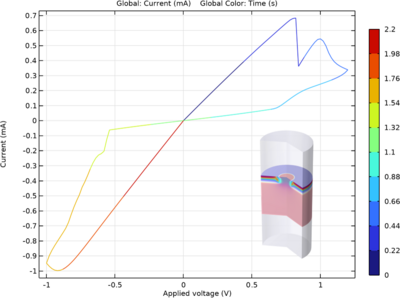
This model captures the dynamic resistive switching behavior of an oxide-based memristor. The device features a thin metal oxide layer sandwiched between two metal electrodes. When a voltage is applied, oxygen vacancies within the oxide layer migrate, acting as charge carriers and ... Mehr lesen
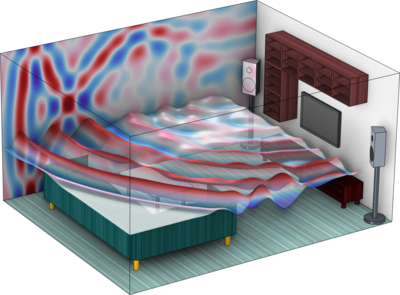
Die Verwendung von wellenbasierten Techniken für raumakustische Simulationen hat sich in den letzten Jahren aufgrund der Steigerung der Rechenleistung sowie der Entwicklung neuer numerischer Methoden verbreitet. Die Herausforderung, realistische Impedanzbedingungen an den Wänden zu ... Mehr lesen

Das folgende Modell untersucht die instationäre, inkompressible Strömung an einem langen Zylinder, der in einem Kanal im rechten Winkel zu dem entgegenkommenden Fluid steht. Der Zylinder ist etwas von der Mitte der Strömung versetzt, um die stationäre symmetrische Strömung instabil zu ... Mehr lesen
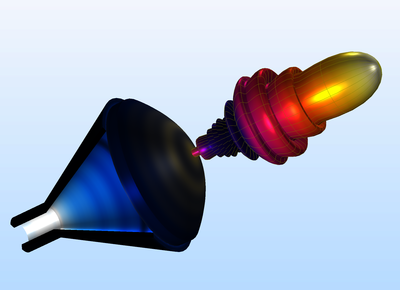
An axisymmetric 3D structure such as a conical horn antenna can be simulated in a fast and efficient way using only its 2D layout. In this model, the antenna radiation and matching characteristics are computed very quickly with respect to the dominant TE mode from the given circular ... Mehr lesen
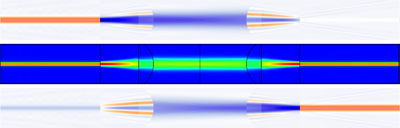
Focusing a laser beam onto the tip of a single mode fiber is a common way to couple light. To achieve good coupling efficiency, the spatial mode of the light field has to match the spatial mode of the fiber. In this model, we use the beam envelopes method to compute a small free-space ... Mehr lesen
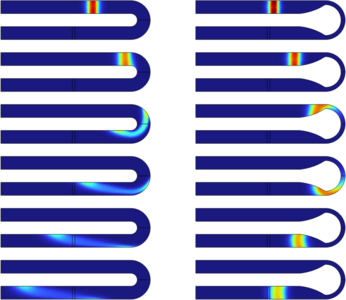
As an analyte band flows through a curved channel in an electroosmotically driven flow, dispersion of the band occurs due to gradients in the fluid velocity across the channel. These velocity gradients result from differences in the electric field acting at the walls within the curved ... Mehr lesen
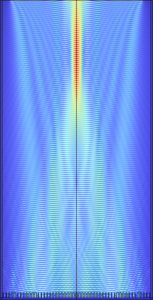
This is a simple yet powerful simulation app for designing a two-dimensional reflective metalens. This metalens consists of a array of glass nanopillars on a metal substrate. Initially, the app determines the optimal grating parameters for a specific wavelength and calculates the ... Mehr lesen
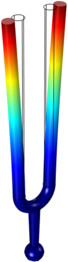
Wenn eine Stimmgabel angeschlagen wird, schwingt sie in einem komplexen Bewegungsmuster, das mathematisch als Überlagerung von Resonanzmoden, auch Eigenmoden genannt, beschrieben werden kann. Jede Mode ist mit einer bestimmten Eigenfrequenz verbunden. Die Stimmgabel erzeugt ihren ... Mehr lesen
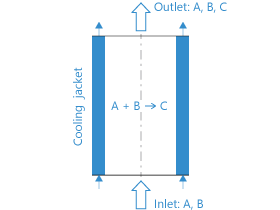
Diese App für einen Rohrreaktor und das dazugehörige eingebettete Modell zeigt, wie die Rechengeschwindigkeit durch die Verwendung eines Ersatzmodells im Gegensatz zu einem vollwertigen Finite-Elemente-Modell erhöht werden kann. Ein Ersatzmodell ist ein einfacheres, in der Regel ... Mehr lesen
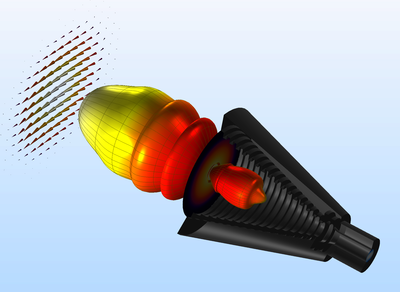
Corrugated circular aperture (conical) horn antennas are popularly used as feed horns for dish reflector antennas due to their low sidelobes and cross-polarization level. The excited TE mode from a circular waveguide passes along the corrugated inner surface of a circular horn antenna, ... Mehr lesen


