
Die Application Gallery bietet COMSOL Multiphysics® Tutorial- und Demo-App-Dateien, die für die Bereiche Elektromagnetik, Strukturmechanik, Akustik, Strömung, Wärmetransport und Chemie relevant sind. Sie können diese Beispiele als Ausgangspunkt für Ihre eigene Simulationsarbeit verwenden, indem Sie das Tutorial-Modell oder die Demo-App-Datei und die dazugehörigen Anleitungen herunterladen.
Suchen Sie über die Schnellsuche nach Tutorials und Apps, die für Ihr Fachgebiet relevant sind. Beachten Sie, dass viele der hier vorgestellten Beispiele auch über die Application Libraries zugänglich sind, die in die COMSOL Multiphysics® Software integriert und über das Menü File verfügbar sind.
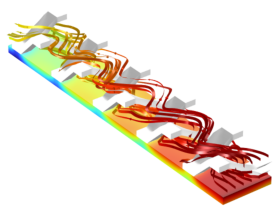
Dieses Tutorial modelliert die miteinander gekoppelten elektrochemischen Reaktionen, den Ladungs- und Speziestransport sowie den Wärmetransport in einer Polymer-Elektrolyt-Membran-Brennstoffzelle. Für die Gasströmungsfelder werden auf der Wasserstoffanodenseite gerade Kanäle verwendet, ... Mehr lesen

In diesem Modellbeispiel wird der Transport von Reaktanten und Wasser in einer Hochtemperatur-Polymerelektrolytmembran-Brennstoffzelle untersucht. Das Modell umfasst Stoff- und Impulstransportphänomene in den Strömungskanälen, Gasdiffusionsschichten (GDLs) und porösen Elektroden sowie ... Mehr lesen

In this model of an ammonia-fed solid oxide fuel cell, the required hydrogen is supplied through endothermic thermal decomposition of ammonia. The model includes the full coupling between the mass balances and gas flow in the H2 and O2 gas diffusion electrodes, the momentum balances in ... Mehr lesen
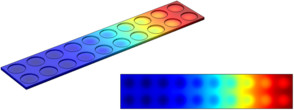
In small PEM fuel cell systems (in the sub-100 W range) no active devices for cooling or air transport are normally used. This is due to the desire to minimize parasitic power losses from pumps and fans, and to reduce the system complexity, size, and cost. The reactants at the cathode ... Mehr lesen
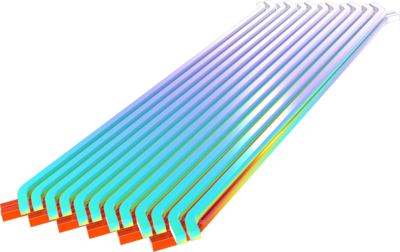
In a polymer electrolyte membrane fuel cell (PEMFC), water is produced at the cathode. The cell is also fed with water vapor via the inlet gas streams, in order to keep the polymer electrolyte membrane humidified. If the water partial pressure in the gas phase exceeds the vapor ... Mehr lesen
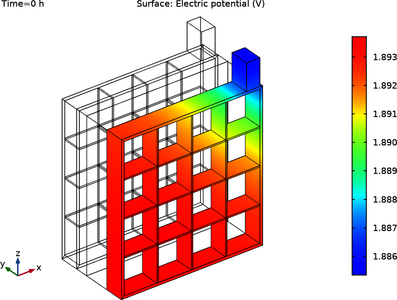
This 3D model example demonstrates the use of the Lead-Acid Battery interface for modeling current distribution in full cell employing a lead-acid battery chemistry. The lead acid battery chemistry uses PbO2 as the positive porous electrode and Pb as the negative porous electrode and ... Mehr lesen

This tutorial demonstrates how to use stationary polarization data to perform parameter estimation of a polymer electrolyte membrane fuel cell (PEMFC) model. The model, defining a 5-layer membrane electrode assembly (MEA) is two-dimensional and includes electronic and ionic charge ... Mehr lesen
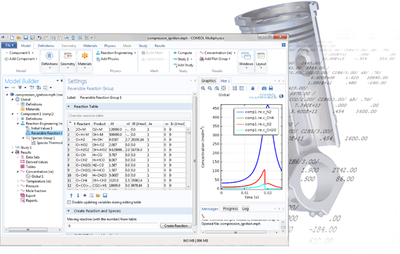
Homogeneous Charge Compression Ignition (HCCI) engines are being considered as an alternative to traditional spark- and compression-ignition engines. As the name implies, a homogeneous fuel/oxidant mixture is auto-ignited by compression with simultaneous combustion occurring throughout ... Mehr lesen
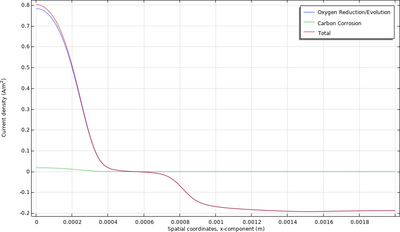
Carbon corrosion is one of the important degradation mechanisms in a Polymer Electrolyte Membrane (PEM) fuel cells which predominantly occurs during start-up or shut down of the fuel cells. During carbon corrosion, carbon support to catalysts is compromised affecting the cell ... Mehr lesen
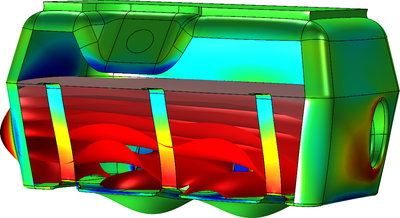
This model analyzes the frequency response of a fuel tank partially filled with fluid. The tank is submitted to a vertical acceleration. Two modeling methods are considered to represent the fluid: a traditional method of smearing the mass of the fluid through the wetted surface of the ... Mehr lesen


