
Die Application Gallery bietet COMSOL Multiphysics® Tutorial- und Demo-App-Dateien, die für die Bereiche Elektromagnetik, Strukturmechanik, Akustik, Strömung, Wärmetransport und Chemie relevant sind. Sie können diese Beispiele als Ausgangspunkt für Ihre eigene Simulationsarbeit verwenden, indem Sie das Tutorial-Modell oder die Demo-App-Datei und die dazugehörigen Anleitungen herunterladen.
Suchen Sie über die Schnellsuche nach Tutorials und Apps, die für Ihr Fachgebiet relevant sind. Beachten Sie, dass viele der hier vorgestellten Beispiele auch über die Application Libraries zugänglich sind, die in die COMSOL Multiphysics® Software integriert und über das Menü File verfügbar sind.
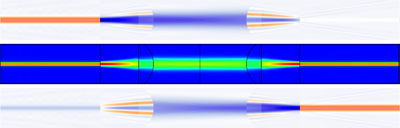
Focusing a laser beam onto the tip of a single mode fiber is a common way to couple light. To achieve good coupling efficiency, the spatial mode of the light field has to match the spatial mode of the fiber. In this model, we use the beam envelopes method to compute a small free-space ... Mehr lesen
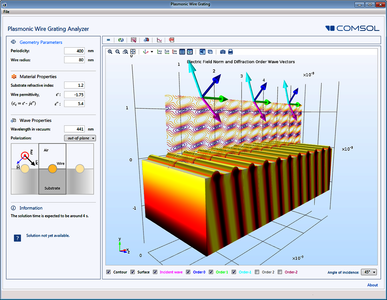
Auf Oberflächenplasmonen basierende Schaltungen werden in Anwendungen wie plasmonischen Chips, Lichterzeugung und Nanolithographie eingesetzt. Die App Plasmonisches Gitter berechnet die Koeffizienten der Brechung, der spiegelnden Reflexion und der Beugung erster Ordnung als Funktionen ... Mehr lesen
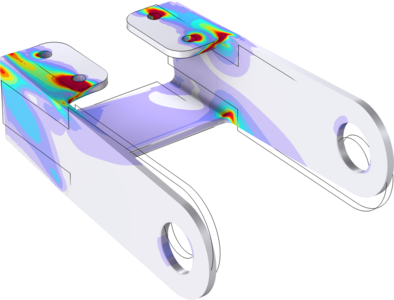
Die Halterungsmodelle dienen als Einführung in die strukturmechanische Modellierung mit dem Structural Mechanics Module. Folgende Features werden vorgestellt: Die Grundlagen: Statische lineare Analyse Parametrische Studie Einbeziehung der Anfangsdehnung Modellierung der thermischen ... Mehr lesen
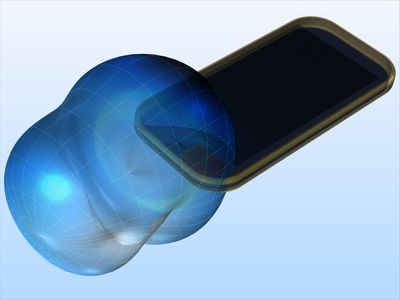
Electrical components in wireless communication systems are designed to be small and lightweight while maintaining decent performance and efficiency. Antennas are essential components in mobile devices and are required to fit in the limited space allowed by industrial specifications. To ... Mehr lesen
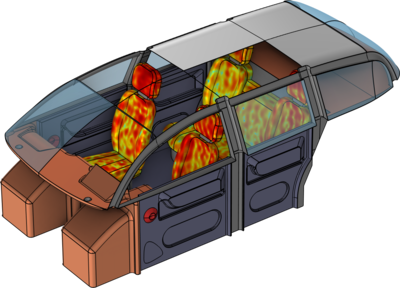
Dieses Tutorial zeigt die Analyse eines Fahrzeuginnenraums, um die Leistung eines Soundsystems im niedrigen bis mittleren Frequenzbereich zu untersuchen. Die Fahrzeugkabine ist eine typische Limousine, d.h. das Innere eines Familienautos mit festem Verdeck. Das Modell untersucht den ... Mehr lesen
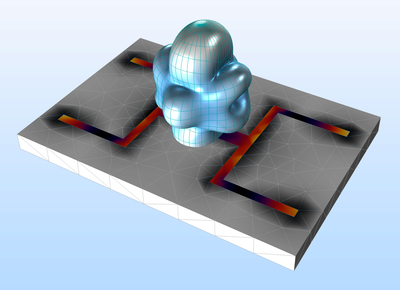
A wideband antenna study, such as an S-parameter or far-field pattern analysis, can be obtained by performing a transient response analysis and a time-to-frequency fast Fourier transform (FFT). This model runs a time dependent study first and then transforms the dependent variable, the ... Mehr lesen
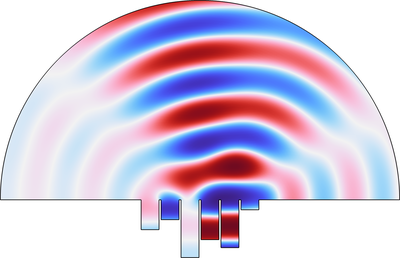
In this model, the scattering coefficient of a Schroeder diffuser is calculated. This coefficient can then be used as input to express boundary conditions in typical room acoustic simulations. The effect of periodicity is also investigated by studying the responses from different ... Mehr lesen
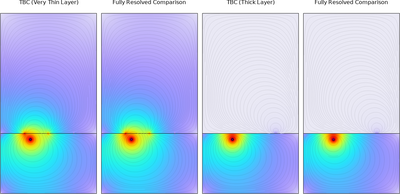
In electromagnetic simulations, such as transformers and converter stations, one often needs to include geometrically thin conductive layers. Explicitly meshing these thin layers can be computationally expensive and numerically challenging, especially when the layer thickness is much ... Mehr lesen
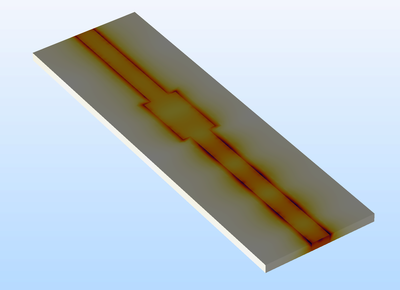
While transient analyses are useful for time domain reflectometry (TDR) to handle signal integrity (SI) problems, many RF and microwave examples are addressed using frequency domain simulations generating S-parameters. However, from the frequency domain data it is difficult to identify ... Mehr lesen

FSI-Analyse einer Sportwagen-Seitentür und eines Seitenrückspiegels. Das Modell basiert auf einer Large-Eddy-Simulationsanalyse eines Sportwagens. Das Strömungsfeld wird für eine Strukturanalyse des Seitenspiegels und der Seitentür verwendet, um die strömungsinduzierten Vibrationen ... Mehr lesen


