
Die Application Gallery bietet COMSOL Multiphysics® Tutorial- und Demo-App-Dateien, die für die Bereiche Elektromagnetik, Strukturmechanik, Akustik, Strömung, Wärmetransport und Chemie relevant sind. Sie können diese Beispiele als Ausgangspunkt für Ihre eigene Simulationsarbeit verwenden, indem Sie das Tutorial-Modell oder die Demo-App-Datei und die dazugehörigen Anleitungen herunterladen.
Suchen Sie über die Schnellsuche nach Tutorials und Apps, die für Ihr Fachgebiet relevant sind. Beachten Sie, dass viele der hier vorgestellten Beispiele auch über die Application Libraries zugänglich sind, die in die COMSOL Multiphysics® Software integriert und über das Menü File verfügbar sind.

This tutorial shows how to solve the full time-dependent wave equation in dispersive media such as plasmas and semiconductors. The 2D TM in-plane wave model solves for the vector potential from the wave equation and for an auxiliary electric polarization density from an ordinary ... Mehr lesen

Light Detection And Ranging (LIDAR) is used extensively in self-driving cars to perform the quantitative ranging of the surroundings obstacles. The LIDAR system consists of a laser beam which gets broadened using a MEMS mirror with a particular horizontal and vertical field of view ... Mehr lesen
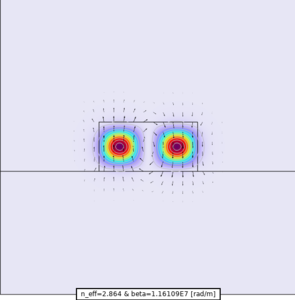
Die Modenanalyse ist ein grundlegendes Werkzeug für eine Vielzahl von Hochfrequenz- und Wellenoptikberechnungen, da sie die Untersuchung von Modeneigenschaften in komplexen Wellenleiterstrukturen ermöglicht. In diesem Tutorial-Modell finden Sie zwei Beispiele, die typische Einstellungen ... Mehr lesen
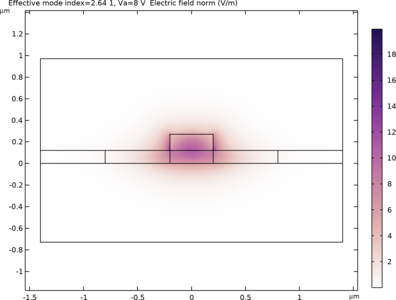
This tutorial demonstrates how to model a Silicon-on-Insulator (SoI) Modulator – a well-known optics device configuration that takes advantage of the free-carrier plasma dispersion effect and allows for the electrical control of the optical waveguide properties. The simulation couples ... Mehr lesen
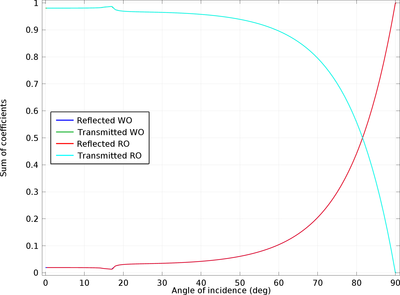
Dieses Modell verwendet das Wave Optics Module und das Ray Optics Module, um die Ausbreitung von Strahlen durch ein Beugungsgitter bei verschiedenen Einfallswinkeln zu modellieren. Es verwendet die S-Parameter, die mit dem Interface Electromagnetic Waves, Frequency Domain auf einer ... Mehr lesen
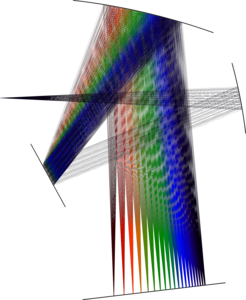
A Czerny-Turner monochromator spatially separates polychromatic light into a series of monochromatic rays. This model simulates a crossed Czerny-Turner configuration that consists of a spherical collimating mirror, a planar diffraction grating, a spherical imaging mirror, and an array ... Mehr lesen

Optical lenses of millimeter size cannot easily be analyzed with the Electromagnetic Waves, Frequency Domain interface on standard workstations due to the large number of finite element mesh elements required. This model explains how the Electromagnetic Waves, Beam Envelopes interface ... Mehr lesen
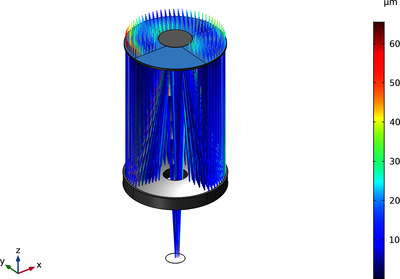
The Schmidt-Cassegrain Telescope demonstrated in this tutorial is a classic design using an aspheric corrector lens and two spherical mirrors. The aspheric corrector is created using the 'Aspheric Even Lens 3D' part from the Ray Optics part library. Mehr lesen
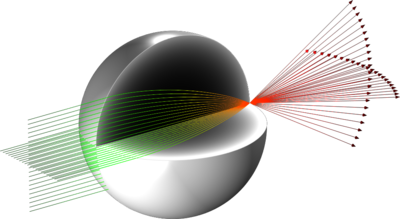
A Luneburg lens is a type of graded index, or GRIN lens, in which the gradient of the refractive index leads to special focusing properties. This example model uses the Geometrical Optics interface to compute the curved ray trajectories in the graded-index medium. Mehr lesen
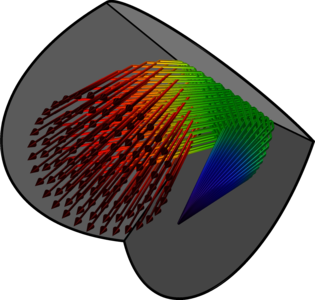
A corner cube retroreflector can be used to reflect rays in a direction exactly antiparallel to their initial direction, regardless of the angle of incidence. This tutorial shows how to simulate the reflection of a bundle of rays at a corner cube retroreflector using the Geometrical ... Mehr lesen


