
Die Application Gallery bietet COMSOL Multiphysics® Tutorial- und Demo-App-Dateien, die für die Bereiche Elektromagnetik, Strukturmechanik, Akustik, Strömung, Wärmetransport und Chemie relevant sind. Sie können diese Beispiele als Ausgangspunkt für Ihre eigene Simulationsarbeit verwenden, indem Sie das Tutorial-Modell oder die Demo-App-Datei und die dazugehörigen Anleitungen herunterladen.
Suchen Sie über die Schnellsuche nach Tutorials und Apps, die für Ihr Fachgebiet relevant sind. Beachten Sie, dass viele der hier vorgestellten Beispiele auch über die Application Libraries zugänglich sind, die in die COMSOL Multiphysics® Software integriert und über das Menü File verfügbar sind.
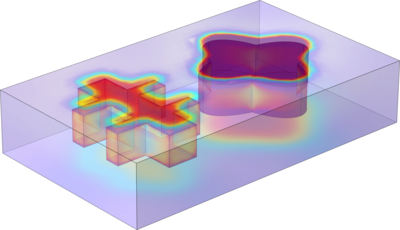
This example shows how to image the interior permittivity of a box by applying a potential difference on the boundaries of the box. The result is a surface charge density that depends on the permittivity of the medium inside the box. Read about this tutorial model in our blog post "The ... Mehr lesen
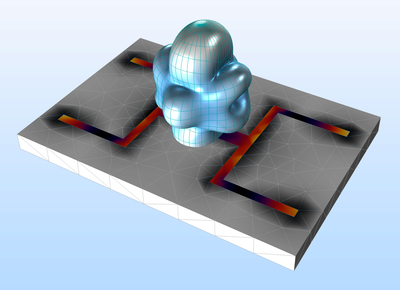
A wideband antenna study, such as an S-parameter or far-field pattern analysis, can be obtained by performing a transient response analysis and a time-to-frequency fast Fourier transform (FFT). This model runs a time dependent study first and then transforms the dependent variable, the ... Mehr lesen
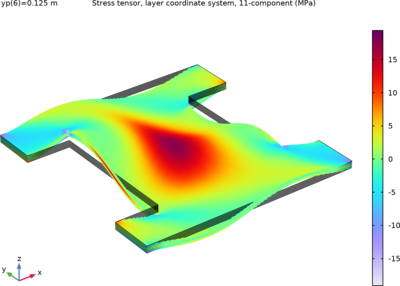
Composite materials are often used in structural applications because their properties, such as stiffness and strength, can be tailored to meet specific requirements. This makes them attractive alternatives to traditional engineering materials. Composites are also used in applications ... Mehr lesen
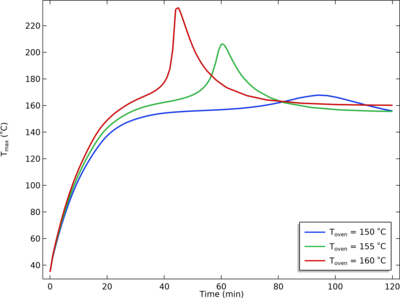
Dieses Beispiel simuliert die Temperaturdynamik in einer zylindrischen Batterie, die zunächst Raumtemperatur hat, nachdem sie in einen Ofen gestellt wurde. Mit steigender Temperatur werden verschiedene exotherme Zersetzungsreaktionen aktiviert, die wiederum zu einer weiteren Erwärmung ... Mehr lesen
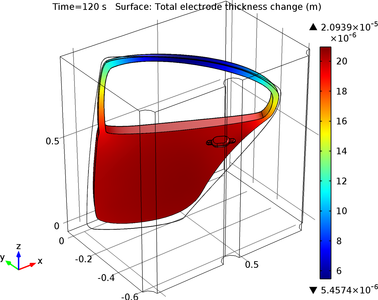
Dieses Beispiel modelliert die Elektrobeschichtung einer Autotür in einer zeitabhängigen Simulation. Die abgeschiedene Farbe hat einen hohen Widerstand, was zu geringeren lokalen Abscheidungsraten für beschichtete Bereiche führt. Zur Beschreibung des Ladungstransports im Elektrolyten ... Mehr lesen
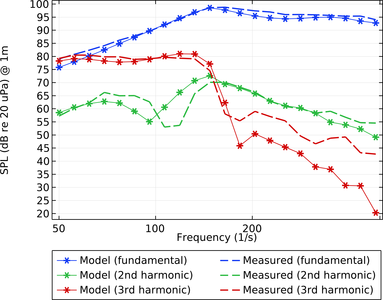
Ein Auto-Mitteltieftöner wird mit dem Lumped-Parameter-Ansatz modelliert. Die elektrischen und mechanischen Komponenten werden mit einem vereinfachten elektrischen Schaltkreis modelliert, der mit einem Finite-Elemente-Modell für die Akustik gekoppelt ist, das die Funktion Lumped Speaker ... Mehr lesen
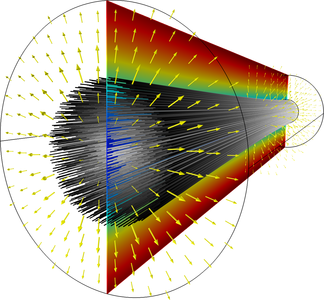
When modeling the propagation of charged particle beams at high currents, the space charge force generated by the beam significantly affects the trajectories of the charged particles. Perturbations to these trajectories, in turn, affect the space charge distribution. The Charged ... Mehr lesen
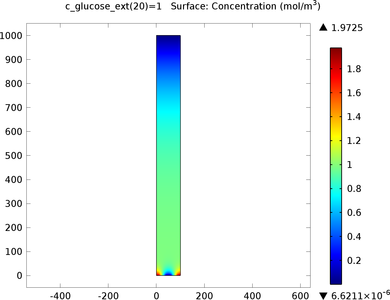
Electrochemical glucose sensors use amperometric methods to measure the concentration of glucose in a sample. This example models the diffusion of glucose and ferri/ferrocyanide redox mediators in a unit cell of electrolyte above an interdigitated electrode. The sensor gives a linear ... Mehr lesen
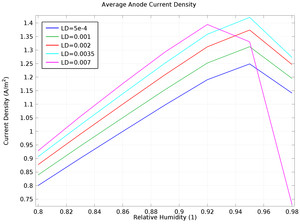
This model simulates atmospheric galvanic corrosion of an aluminum alloy in contact with steel. The electrolyte film thickness depends on the relative humidity of the surrounding air and the salt load density of NaCl crystals on the metal surface. Empirical expressions for the oxygen ... Mehr lesen
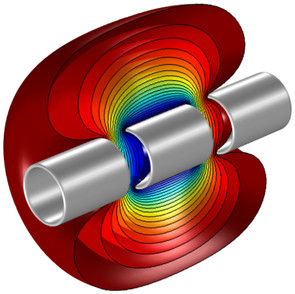
An Einzel lens is an electrostatic device used for focusing charged particle beams. It may be found in cathode ray tubes, ion beam and electron beam experiments, and ion propulsion systems. This particular model consists of three axially aligned cylinders. The outer cylinders are ... Mehr lesen


