
Die Application Gallery bietet COMSOL Multiphysics® Tutorial- und Demo-App-Dateien, die für die Bereiche Elektromagnetik, Strukturmechanik, Akustik, Strömung, Wärmetransport und Chemie relevant sind. Sie können diese Beispiele als Ausgangspunkt für Ihre eigene Simulationsarbeit verwenden, indem Sie das Tutorial-Modell oder die Demo-App-Datei und die dazugehörigen Anleitungen herunterladen.
Suchen Sie über die Schnellsuche nach Tutorials und Apps, die für Ihr Fachgebiet relevant sind. Beachten Sie, dass viele der hier vorgestellten Beispiele auch über die Application Libraries zugänglich sind, die in die COMSOL Multiphysics® Software integriert und über das Menü File verfügbar sind.

Die Ersatzmodell-App Thermischer Aktuator zeigt, wie Sie die Berechnung für Multiphysik-Analysen mithilfe eines Ersatzmodells beschleunigen können. Ein Ersatzmodell ist ein einfacheres, in der Regel rechnerisch günstigeres Modell, das zur Annäherung an das Verhalten eines komplexeren und ... Mehr lesen

This model shows how to model an electrolyte-gated organic field-effect transistor based on a general drift–diffusion model. The model uses the Transport of Charge Carriers interface and the Electrostatics interface. The transistor characteristics are visualized. Formation of the EDLs in ... Mehr lesen
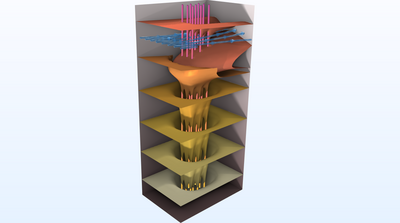
This model shows how to compute an array of borehole heat exchangers (BHEs) for shallow geothermal energy production. The BHEs are simplified as line heat sinks with a uniform heat extraction rate. The array is embedded into a layered subsurface model with groundwater flow in one of the ... Mehr lesen
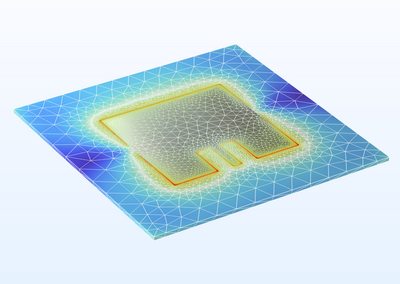
The model utilizes a dedicated mesh refinement study, Frequency Domain RF Adaptive Mesh, which dynamically refines the mesh in the region of interest. For the Application Library model Microstrip Patch Antenna, it increases the mesh resolution around areas with high field variations. The ... Mehr lesen
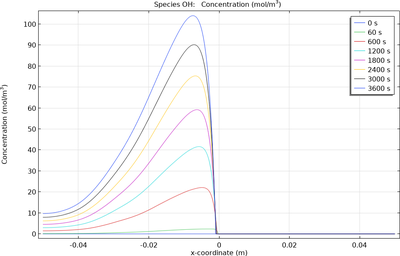
Atmospheric corrosion occurs when metallic structures are exposed to humid air forming a thin electrolyte film in the range of up to a few hundred micrometers. The model presented here accounts for charge transport as well mass transport involving 10 species and 6 homogeneous ... Mehr lesen
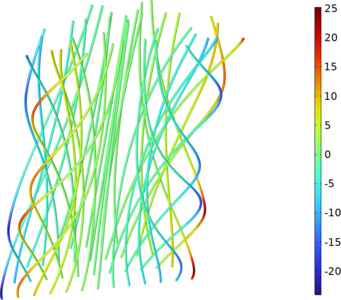
Turbulent flow, SSG-LRR interface is employed to investigate turbulent flow in a straight semicircular duct. The resulting flow pattern is characterized by slow secondary motions in the plane normal to the duct axis. The order of magnitude of velocity of those motions is 1% of the ... Mehr lesen
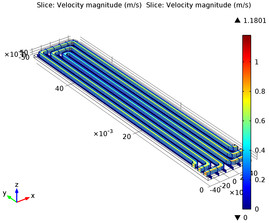
This example models the flow and mass transport in the channels and the gas diffusion layer (GDL) of a polymer electrolyte fuel cell. The cathode electrode reaction is modeled as a boundary condition, where the local current density depends on the overpotential and the local oxygen ... Mehr lesen
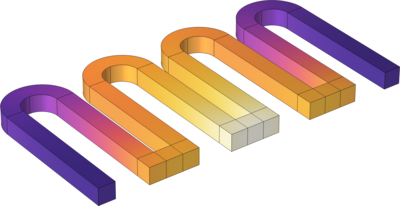
This model analyzes the thermal expansion in a MEMS device, such as a microgyroscope, where thermal expansion should be minimized. The device is made from the copper-beryllium alloy UNS C17500 and uses temperature-dependent material properties from the Material Library. The purpose of ... Mehr lesen
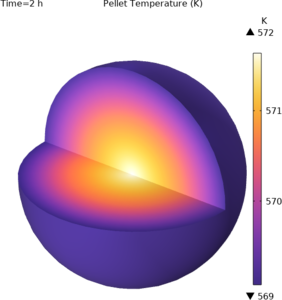
1D model of a thermal energy storage (TES) system consisting of a packed bed of pellets. Three approaches for heat transfer in porous media are compared: A one-equation local thermal equilibrium (LTE) model A two-equations local thermal nonequilibrium (LTNE) model A multiscale ... Mehr lesen
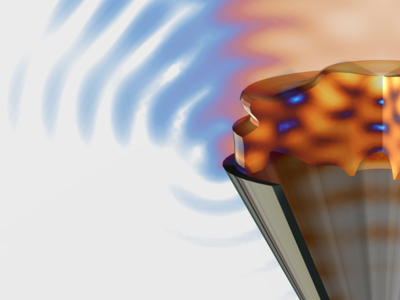
Manual design optimization typically requires numerous sweeps over a parameterized geometry, but it does not guarantee optimal performance under given conditions. Shape optimization removes the need for explicit parameterization and can achieve comparable or even better performance in a ... Mehr lesen


