
Die Application Gallery bietet COMSOL Multiphysics® Tutorial- und Demo-App-Dateien, die für die Bereiche Elektromagnetik, Strukturmechanik, Akustik, Strömung, Wärmetransport und Chemie relevant sind. Sie können diese Beispiele als Ausgangspunkt für Ihre eigene Simulationsarbeit verwenden, indem Sie das Tutorial-Modell oder die Demo-App-Datei und die dazugehörigen Anleitungen herunterladen.
Suchen Sie über die Schnellsuche nach Tutorials und Apps, die für Ihr Fachgebiet relevant sind. Beachten Sie, dass viele der hier vorgestellten Beispiele auch über die Application Libraries zugänglich sind, die in die COMSOL Multiphysics® Software integriert und über das Menü File verfügbar sind.
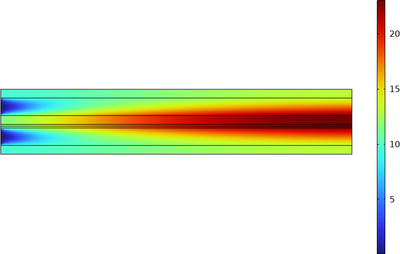
This example models co-electrolysis of H2O and CO2 using a solid oxide electrolyzer cell. The model includes the full coupling between the mass balances and gas flow in the H2 and O2 gas diffusion electrodes, the momentum balances in the H2 and O2 gas flow channels, the energy balance ... Mehr lesen
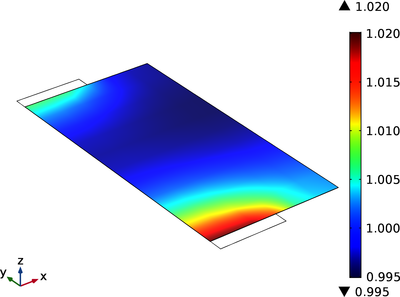
Große Lithium-Ionen-Akkus werden häufig in Elektrofahrzeugen und für stationäre Energiespeicheranwendungen eingesetzt. Beim Design der (gestapelten) Pouch-Akkuzellen verlässt der gesamte Strom die Zelle an den Zell-„Laschen“. Mit zunehmender Größe und Leistung der Zelle können die ... Mehr lesen
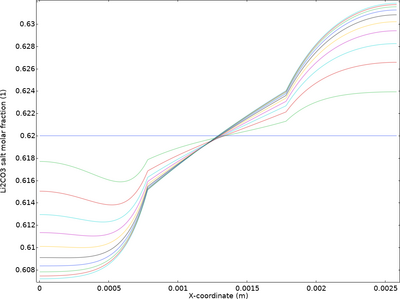
This tutorial shows how to model transport of the individual ions in a salt melt comprising two binary salts, where the transport equations are defined using concentrated solution theory. The example model defines a molten carbonate fuel cell (or electrolyzer), with a 1D-model geometry ... Mehr lesen

This example focuses on the species transport within the gas diffusion layers (GDLs) of a proton exchange membrane (PEM) fuel cell. The geometry models a cell with two adjacent flow channels of different pressures, a situation that may occur in a cell with serpentine flow channels, or in ... Mehr lesen
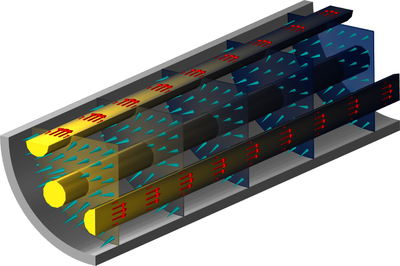
In Brennstoffzellen-Stromerzeugern wird der für den Zellstapel benötigte Wasserstoff in der Regel mit einem Dampfreformer erzeugt. Dieses Beispiel veranschaulicht die Modellierung eines Dampfreformers. Die chemische Reformierung findet in einem porösen Katalysatorbett statt, in dem ... Mehr lesen
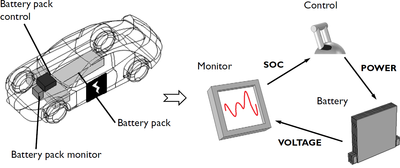
This is a template base model containing the physics, geometry and mesh of a lithium-ion battery, defined in 1D. The model makes use of four lithiation parameters which are used to define the relative balancing of the negative and positive electrodes, as well as global cell state of ... Mehr lesen
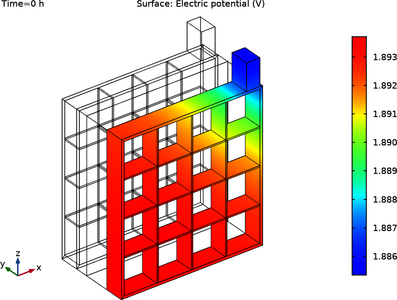
This 3D model example demonstrates the use of the Lead-Acid Battery interface for modeling current distribution in full cell employing a lead-acid battery chemistry. The lead acid battery chemistry uses PbO2 as the positive porous electrode and Pb as the negative porous electrode and ... Mehr lesen
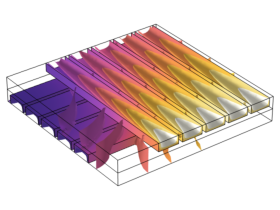
This model solves the fluid flow and heat transfer in a micro heat exchanger made of stainless steel. These types of heat exchangers are found in lab-on-chip devices in biotechnology and micro reactors, for example for micro fuel cells. The model takes heat transferred through both ... Mehr lesen
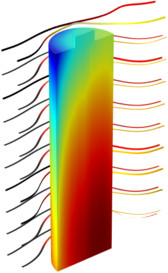
Dieses Beispiel simuliert das Wärmeprofil in einem luftgekühlten zylindrischen Akku in 3D. Der Akku befindet sich in einer Matrix in einem Akkupack. Das thermische Modell ist mit einem 1D- Akkumodell gekoppelt, das verwendet wird, um eine Wärmequelle im aktiven Akkumaterial zu erzeugen. Mehr lesen
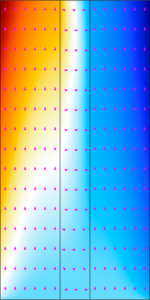
This tutorial demonstrates how to modify a concentration-independent (also known as a secondary current distribution) liquid alkaline water electrolyzer with concentrated electrolyte theory to explicitly resolve local electrolyte and solvent concentrations (thereby creating a tertiary ... Mehr lesen


