
Die Application Gallery bietet COMSOL Multiphysics® Tutorial- und Demo-App-Dateien, die für die Bereiche Elektromagnetik, Strukturmechanik, Akustik, Strömung, Wärmetransport und Chemie relevant sind. Sie können diese Beispiele als Ausgangspunkt für Ihre eigene Simulationsarbeit verwenden, indem Sie das Tutorial-Modell oder die Demo-App-Datei und die dazugehörigen Anleitungen herunterladen.
Suchen Sie über die Schnellsuche nach Tutorials und Apps, die für Ihr Fachgebiet relevant sind. Beachten Sie, dass viele der hier vorgestellten Beispiele auch über die Application Libraries zugänglich sind, die in die COMSOL Multiphysics® Software integriert und über das Menü File verfügbar sind.
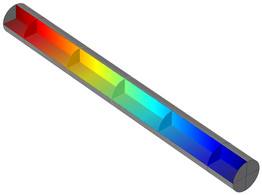
Jedes elektrische Gerät hat einen gewissen Widerstand. Das heißt, wenn eine Spannungsdifferenz zwischen zwei Anschlüssen des Geräts angelegt wird, fließt ein direkt proportionaler Strom. Dieses Modell zeigt, wie der Widerstand eines kurzen Kupferdrahtabschnitts berechnet werden kann. Die ... Mehr lesen
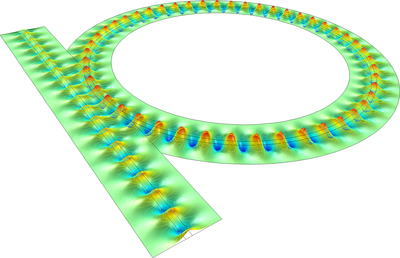
In seiner einfachsten Form besteht ein optischer Ringresonator aus einem geraden Wellenleiter und einem Ringwellenleiter. Die Wellenleiter sind nahe beieinander platziert, so dass das Licht jeweils auf die beiden Strukturen einwirkt. Wenn die Ausbreitungslänge um den Ring eine ganze ... Mehr lesen
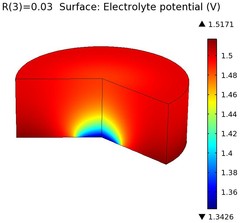
Magnesium alloys are attractive alternatives as lightweight materials in various fields of engineering. Magnesium is however relatively non-noble and may suffer considerable galvanic corrosion when being used in conjunction with other metals, for instance when mounting an Mg alloy ... Mehr lesen

This example shows how to use the Parameter Estimation and Experiment features in the Reaction Engineering interface for optimization with multiple experimental data input files. The application finds the Arrhenius parameters of a first order reaction where Benzene diazonium chloride ... Mehr lesen
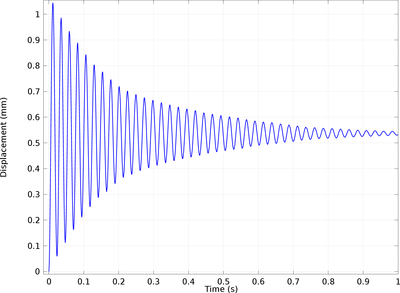
This model studies free and forced vibrations of a deep beam. The solution for eigenfrequency, frequency response and transient analysis are computed using a Timoshenko beam and compared with analytical results. Mehr lesen
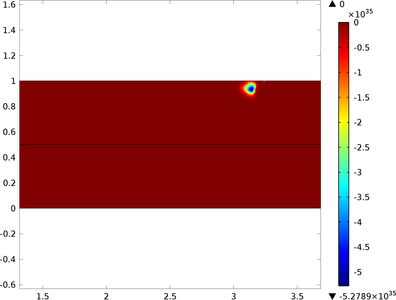
MOSFETs typically operate in three regimes depending on the drain-source voltage for a given gate voltage. Initially the current-voltage relation is linear, this is the Ohmic region. As the drain-source voltage increases the extracted current begins to saturate, this is the saturation ... Mehr lesen
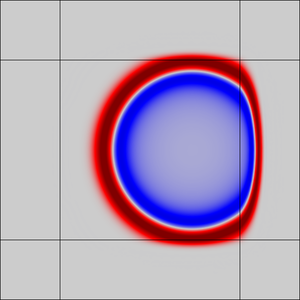
This tutorial simulates a standard test and benchmark model for nonreflecting conditions and sponge layers for linearized Euler-like systems. It involves the propagation of a transient Gaussian pulse in a 2D uniform flow. The Convected Wave Equation, Time Explicit interface solves the ... Mehr lesen
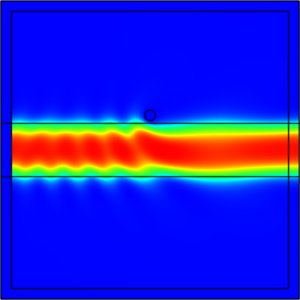
This model includes a dielectric slab waveguide with a small lossy metallic object nearby. The object causes light to be scattered, absorbed, and both reflected and transmitted along the waveguide. Learn more in this accompanying blog post: Modeling a Scatterer Near an Optical Waveguide Mehr lesen
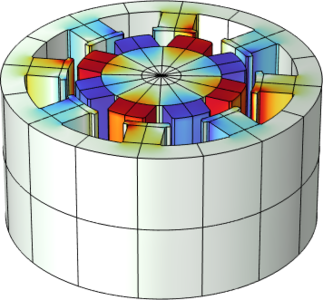
Diese App veranschaulicht, wie man eine elektrische Maschine wie einen Generator, Motor oder Antrieb modelliert, indem man die Sektorsymmetrie ausnutzt, um die Größe des Problems zu reduzieren. Die untersuchte Maschine ist ein vereinfachter elektrischer Generator in 3D, der auf der in ... Mehr lesen
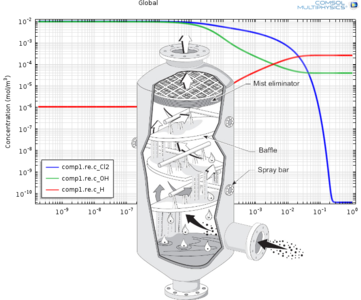
This example studies the kinetics of the neutralization of chlorine gas in water solution. The model assumes that the fluid volume is perfectly mixed and constant. This means that the chlorine has dissolved to an almost saturated state (1·10-2 mol/m3) and that the hydroxide has also ... Mehr lesen


