
Die Application Gallery bietet COMSOL Multiphysics® Tutorial- und Demo-App-Dateien, die für die Bereiche Elektromagnetik, Strukturmechanik, Akustik, Strömung, Wärmetransport und Chemie relevant sind. Sie können diese Beispiele als Ausgangspunkt für Ihre eigene Simulationsarbeit verwenden, indem Sie das Tutorial-Modell oder die Demo-App-Datei und die dazugehörigen Anleitungen herunterladen.
Suchen Sie über die Schnellsuche nach Tutorials und Apps, die für Ihr Fachgebiet relevant sind. Beachten Sie, dass viele der hier vorgestellten Beispiele auch über die Application Libraries zugänglich sind, die in die COMSOL Multiphysics® Software integriert und über das Menü File verfügbar sind.
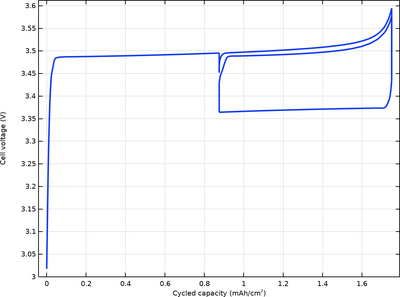
Lithium iron phosphate (LFP) is a common positive electrode material in lithium-ion batteries. Specific for the LFP electrode material is that its equilibrium (open circuit) potential, when defined as a function of the lithiation state, features a large flat plateau with a more or less ... Mehr lesen
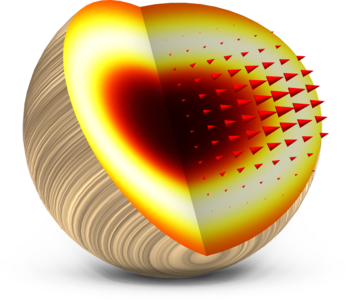
The pyrolysis of a centimeter-sized wood particle presents a fully coupled multiphysics problem with mass transfer, fluid flow, and heat transfer. This example model consists of two parts. The first part demonstrates how to set up a model describing the pyrolysis of a porous, ... Mehr lesen
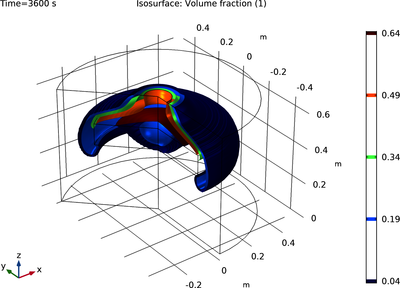
This example demonstrate two-phase flow in a porous medium which contains a low permeable lens. The heavier phase infiltrates the porous medium, so the low permeable lens is infiltrated only when a critical saturation at the outside is reached. Mehr lesen
This is a tutorial model of the coupling between flow of a fluid in an open channel and a porous block attached to one of the channel walls. The flow is described by the Navier-Stokes equation in the free region and a Forchheimer-corrected version of the Brinkman equations in the porous ... Mehr lesen

Die Trocknung poröser Medien ist ein wichtiger Prozess unter anderem in der Lebensmittel- und Papierindustrie. Viele physikalische Effekte müssen berücksichtigt werden: Strömung, Wärmetransport mit Phasenwechsel und Transport der beteiligten Flüssigkeiten und Gase. Alle diese Effekte ... Mehr lesen
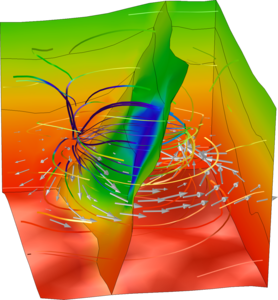
Dies ist eines der beiden Modelle aus dem Blog-Beitrag über den Wärmetransport im Untergrund: Coupling Heat Transfer with Subsurface Porous Media Flow Hinweis: Die Poroelastizität ist hier nicht enthalten. Mehr lesen
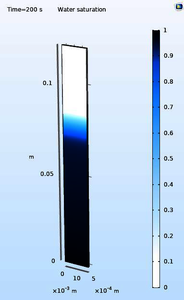
This example models wicking in a porous medium. Wicking is the phenomenon that occurs when a dry porous material is put into contact with a fluid: it will absorb the fluid due to capillary forces. The absorption will continue until an equilibrium is reached where the gravitational forces ... Mehr lesen

In diesem Modellbeispiel wird der Transport von Reaktanten und Wasser in einer Hochtemperatur-Polymerelektrolytmembran-Brennstoffzelle untersucht. Das Modell umfasst Stoff- und Impulstransportphänomene in den Strömungskanälen, Gasdiffusionsschichten (GDLs) und porösen Elektroden sowie ... Mehr lesen

Topology optimization of the Navier-Stokes equations is encountered in different branches and applications, such as in the design of ventilation systems for cars. A common technique applicable to such problems is to let the distribution of porous material vary continuously. In this ... Mehr lesen
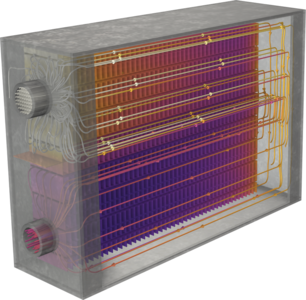
This tutorial model shows how a plate-fin heat exchanger made of aluminum is used to cool down hot oil with colder air. In order to maximize heat transfer, the heat exchanger is made of a porous aluminum matrix in which the hot oil flows. Heat is conducted through aluminum fins in ... Mehr lesen


