
Die Application Gallery bietet COMSOL Multiphysics® Tutorial- und Demo-App-Dateien, die für die Bereiche Elektromagnetik, Strukturmechanik, Akustik, Strömung, Wärmetransport und Chemie relevant sind. Sie können diese Beispiele als Ausgangspunkt für Ihre eigene Simulationsarbeit verwenden, indem Sie das Tutorial-Modell oder die Demo-App-Datei und die dazugehörigen Anleitungen herunterladen.
Suchen Sie über die Schnellsuche nach Tutorials und Apps, die für Ihr Fachgebiet relevant sind. Beachten Sie, dass viele der hier vorgestellten Beispiele auch über die Application Libraries zugänglich sind, die in die COMSOL Multiphysics® Software integriert und über das Menü File verfügbar sind.
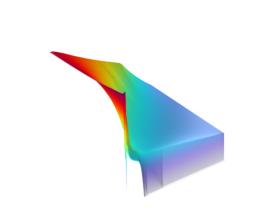
This model solves the Boltzmann equation in two-term approximation for a mixture of nitrogen and oxygen representing a background gas of dry air. Electron transport coefficients and source terms are computed by suitable integration of the electron energy distribution function over ... Mehr lesen
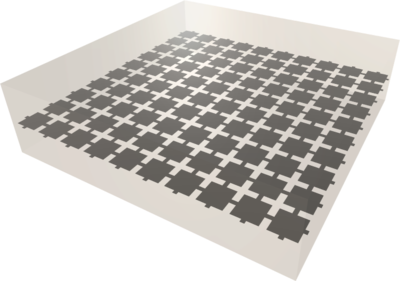
Graphen, in einem zweidimensionalen hexagonalen Gitter angeordnete Kohlenstoffatome, hat seit seiner experimentellen Entdeckung vor etwa zwei Jahrzehnten ein enormes Forschungs- und Anwendungsinteresse geweckt. Dieses magische Material ist nicht nur ultradünn, sondern weist auch eine ... Mehr lesen
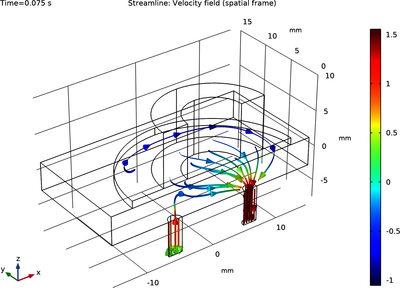
This tutorial model is kindly provided by Riccardo Vietri, James Ransley and Andrew Spann at Veryst Engineering, LLC. Piezoelectric micropumps are frequently used in medical applications because of their ability to precisely control the metering of very small volumes of fluids or gases. ... Mehr lesen

A Gaussian electromagnetic wave is incident on a dense array of very thin wires (or rods). The distance between the rods and, thus, the rod diameter is much smaller than the wavelength. Under these circumstances, the rod array does not function as a diffraction grating (see the Plasmonic ... Mehr lesen
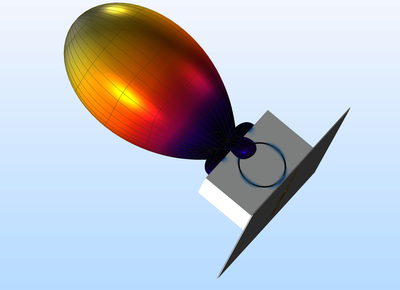
A dielectric resonator placed near a radiating element can be used to increase directivity and gain. Here, a block of quartz dielectric, with additional passive metallic antenna elements, is placed above a slot antenna. The fields in and around the antenna are solved for. The far field ... Mehr lesen

A planar dielectric slab waveguide demonstrates the principles behind any kind of dielectric waveguide such as a ridge waveguide or a step-index fiber. This model solves for the effective index and fields of a dielectric slab waveguide and compares the solution to analytic results. Mehr lesen
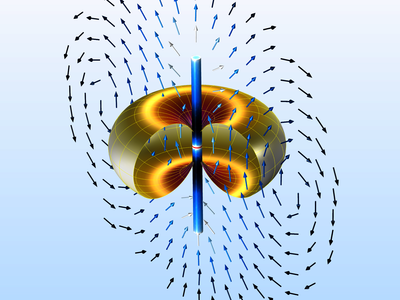
The dipole antenna is one of the most straightforward antenna configurations. It can be realized with two thin metallic rods that have a sinusoidal voltage difference applied between them. The length of the rods is chosen such that they are quarter wavelength elements at the operating ... Mehr lesen
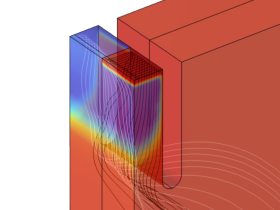
In this second half of a two-part example, a 3D model of a trench-gate IGBT is built by extruding the 2D model from the first half. Unlike the 2D model, now it is possible to arrange the alternating n+ and p+ emitters along the direction of extrusion as in the real device. This more ... Mehr lesen
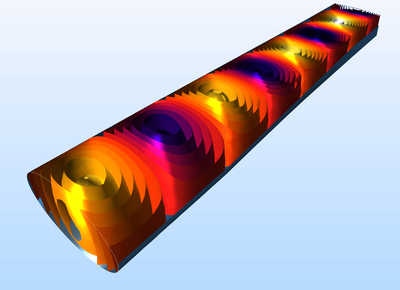
Dies ist ein Modell eines Adapters für die Mikrowellenausbreitung im Übergang zwischen einem rechteckigen und einem elliptischen Wellenleiter. Solche Wellenleiteradapter sind so konzipiert, dass die Energieverluste aufgrund von Reflexionen bei den Betriebsfrequenzen minimal sind. Um die ... Mehr lesen
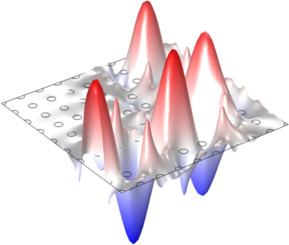
Photonische Kristalle sind periodische Strukturen aus abwechselnden Schichten von Materialien mit unterschiedlichen Brechungsindizes. Wellenleiter, die in einem photonischen Kristall eingeschlossen sind, können sehr scharfe, verlustarme Biegungen aufweisen, was eine Erhöhung der ... Mehr lesen


