
Die Application Gallery bietet COMSOL Multiphysics® Tutorial- und Demo-App-Dateien, die für die Bereiche Elektromagnetik, Strukturmechanik, Akustik, Strömung, Wärmetransport und Chemie relevant sind. Sie können diese Beispiele als Ausgangspunkt für Ihre eigene Simulationsarbeit verwenden, indem Sie das Tutorial-Modell oder die Demo-App-Datei und die dazugehörigen Anleitungen herunterladen.
Suchen Sie über die Schnellsuche nach Tutorials und Apps, die für Ihr Fachgebiet relevant sind. Beachten Sie, dass viele der hier vorgestellten Beispiele auch über die Application Libraries zugänglich sind, die in die COMSOL Multiphysics® Software integriert und über das Menü File verfügbar sind.
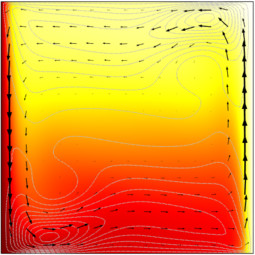
This model couples the Navier Stokes equations and the heat transfer equations to examine density driven flow of free fluids. Here the fluid is in a square cavity with a heated wall. The buoyancy force is a Boussinesq term added to the Navier-Stokes equations. The equation is ... Mehr lesen
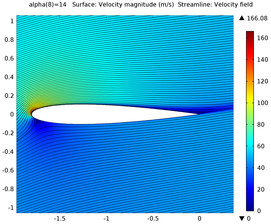
Dieses Modell simuliert die Umströmung einer geneigten NACA-0012-Tragfläche bei verschiedenen Anstellwinkeln unter Verwendung des SST-Turbulenzmodells. Die Ergebnisse zeigen eine gute Übereinstimmung mit den experimentellen Auftriebsdaten von Ladson und den Druckdaten von Gregory und O ... Mehr lesen

Free-surface calculations in the predefined flow interfaces are currently limited to time-dependent studies when using the built-in boundary conditions. Here, a stationary formulation following Romero et al. [1] is implemented using equation contributions. The attached slides describe ... Mehr lesen
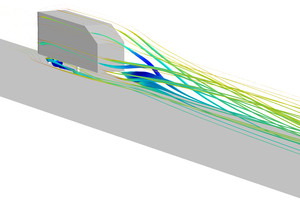
Der Ahmed-Körper stellt eine vereinfachte, bodennahe Fahrzeuggeometrie eines stumpfen Körpers (bluff body) dar. Seine Form ist einfach genug, um eine genaue Strömungssimulation zu ermöglichen, behält aber einige wichtige praktische Merkmale bei, die für Automobilkarosserien relevant ... Mehr lesen
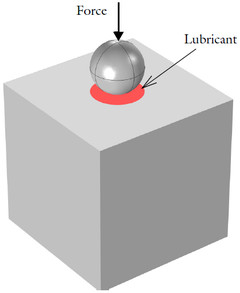
This benchmark model computes the transient pressure distribution and film height in a squeeze film bearing for lubrication in a nonconformal conjunction of a solid sphere and an elastic wall separated by a lubricant film. This model solves the benchmark case of hydrodynamic interaction ... Mehr lesen

The Turbulent flow, Elliptic Blending R-ε interface is used to analyze fully developed turbulent flow in a spanwise rotating channel. Due to the influence of the Coriolis force on turbulence, profiles of the flow variables are skewed at moderate rotation rates. An asymmetry between the ... Mehr lesen
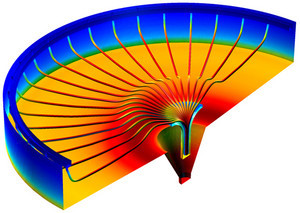
Wastewater treatment is a several-step process for removing contaminants. Firstly, large, solid particles are removed through sedimentation, flotation, and filtration. And then in a second step, biological treatment causes the smaller particles to aggregate, forming so called flocs. ... Mehr lesen
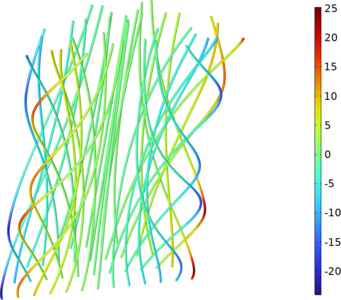
Turbulent flow, SSG-LRR interface is employed to investigate turbulent flow in a straight semicircular duct. The resulting flow pattern is characterized by slow secondary motions in the plane normal to the duct axis. The order of magnitude of velocity of those motions is 1% of the ... Mehr lesen
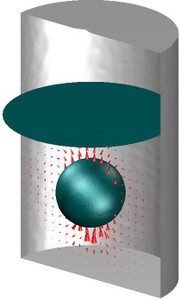
Die Level-Set-Methode eignet sich gut für Probleme mit beweglichen Rändern, bei denen sich die Topologie der Geometrie mit der Zeit ändert. Eine Ölblase, die sich durch das Wasser nach oben bewegt und schließlich mit dem Öl an der Oberfläche verschmilzt, verursacht diese Art von ... Mehr lesen
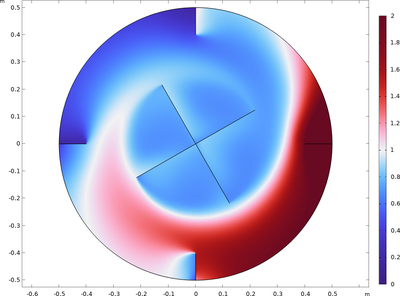
This example shows how the mixing capability of a stirred vessel can be evaluated. To efficiently reach the steady operational conditions the turbulent flow is solved for using a frozen rotor analysis, and a following time dependent simulation. When a quasi-steady flow field has ... Mehr lesen


