
Die Application Gallery bietet COMSOL Multiphysics® Tutorial- und Demo-App-Dateien, die für die Bereiche Elektromagnetik, Strukturmechanik, Akustik, Strömung, Wärmetransport und Chemie relevant sind. Sie können diese Beispiele als Ausgangspunkt für Ihre eigene Simulationsarbeit verwenden, indem Sie das Tutorial-Modell oder die Demo-App-Datei und die dazugehörigen Anleitungen herunterladen.
Suchen Sie über die Schnellsuche nach Tutorials und Apps, die für Ihr Fachgebiet relevant sind. Beachten Sie, dass viele der hier vorgestellten Beispiele auch über die Application Libraries zugänglich sind, die in die COMSOL Multiphysics® Software integriert und über das Menü File verfügbar sind.

This example describes how to simulate the self-lubricating phenomenon of a liquid lubricant in a journal bearing. A porous bushing is press-fitted to a bearing and saturated with a lubricant. It acts as a reservoir for the redistribution of the thin film of lubricant between regions of ... Mehr lesen

This model performs a topological optimization for a Tesla microvalve. A Tesla microvalve inhibits backwards flow using friction forces rather than moving parts. The design can be optimized by distributing a specific amount of material within the modeling domain. The goal is to maximize ... Mehr lesen
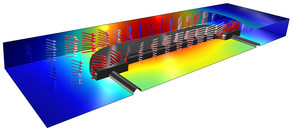
Tutorial model of electroplating. The model uses secondary current distribution with full Butler-Volmer kinetics for both anode and cathode. The thickness of the deposited layer at the cathode is computed as well as the pattern caused by dissolution of the anode surface. Mehr lesen
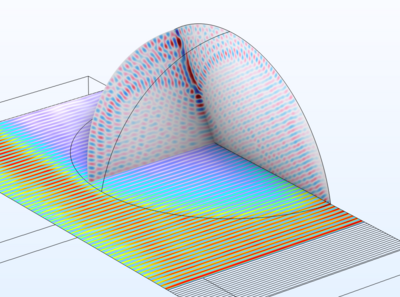
Wird ein Tropfen auf ein Substrat aufgebracht, auf dem sich akustische Oberflächenwellen ausbreiten, wird deren Energie in den Tropfen übertragen und erzeugt ein akustisches Feld. Die übertragene Energie wird gedämpft und führt zu einer Strömung. Diese Strömung ermöglicht eine ... Mehr lesen
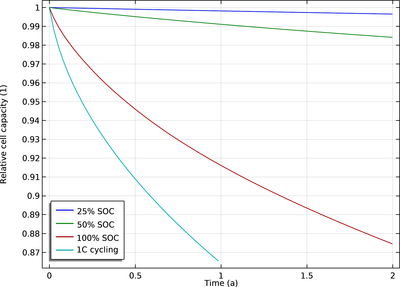
This tutorial demonstrates the Lumped Battery interface for modeling capacity loss in a battery. A set of lumped parameters are used to describe the capacity loss that occurs due to parasitic reactions in the battery, assuming no knowledge of the internal structure or design of the ... Mehr lesen
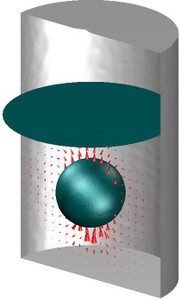
Die Level-Set-Methode eignet sich gut für Probleme mit beweglichen Rändern, bei denen sich die Topologie der Geometrie mit der Zeit ändert. Eine Ölblase, die sich durch das Wasser nach oben bewegt und schließlich mit dem Öl an der Oberfläche verschmilzt, verursacht diese Art von ... Mehr lesen
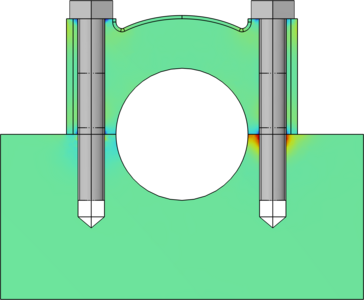
This example shows how to model prestressed bolts. The bolt geometry is taken from the Part Libraries. For comparison, one of the bolts is modeled using a thread contact formulation, whereas the other bolt is connected to the bolt hole by a pure continuity condition. The reduced ... Mehr lesen
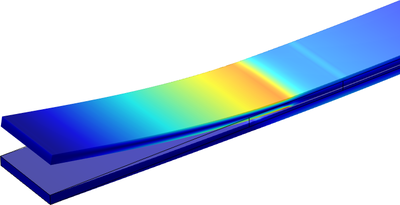
Interfacial failure by delamination or debonding can be simulated with a Cohesive Zone Model (CZM). This example shows the implementation of a CZM with a bilinear traction-separation law. It is used to predict the mixed-mode softening onset and delamination propagation in a composite ... Mehr lesen
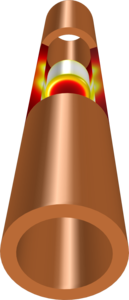
A cylindrical magnet falling through a copper tube induces eddy currents on the tube walls, which in turn, create a magnetic field that opposes the magnetic field of the magnet and induces a braking force that opposes the motion of the magnet. This model computes the velocity of the ... Mehr lesen
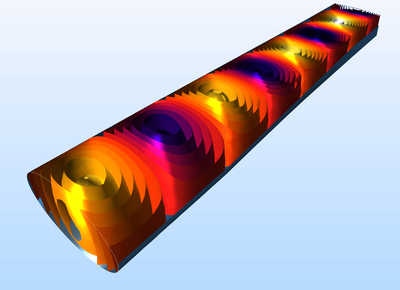
Dies ist ein Modell eines Adapters für die Mikrowellenausbreitung im Übergang zwischen einem rechteckigen und einem elliptischen Wellenleiter. Solche Wellenleiteradapter sind so konzipiert, dass die Energieverluste aufgrund von Reflexionen bei den Betriebsfrequenzen minimal sind. Um die ... Mehr lesen


