
Die Application Gallery bietet COMSOL Multiphysics® Tutorial- und Demo-App-Dateien, die für die Bereiche Elektromagnetik, Strukturmechanik, Akustik, Strömung, Wärmetransport und Chemie relevant sind. Sie können diese Beispiele als Ausgangspunkt für Ihre eigene Simulationsarbeit verwenden, indem Sie das Tutorial-Modell oder die Demo-App-Datei und die dazugehörigen Anleitungen herunterladen.
Suchen Sie über die Schnellsuche nach Tutorials und Apps, die für Ihr Fachgebiet relevant sind. Beachten Sie, dass viele der hier vorgestellten Beispiele auch über die Application Libraries zugänglich sind, die in die COMSOL Multiphysics® Software integriert und über das Menü File verfügbar sind.
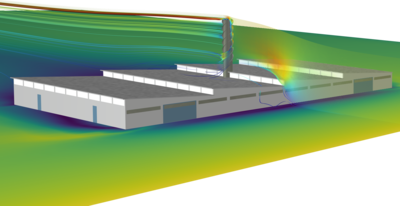
Wind strakes on a chimney impede the uniform detachment along the height of the chimney, which can induce vibrations and eventually lead to fatigue at the footing of the chimney. A stationary turbulent flow simulation is computed for a chimney with strakes mounted on a factory building. ... Mehr lesen
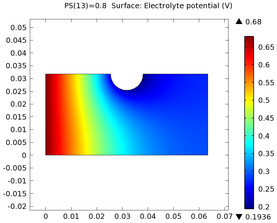
This example models cathodic protection of a steel reinforcing bar in concrete. Three different electrochemical reactions are considered on the steel surface. Charge and oxygen transport are modeled in the concrete domain, where the electrolyte conductivity and oxygen diffusivity depend ... Mehr lesen
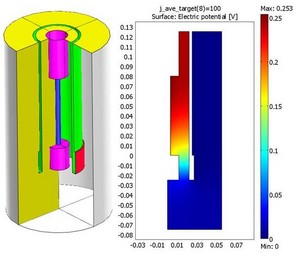
Rotating cylinder Hull cells are an important experimental tool in electroplating and electrodeposition and are used for the measurement of nonuniform current distribution, mass transport, and throwing power of plating baths. The model reproduces the results for a commercially available ... Mehr lesen

This model shows how to create dispersion diagrams from simulation results by extending the tutorial Thin-Film BAW Composite Resonator. The dispersion curve can be plotted against both real and imaginary values of the wave number, corresponding to the propagating modes and evanescent ... Mehr lesen
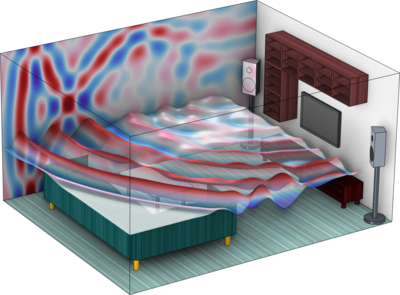
Die Verwendung von wellenbasierten Techniken für raumakustische Simulationen hat sich in den letzten Jahren aufgrund der Steigerung der Rechenleistung sowie der Entwicklung neuer numerischer Methoden verbreitet. Die Herausforderung, realistische Impedanzbedingungen an den Wänden zu ... Mehr lesen
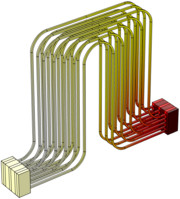
Dieses Modell simuliert ein Temperaturprofil in einer Reihe von Zellen und Kühlrippen in einem flüssigkeitsgekühlten Akkupack. Das Modell wird in 3D und für einen Betriebspunkt während eines Ladezyklus gelöst. Ein vollständiges elektrochemisches 1D-Modell für den Lithium-Akku berechnet ... Mehr lesen

In this example, a spring-loaded valve-opening mechanism consisting of a rocker arm and a radial cam is studied. All of the system components are modeled as rigid and are connected through prismatic, hinge, and slot joints. The cam-follower connection as well as other joint connections ... Mehr lesen
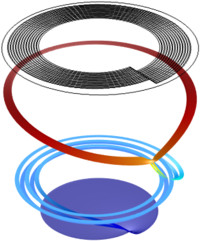
Due to the large differences in length scales in a lithium-ion battery, with the thickness of the different layers typically being several orders of magnitude smaller than the extension in the sheet direction, a lithium-ion battery is often well represented by a one-dimensional model. ... Mehr lesen
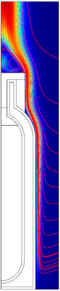
Das folgende Beispiel löst ein reines Konduktions- und ein freies Konvektionsproblem, bei dem eine Thermoskanne mit heißem Kaffee Wärmeenergie abgibt. Das Hauptinteresse besteht darin, die Kühlleistung der Thermoskanne zu berechnen, d.h. wie viel Wärme sie pro Zeiteinheit verliert. In ... Mehr lesen
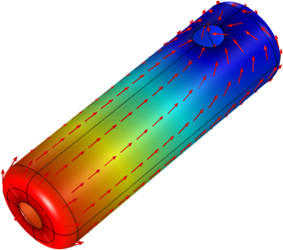
A goal for many applications is to predict physics in thin structures, such as shells, without modeling the thickness of the structure. This is because large aspect ratios can cause meshing and geometry analysis problems. This model demonstrates how to use the tangential derivative ... Mehr lesen


