
Die Application Gallery bietet COMSOL Multiphysics® Tutorial- und Demo-App-Dateien, die für die Bereiche Elektromagnetik, Strukturmechanik, Akustik, Strömung, Wärmetransport und Chemie relevant sind. Sie können diese Beispiele als Ausgangspunkt für Ihre eigene Simulationsarbeit verwenden, indem Sie das Tutorial-Modell oder die Demo-App-Datei und die dazugehörigen Anleitungen herunterladen.
Suchen Sie über die Schnellsuche nach Tutorials und Apps, die für Ihr Fachgebiet relevant sind. Beachten Sie, dass viele der hier vorgestellten Beispiele auch über die Application Libraries zugänglich sind, die in die COMSOL Multiphysics® Software integriert und über das Menü File verfügbar sind.

This model shows how to use the scattered field formulation to compute the transmission coefficient for impinging P and S plane elastic waves onto a finite size phononic crystal. The transmission tends to zero in the frequency range corresponding to P- and S-wave band gaps, as ... Mehr lesen
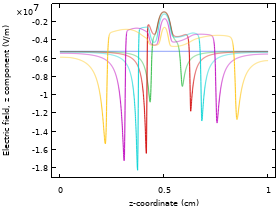
This tutorial model presents a study of a double-headed streamer in nitrogen at atmospheric pressure. An initial seed of electrons is placed between two electrodes which apply an initial electric field of 52 kV/cm to the gas. A negative and positive streamer propagate toward the ... Mehr lesen
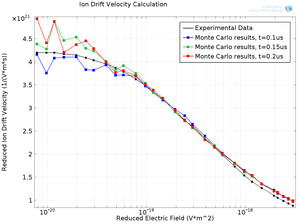
The drift velocity of Ar+ is calculated using a Monte Carlo simulation in which the elastic collisions of Argon ions with ambient neutrals are explicitly modeled. The model uses energy-dependent collision cross-section data from experiment. The average ion velocity values are consistent ... Mehr lesen
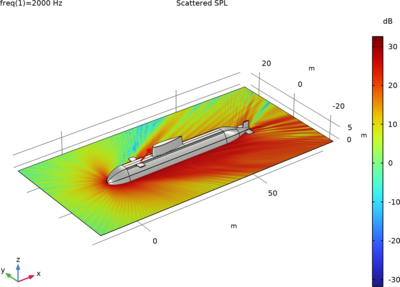
The primary defense of a submarine lies in its capacity to remain hidden during operation. As radio waves are strongly absorbed by sea water, sound navigation ranging, or SONAR, is one of the main methods used for the detection of submarines. SONAR systems are also used for underwater ... Mehr lesen
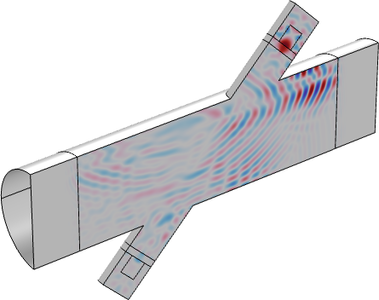
Ultraschall-Durchflussmesser bestimmen die Geschwindigkeit eines Fluids, das durch ein Rohr fließt, indem sie ein Ultraschallsignal in einem schrägen Winkel durch die Strömung senden. Wenn keine Strömung vorhanden ist, ist die Übertragungszeit zwischen dem Sender und dem Empfänger für ... Mehr lesen
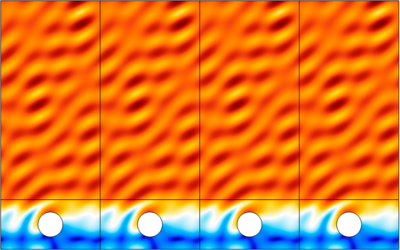
Dies ist ein Modell der Schallabsorption durch einen porösen akustischen offenzelligen Schaumstoff. In porösen Materialien breitet sich der Schall in einem Netzwerk aus kleinen, miteinander verbundenen Poren aus. Da die Dimensionen der Poren klein sind, entstehen Verluste durch ... Mehr lesen
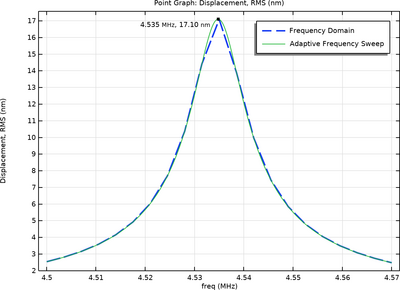
This tutorial shows how to model a miniaturized magnetostrictive antenna developed for use inside living cells. The stress in the antenna, the magnetic flux density, the current density, and the displacement of the tip of the device are investigated at the resonance frequency. Mehr lesen

Dieses Modell demonstriert die Simulation der Streuung einer ebenen Lichtwelle an einer Gold-Nanosphäre. Die Streuung wird für den optischen Frequenzbereich berechnet, in dem Gold als ein Material mit negativer komplexwertiger Permittivität modelliert werden kann. Das Fernfeldmuster und ... Mehr lesen
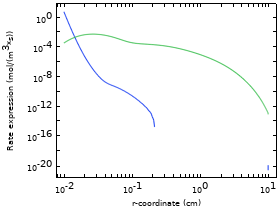
This tutorial presents a study of positive and negative corona discharges in dry air at atmospheric pressure. The discharges are sustained within two electrodes in a coaxial configuration by a high voltage DC source applied to the inner electrode. Two different types of models are used: ... Mehr lesen
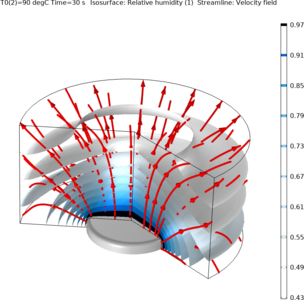
This tutorial model demonstrates the use of the Moisture Flow coupling node to account for the Stefan flow in moist air, over an evaporation surface. The effects on the velocity field and vapor concentration are presented with different ambient temperature conditions. Mehr lesen


