
Die Application Gallery bietet COMSOL Multiphysics® Tutorial- und Demo-App-Dateien, die für die Bereiche Elektromagnetik, Strukturmechanik, Akustik, Strömung, Wärmetransport und Chemie relevant sind. Sie können diese Beispiele als Ausgangspunkt für Ihre eigene Simulationsarbeit verwenden, indem Sie das Tutorial-Modell oder die Demo-App-Datei und die dazugehörigen Anleitungen herunterladen.
Suchen Sie über die Schnellsuche nach Tutorials und Apps, die für Ihr Fachgebiet relevant sind. Beachten Sie, dass viele der hier vorgestellten Beispiele auch über die Application Libraries zugänglich sind, die in die COMSOL Multiphysics® Software integriert und über das Menü File verfügbar sind.
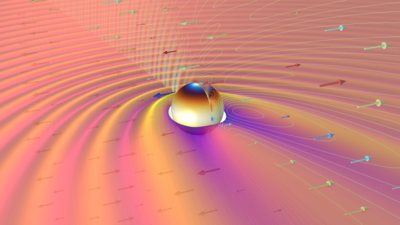
This verification model uses the Electromagnetic Waves, Boundary Elements interface to simulate the RCS of perfectly conducting sphere. The simulated result is compared to analytical calculation to verify the accuracy. Mehr lesen
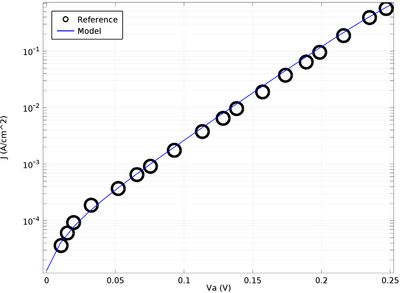
Schottky Contact This benchmark simulates the behavior of an ideal Schottky barrier diode made of a tungsten contact deposited on a silicon wafer. The resulting J-V (current density vs. applied voltage) curve obtained from the model under forward bias is compared with experimental ... Mehr lesen

The study explores charge transport dynamics in polyethylene, a common solid dielectric insulation material. It employs a bipolar charge transport model to calculate the densities of electrons, holes, and their trapped counterparts. The simulation's outcomes for discharge current and ... Mehr lesen

This example simulates Trichel pulses produced by negative corona discharge under a point-to-plate configuration. The electron density and the electric field are obtained, as well as the discharge current. The discharge current clearly shows the pulsating characters. Each current pulse ... Mehr lesen

The miniaturization of electronics devices requires batteries with higher energy density and power. To increase the contact area between the electrodes and the solid electrolyte, 3D configurations such as the trench geometry are used. This example demonstrates how to model a solid-state ... Mehr lesen
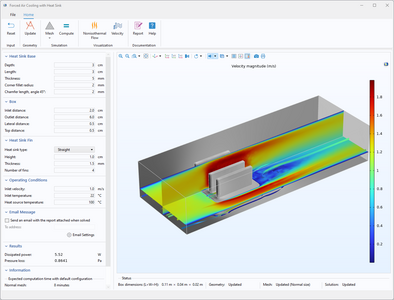
Diese Anwendung demonstriert: Geometrieteile und parametrisierte Geometrien Versenden einer E-Mail mit einem Bericht, wenn die Berechnung abgeschlossen ist Benutzerdefinierte E-Mail-Server-Einstellungen, die nützlich sind, wenn kompilierte Standalone-Apps ausgeführt werden Optionen zur ... Mehr lesen
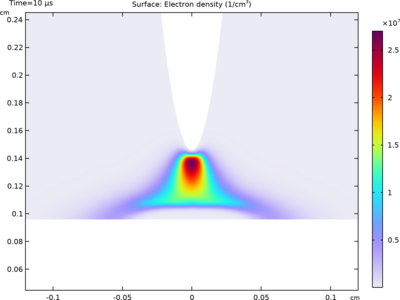
This model simulates a negative dielectric barrier discharge under a point-to-plate electrode configuration. Two solid dielectric layers are inserted into the air gap. A negative voltage of 2.5 kV is applied to the cathode electrode, initiating a corona streamer that propagates and ... Mehr lesen
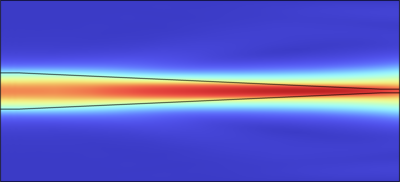
Eine konische optische Wellenleiterstruktur wird verwendet, um zwei Wellenleiter mit unterschiedlichen geometrischen Querschnitten und/oder unterschiedlichen Materialparametern zu verbinden. Der konische Wellenleiter hat einen geometrischen Querschnitt in der Eingangsebene und einen ... Mehr lesen
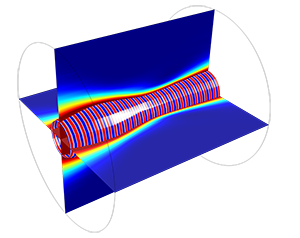
A Gaussian beam is launched into BK-7 optical glass. The material has an intensity-dependent refractive index. At the center of the beam, the refractive index is the largest. The induced refractive index profile counteracts diffraction and actually focuses the beam. Self-focusing is ... Mehr lesen
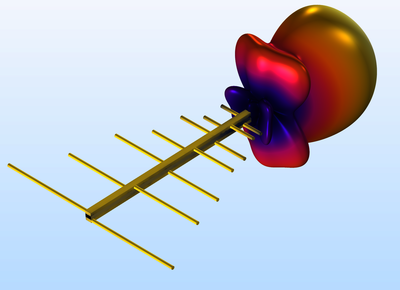
The shape of a log-periodic antenna resembles that of a Yagi-Uda antenna, but is composed of a coplanar array to achieve a wider bandwidth. It is also known as a wideband or frequency-independent antenna. All metallic parts are modeled using the perfect electric conductor (PEC) boundary ... Mehr lesen


