
Die Application Gallery bietet COMSOL Multiphysics® Tutorial- und Demo-App-Dateien, die für die Bereiche Elektromagnetik, Strukturmechanik, Akustik, Strömung, Wärmetransport und Chemie relevant sind. Sie können diese Beispiele als Ausgangspunkt für Ihre eigene Simulationsarbeit verwenden, indem Sie das Tutorial-Modell oder die Demo-App-Datei und die dazugehörigen Anleitungen herunterladen.
Suchen Sie über die Schnellsuche nach Tutorials und Apps, die für Ihr Fachgebiet relevant sind. Beachten Sie, dass viele der hier vorgestellten Beispiele auch über die Application Libraries zugänglich sind, die in die COMSOL Multiphysics® Software integriert und über das Menü File verfügbar sind.
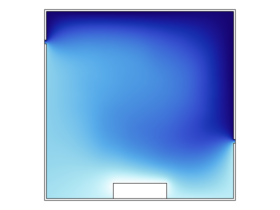
This example simulates the thermodynamical evolution of moist air in an electronic box with the aim of detecting whether condensation occurs when the external environment properties change. The model imports measured data for the air temperature, pressure, and water vapor concentration. ... Mehr lesen
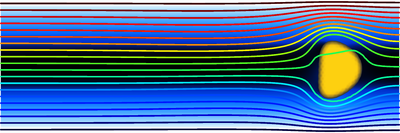
Applying an electric field across a suspension of immiscible liquids may stimulate droplets of the same phase to coalesce. The method known as electrocoalescence has important applications, for instance, in the separation of oil from water. To model electrocoalescence, you need to solve ... Mehr lesen

This tutorial demonstrates how to use stationary polarization data to perform parameter estimation of a polymer electrolyte membrane fuel cell (PEMFC) model. The model, defining a 5-layer membrane electrode assembly (MEA) is two-dimensional and includes electronic and ionic charge ... Mehr lesen
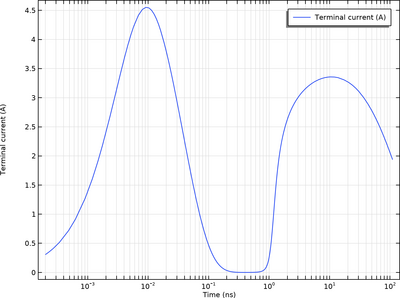
This model shows how to simulate the complex discharge physics behind the well-known electrostatic discharge (ESD). The model connects the Electrical Discharge interface with the Circuit interface to simulate how ESD current is generated when a human hand touches metal. Mehr lesen
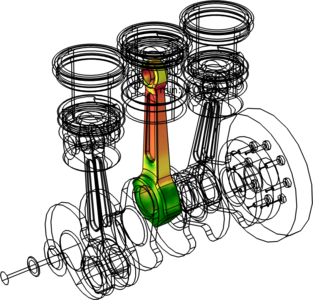
In a reciprocating piston engine the connecting rods transfer rotating motion into reciprocating motion. The connecting rods are constantly under high stresses and the load increases with the engine speed. A failure of one part in the engine usually results in a replacement of the whole ... Mehr lesen
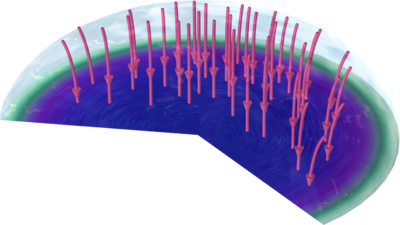
An Evans droplet experiment is a century-old corrosion experiment for demonstrating oxygen transport-limited corrosion. A droplet of water is placed on a metal surface, and over time the surface features differences in the radial direction of the surface in terms of amount of corroded ... Mehr lesen
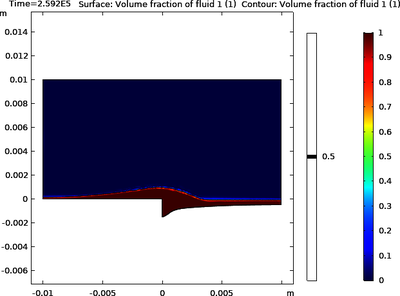
In this model, the effect of corrosion product on galvanic corrosion between a magnesium alloy (AE44) and mild steel in contact with brine solution is presented, wherein deformed boundaries due to both deposition of corrosion product as well as dissolution of magnesium are considered. ... Mehr lesen
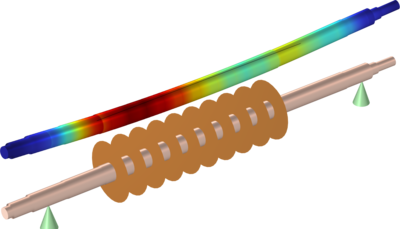
The fluid flow in seals causes a strong restoring radial force, opposing the shaft motion. Also, there is a cross coupled force due to the axial variation of the circumferential flow. The first type of force always has a stabilizing effect on the rotor, whereas the second one in certain ... Mehr lesen
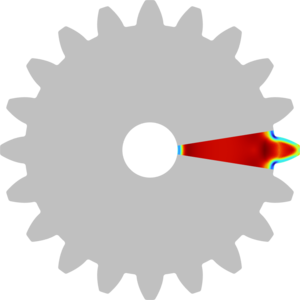
This model shows how to simulate carburization and quenching of a steel gear. Diffusion of carbon into the surface of the gear affects the onset of martensitic transformation. Residual stresses are computed, and it is shown that high residual compressive stresses appear at the root of ... Mehr lesen
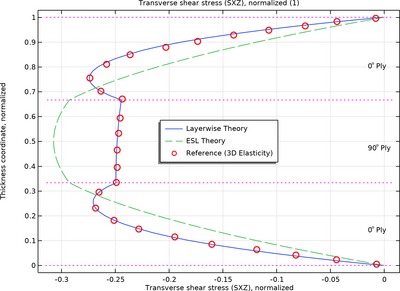
This example demonstrates the bending analysis of a simply supported composite laminate under sinusoidal distributed transverse load. The composite laminate is thick, with a thickness to side length ratio of 1/4. The laminate has three layers in a cross-ply layup. The model is solved ... Mehr lesen


