
Die Application Gallery bietet COMSOL Multiphysics® Tutorial- und Demo-App-Dateien, die für die Bereiche Elektromagnetik, Strukturmechanik, Akustik, Strömung, Wärmetransport und Chemie relevant sind. Sie können diese Beispiele als Ausgangspunkt für Ihre eigene Simulationsarbeit verwenden, indem Sie das Tutorial-Modell oder die Demo-App-Datei und die dazugehörigen Anleitungen herunterladen.
Suchen Sie über die Schnellsuche nach Tutorials und Apps, die für Ihr Fachgebiet relevant sind. Beachten Sie, dass viele der hier vorgestellten Beispiele auch über die Application Libraries zugänglich sind, die in die COMSOL Multiphysics® Software integriert und über das Menü File verfügbar sind.

The miniaturization of electronics devices requires batteries with higher energy density and power. To increase the contact area between the electrodes and the solid electrolyte, 3D configurations such as the trench geometry are used. This example demonstrates how to model a solid-state ... Mehr lesen

Light rail transit (LRT) systems often utilize DC power for train propulsion. In these systems the potential gradients in the rails may induce stray currents, which corrode adjacent metallic structures. In this example, the Cathodic Protection interface, using Edge Electrode nodes, is ... Mehr lesen
Planare photonische Wellenleiter aus Siliziumdioxid (SiO2) haben ein großes Potenzial für den Einsatz in Anwendungen des Wavelength Routing. Das größte Problem bei dieser Art von Wellenleitern ist die Doppelbrechung. Anisotrope Brechungsindizes führen zu einer Aufspaltung der Grundmoden ... Mehr lesen

This model demonstrates how to perform simulations of an absorbing bandstop color filter, based on a hexagonal array of holes in a thin aluminum layer. The structure is hexagonally periodic but this example also shows how to set the model up as rectangularly periodic. Mehr lesen
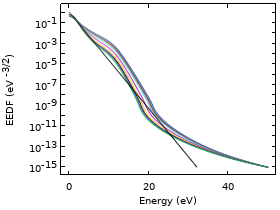
In this example, a hydrogen plasma reactor at moderate pressure is studied using a global model. The heavy species heat equation is included. In the first part of the study, a Maxwellian electron energy distribution function is used. In the second part, the global model is solved self ... Mehr lesen
This example of a dipole antenna array demonstrates a cost-effective analysis using the Boundary Element Method (BEM). When dealing with a large array made of metallic radiators, the Finite Element Method (FEM) would necessitate greater computational resources. The simulation results ... Mehr lesen
Die Level-Set-Methode eignet sich gut für Probleme mit beweglichen Rändern, bei denen sich die Topologie der Geometrie mit der Zeit ändert. Eine Ölblase, die sich durch das Wasser nach oben bewegt und schließlich mit dem Öl an der Oberfläche verschmilzt, verursacht diese Art von ... Mehr lesen
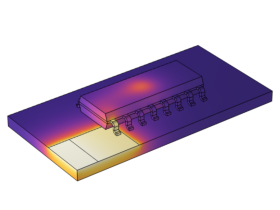
All integrated circuits (ICs) — especially high-speed devices — produce heat. In today’s dense electronic system layouts, heat sources are many times placed close to heat-sensitive ICs. Designers of printed circuit boards often need to consider the relative placement of heat ... Mehr lesen
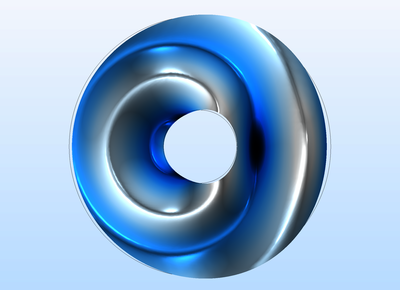
This example model calculates the bistatic radar cross section (RCS) per unit length of a circle using the Electromagnetic Waves, Time Explicit physics interface. A 2D circle is excited by a 200 MHz sinusoidal signal modulated by a temporal Gaussian pulse. A wideband RCS frequency ... Mehr lesen
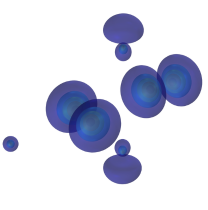
For a description of this model, see our accompanying blog post "Can COMSOL Multiphysics® Solve the Hydrogen Atom?". Mehr lesen


