
Die Application Gallery bietet COMSOL Multiphysics® Tutorial- und Demo-App-Dateien, die für die Bereiche Elektromagnetik, Strukturmechanik, Akustik, Strömung, Wärmetransport und Chemie relevant sind. Sie können diese Beispiele als Ausgangspunkt für Ihre eigene Simulationsarbeit verwenden, indem Sie das Tutorial-Modell oder die Demo-App-Datei und die dazugehörigen Anleitungen herunterladen.
Suchen Sie über die Schnellsuche nach Tutorials und Apps, die für Ihr Fachgebiet relevant sind. Beachten Sie, dass viele der hier vorgestellten Beispiele auch über die Application Libraries zugänglich sind, die in die COMSOL Multiphysics® Software integriert und über das Menü File verfügbar sind.
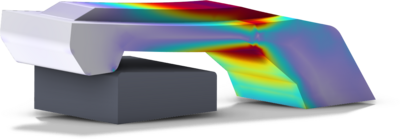
This example simulates the insertion of a snap hook in its groove. Fasteners like this are common in the automotive industry, for example, in the control panel of a car. In this case it is important to know the force that must be applied in order to place the hook in the slot and also ... Mehr lesen
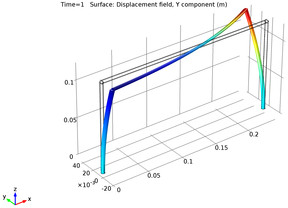
This is a benchmark model for flexible multibody dynamics. This model simulates the dynamic behavior of a planar four-bar mechanism when one of the joints has a defect. The out-of-plane motion in the mechanism, caused by the defect in the joint, is compared with the results from the ... Mehr lesen
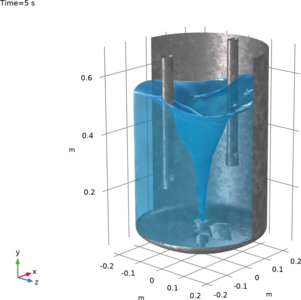
This example of turbulent flow in a partially baffled turbulent mixer with a three-bladed impeller shows how to set up the Rotating Machinery, Turbulent Flow interfaces from the Mixer Module with a Level Set method for free surface flow in a rotating geometry. A time-dependent simulation ... Mehr lesen
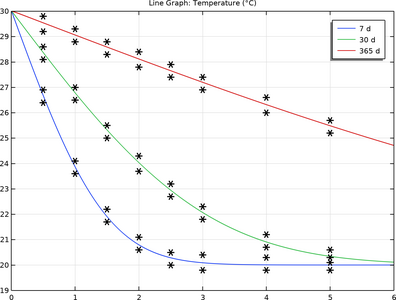
The model is defined as a benchmark case in norm 15026:2007 annex A. The purpose of the model is to calculate the temperature and moisture profiles at different times after a change in the external conditions (temperature and relative humidity) inside a wall material (kind of concrete). ... Mehr lesen

In friction stir welding, a rotating tool moves along the weld joint and melts the aluminum through the generation of friction heat. The tool’s rotation stirs the melted aluminum such that the two plates are joined. In this model, two aluminum plates are joined by generating friction ... Mehr lesen
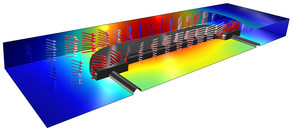
Tutorial model of electroplating. The model uses secondary current distribution with full Butler-Volmer kinetics for both anode and cathode. The thickness of the deposited layer at the cathode is computed as well as the pattern caused by dissolution of the anode surface. Mehr lesen
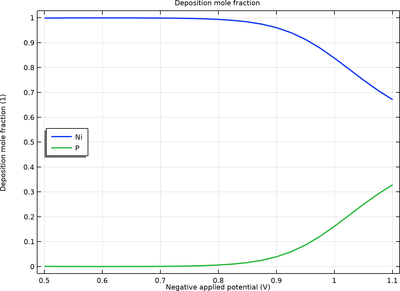
Electrochemical codeposition is a common low-cost method for producing metal alloys. This tutorial model demonstrates electrodeposition of a nickel (Ni)–phosphorous (P) alloy. The model accounts for charge and mass transport of a multitude of species along with multiple electrode ... Mehr lesen
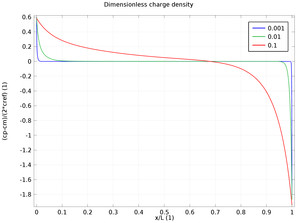
In the diffuse double layer and within the first few nanometers of an electrode surface, the assumption of electroneutrality is not valid due to charge separation. Typically, the diffuse double layer may be of interest when modeling very thin layers of electrolyte including those in ... Mehr lesen
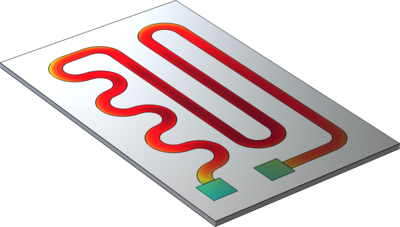
Small heating circuits find use in many applications. For example, in manufacturing processes, they heat up reactive fluids. The device in this tutorial consists of an electrically resistive layer deposited on a glass plate. The layer results in Joule heating when a voltage is applied to ... Mehr lesen
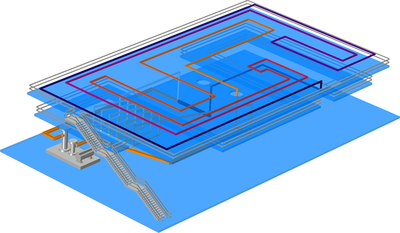
This example demonstrates how to model coupled flow, heat transfer, and structural deformation and stress in a pipeline network. Gravity loads from the pipe and fluid are also taken into account. Mehr lesen


